SteelBeam-column

Axial compression and biaxial bending of a W shape, HSS or channel to CSA S16 Cl. 13.8. Check a W, WWF, S or HP shape, a rectangular HSS or a channel under axial compression and bending about one or both axes. The section is classified by S16 Table 2 for beam-columns, and its class picks the interaction: cross-sectional strength, overall member strength with the amplification for a braced or unbraced frame about each axis, and lateral-torsional buckling strength with Cl. 13.6's moment resistance.

CA$4.00 for this report, or Pro

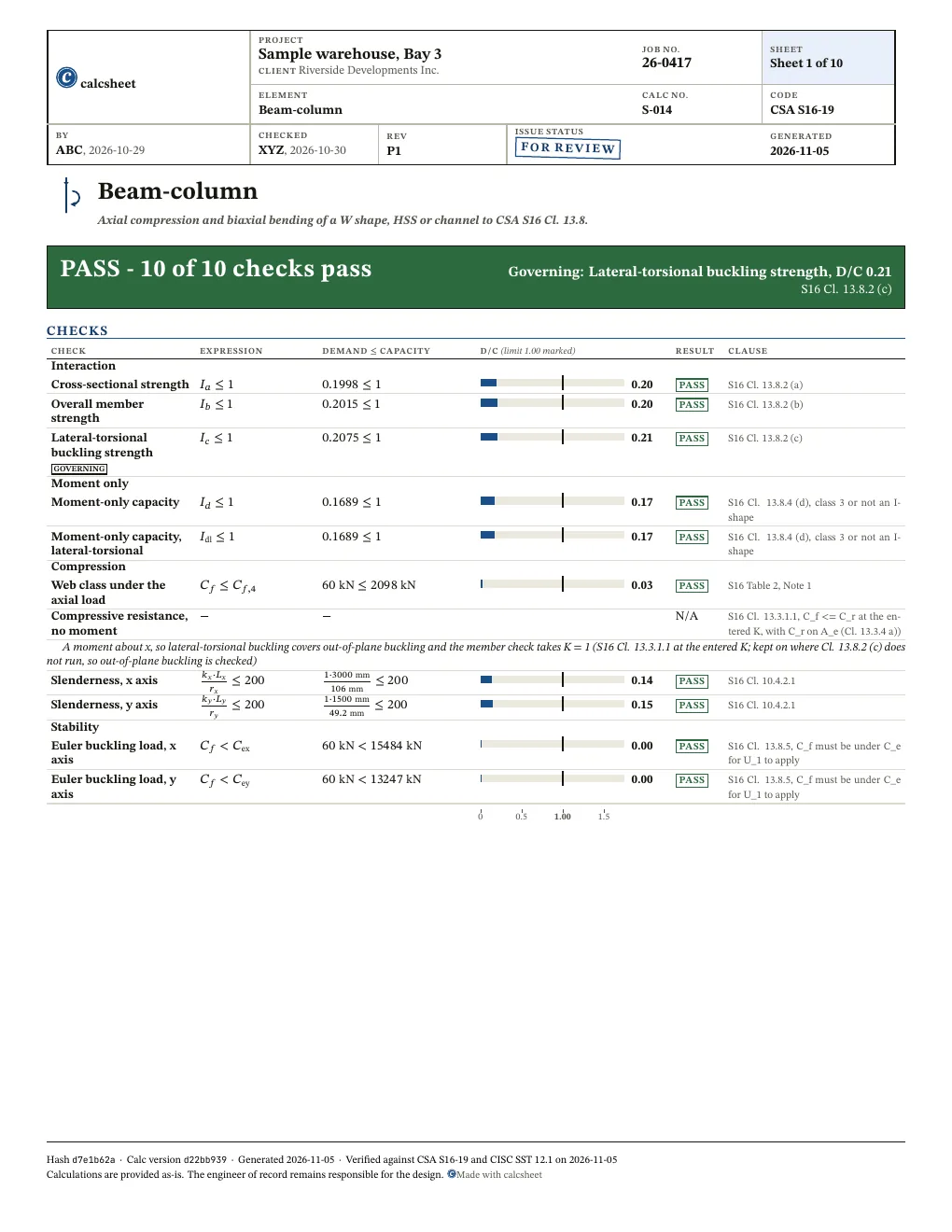
PASS Governing: Lateral-torsional buckling strength, D/C 0.21, S16 Cl. 13.8.2 (c)10 of 10 checks below pass

Given

Jump to results

Type any value, everything below recomputes. Hover or tap a symbol to trace it.

Loads
changed from the declared value CfC_{f} kN\mathrm{kN} 0-50,000
changed from the declared value MfxM_{\mathrm{fx}} kN⋅m\mathrm{kN} \cdot \mathrm{m} 0-10,000
changed from the declared value MfyM_{\mathrm{fy}} kN⋅m\mathrm{kN} \cdot \mathrm{m} 0-5,000
Section
changed from the declared value
Framing
changed from the declared value
changed from the declared value ω1x\omega_{1x} 0.4-1
changed from the declared value ω1y\omega_{1y} 0.4-1
changed from the declared value ω2\omega_{2} 1-2.5
Bracing
changed from the declared value LxL_{x} mm\mathrm{mm} 100-30,000
changed from the declared value kxk_{x} 0.5-2.5
changed from the declared value LyL_{y} mm\mathrm{mm} 100-30,000
changed from the declared value kyk_{y} 0.5-2.5
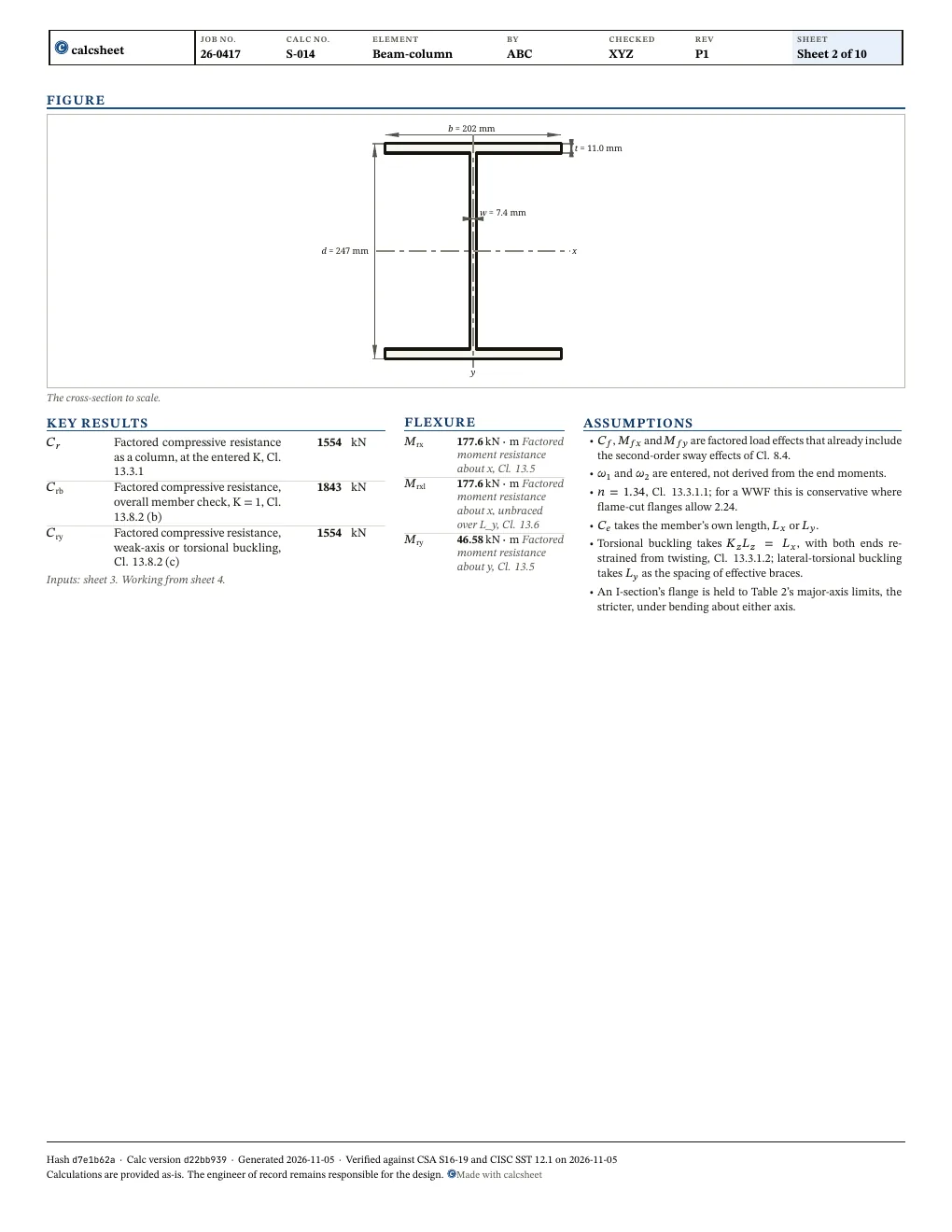
d = 247 mm b = 202 mm t = 11.0 mm w = 7.4 mm x y
The cross-section to scale.

Title block

Optional. Printed in the title block of the PDF.

Checks

! marks a check that passes with D/C at or above 0.95: close to its limit. The band is a site convention, not a code limit.

Interaction

Check D/C Utilisation Result
Cross-sectional strengthS16 Cl. 13.8.2 (a)Ia≤1⇒0.1998≤1\htmlClass{sym-I_a}{I_{a}} \leq 1 \quad \Rightarrow \quad \htmlClass{sym-I_a}{0.1998} \leq 1 0.20 PASS
Overall member strengthS16 Cl. 13.8.2 (b)Ib≤1⇒0.2015≤1\htmlClass{sym-I_b}{I_{b}} \leq 1 \quad \Rightarrow \quad \htmlClass{sym-I_b}{0.2015} \leq 1 0.20 PASS
Lateral-torsional buckling strengthS16 Cl. 13.8.2 (c)Ic≤1⇒0.2075≤1\htmlClass{sym-I_c}{I_{c}} \leq 1 \quad \Rightarrow \quad \htmlClass{sym-I_c}{0.2075} \leq 1 0.21 PASS

Moment only

Check D/C Utilisation Result
Moment-only capacityS16 Cl. 13.8.4 (d), class 3 or not an I-shapeId≤1⇒0.1689≤1\htmlClass{sym-I_d}{I_{d}} \leq 1 \quad \Rightarrow \quad \htmlClass{sym-I_d}{0.1689} \leq 1 0.17 PASS
Moment-only capacity, lateral-torsionalS16 Cl. 13.8.4 (d), class 3 or not an I-shapeIdl≤1⇒0.1689≤1\htmlClass{sym-I_dl}{I_{\mathrm{dl}}} \leq 1 \quad \Rightarrow \quad \htmlClass{sym-I_dl}{0.1689} \leq 1 0.17 PASS

Compression

Check D/C Utilisation Result
Web class under the axial loadS16 Table 2, Note 1Cf≤Cf,4⇒60 kN≤2098 kN\htmlClass{sym-C_f}{C_{f}} \leq \htmlClass{sym-C_f_4}{C_{f,4}} \quad \Rightarrow \quad \htmlClass{sym-C_f}{60\ \mathrm{kN}} \leq \htmlClass{sym-C_f_4}{2098\ \mathrm{kN}} 0.03 PASS
Compressive resistance, no momentS16 Cl. 13.3.1.1, C_f <= C_r at the entered K, with C_r on A_e (Cl. 13.3.4 a))A moment about x, so lateral-torsional buckling covers out-of-plane buckling and the member check takes K = 1 (S16 Cl. 13.3.1.1 at the entered K; kept on where Cl. 13.8.2 (c) does not run, so out-of-plane buckling is checked) N/A
Slenderness, x axisS16 Cl. 10.4.2.1kx⋅Lxrx≤200⇒1⋅3000 mm106 mm≤200\frac{\htmlClass{sym-k_x}{k_{x}} \cdot \htmlClass{sym-L_x}{L_{x}}}{\htmlClass{sym-r_x}{r_{x}}} \leq 200 \quad \Rightarrow \quad \frac{\htmlClass{sym-k_x}{1} \cdot \htmlClass{sym-L_x}{3000\ \mathrm{mm}}}{\htmlClass{sym-r_x}{106\ \mathrm{mm}}} \leq 200 0.14 PASS
Slenderness, y axisS16 Cl. 10.4.2.1ky⋅Lyry≤200⇒1⋅1500 mm49.2 mm≤200\frac{\htmlClass{sym-k_y}{k_{y}} \cdot \htmlClass{sym-L_y}{L_{y}}}{\htmlClass{sym-r_y}{r_{y}}} \leq 200 \quad \Rightarrow \quad \frac{\htmlClass{sym-k_y}{1} \cdot \htmlClass{sym-L_y}{1500\ \mathrm{mm}}}{\htmlClass{sym-r_y}{49.2\ \mathrm{mm}}} \leq 200 0.15 PASS

Stability

Check D/C Utilisation Result
Euler buckling load, x axisS16 Cl. 13.8.5, C_f must be under C_e for U_1 to applyCf<Cex⇒60 kN<15484 kN\htmlClass{sym-C_f}{C_{f}} < \htmlClass{sym-C_ex}{C_{\mathrm{ex}}} \quad \Rightarrow \quad \htmlClass{sym-C_f}{60\ \mathrm{kN}} < \htmlClass{sym-C_ex}{15484\ \mathrm{kN}} 0.00 PASS
Euler buckling load, y axisS16 Cl. 13.8.5, C_f must be under C_e for U_1 to applyCf<Cey⇒60 kN<13247 kN\htmlClass{sym-C_f}{C_{f}} < \htmlClass{sym-C_ey}{C_{\mathrm{ey}}} \quad \Rightarrow \quad \htmlClass{sym-C_f}{60\ \mathrm{kN}} < \htmlClass{sym-C_ey}{13247\ \mathrm{kN}} 0.00 PASS

Design conditions

A moment about x, so lateral-torsional buckling covers out-of-plane buckling and the member check takes K = 1S16 Cl. 13.3.1.1 at the entered K; kept on where Cl. 13.8.2 (c) does not run, so out-of-plane buckling is checkedMfx>0 kN⋅m⇒30 kN⋅m>0 kN⋅m\htmlClass{sym-M_fx}{M_{\mathrm{fx}}} > 0\ \mathrm{kN} \cdot \mathrm{m} \quad \Rightarrow \quad \htmlClass{sym-M_fx}{30\ \mathrm{kN} \cdot \mathrm{m}} > 0\ \mathrm{kN} \cdot \mathrm{m}
Braced about at least one axisS16 Cl. 13.8.2 (a) and 13.8.1bracedaxes≥1⇒1≥1\htmlClass{sym-braced_axes}{\mathrm{braced}_{\mathrm{axes}}} \geq 1 \quad \Rightarrow \quad \htmlClass{sym-braced_axes}{1} \geq 1
A moment about x, so lateral-torsional buckling appliesS16 Cl. 13.8.2 (c), when applicableMfx>0 kN⋅m⇒30 kN⋅m>0 kN⋅m\htmlClass{sym-M_fx}{M_{\mathrm{fx}}} > 0\ \mathrm{kN} \cdot \mathrm{m} \quad \Rightarrow \quad \htmlClass{sym-M_fx}{30\ \mathrm{kN} \cdot \mathrm{m}} > 0\ \mathrm{kN} \cdot \mathrm{m}
Braced about at least one axis, so Cl. 13.8.4 (d) appliesS16 Cl. 13.8.4 (d)bracedaxes≥1⇒1≥1\htmlClass{sym-braced_axes}{\mathrm{braced}_{\mathrm{axes}}} \geq 1 \quad \Rightarrow \quad \htmlClass{sym-braced_axes}{1} \geq 1

Results

Compression

Quantity Description Value Unit
Cr\htmlClass{sym-C_r}{C_{r}} Factored compressive resistance as a column, at the entered K, Cl. 13.3.1 1554 kN\mathrm{kN}
Crb\htmlClass{sym-C_rb}{C_{\mathrm{rb}}} Factored compressive resistance, overall member check, K = 1, Cl. 13.8.2 (b) 1843 kN\mathrm{kN}
Cry\htmlClass{sym-C_ry}{C_{\mathrm{ry}}} Factored compressive resistance, weak-axis or torsional buckling, Cl. 13.8.2 (c) 1554 kN\mathrm{kN}

Flexure

Quantity Description Value Unit
Mrx\htmlClass{sym-M_rx}{M_{\mathrm{rx}}} Factored moment resistance about x, Cl. 13.5 177.6 kN⋅m\mathrm{kN} \cdot \mathrm{m}
Mrxl\htmlClass{sym-M_rxl}{M_{\mathrm{rxl}}} Factored moment resistance about x, unbraced over L_y, Cl. 13.6 177.6 kN⋅m\mathrm{kN} \cdot \mathrm{m}
Mry\htmlClass{sym-M_ry}{M_{\mathrm{ry}}} Factored moment resistance about y, Cl. 13.5 46.58 kN⋅m\mathrm{kN} \cdot \mathrm{m}
Also worth checking
  • Class 4 sections: a class 4 flange is refused and a class 4 web fails; a class 4 flange takes the effective flange of Cl. 13.5 c) iii) and a class 4 web takes Cl. 14.3.4
  • Circular HSS, singly symmetric I-sections, tees and angles, which the section list does not offer
  • 350W Class H HSS, whose n = 2.24 in Cl. 13.3.1.1 the calc does not take
  • A class 4 channel's web under M_fy: it is refused, and Cl. 13.5 c) iii)'s effective section is not computed
  • Loads applied above the shear centre, Cl. 13.6.1 a), and cantilevered segments, Cl. 13.6.1 d): M_u is for a segment between effective brace points loaded at the shear centre
  • Shear, Cl. 13.4, tension, deflection and the connections

Derivation

S.1 Resistance factor

Compared with CSA S16-19 Cl. 13.1 a) (phi = 0.90, structural steel)

ϕ=0.9(Resistance factor | S16 Cl. 13.1)\begin{aligned} \htmlClass{sym-phi}{\phi} &= 0.9 \quad \left(\text{Resistance factor | S16 Cl. 13.1}\right) \end{aligned}
S.2 Steel modulus

Compared with CSA S16-19 Cl. 3 symbols, E = 200 000 MPa assumed

E=200000 MPa\begin{aligned} \htmlClass{sym-E}{E} &= 200000\ \mathrm{MPa} \end{aligned}
S.3 Shear modulus

Compared with CSA S16-19 Cl. 3 symbols, G = 77 000 MPa assumed

G=77000 MPa\begin{aligned} \htmlClass{sym-G}{G} &= 77000\ \mathrm{MPa} \end{aligned}
S.4

Accepted by the author: the specified minimum yield of the grade, from the cisc_sections grade table; the standard grade by family, A992 for W shapes (CISC FAQ), 350W Class C for G40.21 HSS, A500 Grade C for A500 HSS, and 350W for channels, angles and every other family (CISC 11th edition Handbook), confirmed by the owner

Fy=345 MPa(Yield strength, A992 (ASTM A992/A992M, Structural Steel Shapes))\begin{aligned} \htmlClass{sym-F_y}{F_{y}} &= 345\ \mathrm{MPa} \quad \left(\text{Yield strength, A992 (ASTM A992/A992M, Structural Steel Shapes)}\right) \end{aligned}
S.5 Root of the yield strength

Accepted by the author: definition, the root of F_y in MPa that every CSA S16-19 Table 2 limit divides by

rootF,y=Fy1 MPa=345 MPa1 MPa=18.57\begin{aligned} \htmlClass{sym-root_F_y}{\mathrm{root}_{F,y}} &= \sqrt{\frac{\htmlClass{sym-F_y}{F_{y}}}{1\ \mathrm{MPa}}} \\ &= \sqrt{\frac{\htmlClass{sym-F_y}{345\ \mathrm{MPa}}}{1\ \mathrm{MPa}}} \\ &= 18.57 \end{aligned}

Branch: Mfx+Mfy>0 kN⋅mM_{\mathrm{fx}} + M_{\mathrm{fy}} > 0\ \mathrm{kN} \cdot \mathrm{m} held

S.6 Gross area

Accepted by the author: CISC SST 12.1 section table value (sections-data/cisc_12.1/), a given and not a formula; an HSS wall is the table's design thickness Tdes

A0=6250 mm2(Cross-sectional area)\begin{aligned} \htmlClass{sym-A_0}{A_{0}} &= 6250\ \mathrm{mm}^{2} \quad \left(\text{Cross-sectional area}\right) \end{aligned}
S.7 Width

Accepted by the author: CISC SST 12.1 section table value (sections-data/cisc_12.1/), a given and not a formula; an HSS wall is the table's design thickness Tdes

b=202 mm(Width of flange or horizontal leg)\begin{aligned} \htmlClass{sym-b}{b} &= 202\ \mathrm{mm} \quad \left(\text{Width of flange or horizontal leg}\right) \end{aligned}
S.8 Depth

Accepted by the author: CISC SST 12.1 section table value (sections-data/cisc_12.1/), a given and not a formula; an HSS wall is the table's design thickness Tdes

d=247 mm(Depth of section or height of vertical leg)\begin{aligned} \htmlClass{sym-d}{d} &= 247\ \mathrm{mm} \quad \left(\text{Depth of section or height of vertical leg}\right) \end{aligned}
S.9 Elastic modulus about x

Accepted by the author: CISC SST 12.1 section table value (sections-data/cisc_12.1/), a given and not a formula; an HSS wall is the table's design thickness Tdes

Sx=572000 mm3(Elastic section modulus about axis XX)\begin{aligned} \htmlClass{sym-S_x}{S_{x}} &= 572000\ \mathrm{mm}^{3} \quad \left(\text{Elastic section modulus about axis XX}\right) \end{aligned}
S.10 Elastic modulus about y

Accepted by the author: CISC SST 12.1 section table value (sections-data/cisc_12.1/), a given and not a formula; an HSS wall is the table's design thickness Tdes

Sy=150000 mm3(Elastic section modulus about axis YY)\begin{aligned} \htmlClass{sym-S_y}{S_{y}} &= 150000\ \mathrm{mm}^{3} \quad \left(\text{Elastic section modulus about axis YY}\right) \end{aligned}
S.11 Axial yield load

Accepted by the author: definition, CSA S16-19 Cl. 1 symbols, C_y = axial compressive load at yield stress, A F_y

Cy=A0⋅Fy=6250 mm2⋅345 MPa=2156 kN\begin{aligned} \htmlClass{sym-C_y}{C_{y}} &= \htmlClass{sym-A_0}{A_{0}} \cdot \htmlClass{sym-F_y}{F_{y}} \\ &= \htmlClass{sym-A_0}{6250\ \mathrm{mm}^{2}} \cdot \htmlClass{sym-F_y}{345\ \mathrm{MPa}} \\ &= 2156\ \mathrm{kN} \end{aligned}
S.12 Axial load ratio

Compared with CSA S16-19 Table 2, the ratio C_f/(phi C_y) in the web limits

ρ=Cfϕ⋅Cy=60 kN0.9⋅2156 kN=0.03092\begin{aligned} \htmlClass{sym-rho}{\rho} &= \frac{\htmlClass{sym-C_f}{C_{f}}}{\htmlClass{sym-phi}{\phi} \cdot \htmlClass{sym-C_y}{C_{y}}} \\ &= \frac{\htmlClass{sym-C_f}{60\ \mathrm{kN}}}{\htmlClass{sym-phi}{0.9} \cdot \htmlClass{sym-C_y}{2156\ \mathrm{kN}}} \\ &= 0.03092 \end{aligned}
S.13 Flange or wall thickness

Accepted by the author: CISC SST 12.1 section table value (sections-data/cisc_12.1/), a given and not a formula; an HSS wall is the table's design thickness Tdes

t=11 mm(Thickness of flange)\begin{aligned} \htmlClass{sym-t}{t} &= 11\ \mathrm{mm} \quad \left(\text{Thickness of flange}\right) \end{aligned}
S.14 Web or wall thickness

Accepted by the author: CISC SST 12.1 section table value (sections-data/cisc_12.1/), a given and not a formula; an HSS wall is the table's design thickness Tdes

w=7.4 mm(Thickness of web)\begin{aligned} \htmlClass{sym-w}{w} &= 7.4\ \mathrm{mm} \quad \left(\text{Thickness of web}\right) \end{aligned}
S.15 Flange width-to-thickness ratio

Compared with CSA S16-19 Cl. 11.3.1 c), b_el of a beam flange is one-half the nominal width; a channel flange takes the full width, Cl. 11.3.1 b); an HSS flange the outside less 4t, Cl. 11.3.2 b)

λf=b2⋅t=202 mm2⋅11 mm=9.182\begin{aligned} \htmlClass{sym-lambda_f}{\lambda_{f}} &= \frac{\htmlClass{sym-b}{b}}{2 \cdot \htmlClass{sym-t}{t}} \\ &= \frac{\htmlClass{sym-b}{202\ \mathrm{mm}}}{2 \cdot \htmlClass{sym-t}{11\ \mathrm{mm}}} \\ &= 9.182 \end{aligned}
S.16 Class 1 limit, flange

Compared with CSA S16-19 Table 2 (flange limit 145/sqrt(F_y), Class 1; Table 2 OCR is scrambled, classes read in ascending order)

S16 Table 2, flanges

λf1=145rootF,y=14518.57=7.807\begin{aligned} \htmlClass{sym-lambda_f1}{\lambda_{f1}} &= \frac{145}{\htmlClass{sym-root_F_y}{\mathrm{root}_{F,y}}} \\ &= \frac{145}{\htmlClass{sym-root_F_y}{18.57}} \\ &= 7.807 \end{aligned}
S.17 Class 2 limit, flange

Compared with CSA S16-19 Table 2 (flange limit 170/sqrt(F_y), Class 2)

S16 Table 2, flanges

λf2=170rootF,y=17018.57=9.152\begin{aligned} \htmlClass{sym-lambda_f2}{\lambda_{f2}} &= \frac{170}{\htmlClass{sym-root_F_y}{\mathrm{root}_{F,y}}} \\ &= \frac{170}{\htmlClass{sym-root_F_y}{18.57}} \\ &= 9.152 \end{aligned}
S.18 Class 3 limit, flange

Compared with CSA S16-19 Table 2 (flange limit 200/sqrt(F_y), Class 3)

S16 Table 2, flanges

λf3=200rootF,y=20018.57=10.77\begin{aligned} \htmlClass{sym-lambda_f3}{\lambda_{f3}} &= \frac{200}{\htmlClass{sym-root_F_y}{\mathrm{root}_{F,y}}} \\ &= \frac{200}{\htmlClass{sym-root_F_y}{18.57}} \\ &= 10.77 \end{aligned}
S.19 Web depth-to-thickness ratio

Compared with CSA S16-19 Cl. 11.3.2 d), h of a hot-rolled web is the clear distance between flanges; an HSS web the outside less 4t, Cl. 11.3.2 b)

λw=d−2⋅tw=247 mm−2⋅11 mm7.4 mm=30.41\begin{aligned} \htmlClass{sym-lambda_w}{\lambda_{w}} &= \frac{\htmlClass{sym-d}{d} - 2 \cdot \htmlClass{sym-t}{t}}{\htmlClass{sym-w}{w}} \\ &= \frac{\htmlClass{sym-d}{247\ \mathrm{mm}} - 2 \cdot \htmlClass{sym-t}{11\ \mathrm{mm}}}{\htmlClass{sym-w}{7.4\ \mathrm{mm}}} \\ &= 30.41 \end{aligned}

Branch: Mfy>0 kN⋅mM_{\mathrm{fy}} > 0\ \mathrm{kN} \cdot \mathrm{m} did not hold

Branch: MfySy>0.9⋅MfxSx\frac{M_{\mathrm{fy}}}{S_{y}} > \frac{0.9 \cdot M_{\mathrm{fx}}}{S_{x}} did not hold

S.20 Class 1 limit, web

Compared with CSA S16-19 Table 2 (web with axial compression and major-axis bending, Class 1: 1100/sqrt(F_y) (1 - 0.39 C_f/(phi C_y)))

S16 Table 2, webs in axial compression and bending

λw1=1100rootF,y⋅(1−0.39⋅ρ)=110018.57⋅(1−0.39⋅0.03092)=58.51\begin{aligned} \htmlClass{sym-lambda_w1}{\lambda_{w1}} &= \frac{1100}{\htmlClass{sym-root_F_y}{\mathrm{root}_{F,y}}} \cdot \left(1 - 0.39 \cdot \htmlClass{sym-rho}{\rho}\right) \\ &= \frac{1100}{\htmlClass{sym-root_F_y}{18.57}} \cdot \left(1 - 0.39 \cdot \htmlClass{sym-rho}{0.03092}\right) \\ &= 58.51 \end{aligned}
S.21 Class 2 limit, web

Compared with CSA S16-19 Table 2 (web with axial compression and major-axis bending, Class 2: 1700/sqrt(F_y) (1 - 0.61 C_f/(phi C_y)))

S16 Table 2, webs in axial compression and bending

λw2=1700rootF,y⋅(1−0.61⋅ρ)=170018.57⋅(1−0.61⋅0.03092)=89.8\begin{aligned} \htmlClass{sym-lambda_w2}{\lambda_{w2}} &= \frac{1700}{\htmlClass{sym-root_F_y}{\mathrm{root}_{F,y}}} \cdot \left(1 - 0.61 \cdot \htmlClass{sym-rho}{\rho}\right) \\ &= \frac{1700}{\htmlClass{sym-root_F_y}{18.57}} \cdot \left(1 - 0.61 \cdot \htmlClass{sym-rho}{0.03092}\right) \\ &= 89.8 \end{aligned}
S.22 Class 3 limit, web

Compared with CSA S16-19 Table 2 (web with axial compression, Class 3: 1900/sqrt(F_y) (1 - 0.65 C_f/(phi C_y)))

S16 Table 2, webs in axial compression and bending

λw3=1900rootF,y⋅(1−0.65⋅ρ)=190018.57⋅(1−0.65⋅0.03092)=100.2\begin{aligned} \htmlClass{sym-lambda_w3}{\lambda_{w3}} &= \frac{1900}{\htmlClass{sym-root_F_y}{\mathrm{root}_{F,y}}} \cdot \left(1 - 0.65 \cdot \htmlClass{sym-rho}{\rho}\right) \\ &= \frac{1900}{\htmlClass{sym-root_F_y}{18.57}} \cdot \left(1 - 0.65 \cdot \htmlClass{sym-rho}{0.03092}\right) \\ &= 100.2 \end{aligned}

Branch: λf≤λf1\lambda_{f} \leq \lambda_{f1} did not hold

Branch: λf≤λf2\lambda_{f} \leq \lambda_{f2} did not hold

Branch: λf≤λf3\lambda_{f} \leq \lambda_{f3} held

S.23 Flange class

Compared with CSA S16-19 Table 2, the class is the first limit the ratio meets, past Class 3 is Class 4 by Note 1

classf=3(Flange class 3)\begin{aligned} \htmlClass{sym-class_f}{\mathrm{class}_{f}} &= 3 \quad \left(\text{Flange class 3}\right) \end{aligned}

Branch: λw≤λw1\lambda_{w} \leq \lambda_{w1} held

S.24 Web class

Compared with CSA S16-19 Table 2, the class is the first limit the ratio meets, past Class 3 is Class 4 by Note 1

classw=1(Web class 1)\begin{aligned} \htmlClass{sym-class_w}{\mathrm{class}_{w}} &= 1 \quad \left(\text{Web class 1}\right) \end{aligned}

Branch: classf>3\mathrm{class}_{f} > 3 did not hold

S.25 Section class

Accepted by the author: definition, Table 2 classifies the flange and the web separately and the section takes the worse of the two

sectionclass=max⁡(classf,classw)=max⁡(3,1)=3\begin{aligned} \htmlClass{sym-section_class}{\mathrm{section}_{\mathrm{class}}} &= \max\left(\htmlClass{sym-class_f}{\mathrm{class}_{f}}, \htmlClass{sym-class_w}{\mathrm{class}_{w}}\right) \\ &= \max\left(\htmlClass{sym-class_f}{3}, \htmlClass{sym-class_w}{1}\right) \\ &= 3 \end{aligned}
S.26 Axial load at which the web turns class 4

Compared with CSA S16-19 Table 2, the Class 3 web limit h/w <= 1900/sqrt(F_y) (1 - 0.65 C_f/(phi C_y)) solved for C_f; that limit is the same in every web row

S16 Table 2, webs, h/w at the class 3 limit

Cf,4=ϕ⋅Cy⋅(1−λw⋅rootF,y1900)0.65=0.9⋅2156 kN⋅(1−30.41⋅18.571900)0.65=2098 kN\begin{aligned} \htmlClass{sym-C_f_4}{C_{f,4}} &= \frac{\htmlClass{sym-phi}{\phi} \cdot \htmlClass{sym-C_y}{C_{y}} \cdot \left(1 - \frac{\htmlClass{sym-lambda_w}{\lambda_{w}} \cdot \htmlClass{sym-root_F_y}{\mathrm{root}_{F,y}}}{1900}\right)}{0.65} \\ &= \frac{\htmlClass{sym-phi}{0.9} \cdot \htmlClass{sym-C_y}{2156\ \mathrm{kN}} \cdot \left(1 - \frac{\htmlClass{sym-lambda_w}{30.41} \cdot \htmlClass{sym-root_F_y}{18.57}}{1900}\right)}{0.65} \\ &= 2098\ \mathrm{kN} \end{aligned}

Branch: Cf,4<0 kNC_{f,4} < 0\ \mathrm{kN} did not hold

S.27 Table 1 limit, webs and walls

Compared with CSA S16-19 Table 1 (compression elements, webs supported on both edges: width-to-thickness limit 670 / sqrt(F_y))

S16 Cl. 11, Table 1, webs and HSS walls in compression

λ3w=670rootF,y=67018.57=36.07\begin{aligned} \htmlClass{sym-lambda_3w}{\lambda_{3w}} &= \frac{670}{\htmlClass{sym-root_F_y}{\mathrm{root}_{F,y}}} \\ &= \frac{670}{\htmlClass{sym-root_F_y}{18.57}} \\ &= 36.07 \end{aligned}

Branch: λw>λ3w\lambda_{w} > \lambda_{3w} did not hold

S.28 Class 4 excess, web or walls across d

Accepted by the author: a selection, zero excess because the web is within the Table 1 limit in compression, so no width is removed

Ad=0 mm2(Web or walls across d not class 4 in compression)\begin{aligned} \htmlClass{sym-A_d}{A_{d}} &= 0\ \mathrm{mm}^{2} \quad \left(\text{Web or walls across d not class 4 in compression}\right) \end{aligned}
S.29 Effective area

Compared with CSA S16-19 Cl. 13.3.4 a) (effective area from widths reduced to the Table 1 limit, the gross area less the excess)

S16 Cl. 13.3.4 a), A_e from reduced widths meeting Table 1, F_e on the gross section

Ae=A0−Ad=6250 mm2−0 mm2=6250 mm2\begin{aligned} \htmlClass{sym-A_e}{A_{e}} &= \htmlClass{sym-A_0}{A_{0}} - \htmlClass{sym-A_d}{A_{d}} \\ &= \htmlClass{sym-A_0}{6250\ \mathrm{mm}^{2}} - \htmlClass{sym-A_d}{0\ \mathrm{mm}^{2}} \\ &= 6250\ \mathrm{mm}^{2} \end{aligned}
S.30 Radius of gyration about x

Accepted by the author: CISC SST 12.1 section table value (sections-data/cisc_12.1/), a given and not a formula; an HSS wall is the table's design thickness Tdes

rx=106 mm(Radius of gyration about axis XX)\begin{aligned} \htmlClass{sym-r_x}{r_{x}} &= 106\ \mathrm{mm} \quad \left(\text{Radius of gyration about axis XX}\right) \end{aligned}
S.31 Radius of gyration about y

Accepted by the author: CISC SST 12.1 section table value (sections-data/cisc_12.1/), a given and not a formula; an HSS wall is the table's design thickness Tdes

ry=49.2 mm(Radius of gyration about axis YY)\begin{aligned} \htmlClass{sym-r_y}{r_{y}} &= 49.2\ \mathrm{mm} \quad \left(\text{Radius of gyration about axis YY}\right) \end{aligned}
S.32 Torsional constant

Accepted by the author: CISC SST 12.1 section table value (sections-data/cisc_12.1/), a given and not a formula; an HSS wall is the table's design thickness Tdes

J=241000 mm4(St-Venant torsional constant)\begin{aligned} \htmlClass{sym-J}{J} &= 241000\ \mathrm{mm}^{4} \quad \left(\text{St-Venant torsional constant}\right) \end{aligned}
S.33 Euler stress about x

Compared with CSA S16-19 Cl. 13.3.1.2, F_ex = pi^2 E/(K_x L_x/r_x)^2 (pi^2 E = 1.974 TPa)

Fex=1.974×10⁶ MPa(kx⋅Lxrx)2=1.974×10⁶ MPa(1⋅3000 mm106 mm)2=2464 MPa\begin{aligned} \htmlClass{sym-F_ex}{F_{\mathrm{ex}}} &= \frac{1.974 \times 10^{6}\ \mathrm{MPa}}{\left(\frac{\htmlClass{sym-k_x}{k_{x}} \cdot \htmlClass{sym-L_x}{L_{x}}}{\htmlClass{sym-r_x}{r_{x}}}\right)^{2}} \\ &= \frac{1.974 \times 10^{6}\ \mathrm{MPa}}{\left(\frac{\htmlClass{sym-k_x}{1} \cdot \htmlClass{sym-L_x}{3000\ \mathrm{mm}}}{\htmlClass{sym-r_x}{106\ \mathrm{mm}}}\right)^{2}} \\ &= 2464\ \mathrm{MPa} \end{aligned}
S.34 Euler stress about y

Compared with CSA S16-19 Cl. 13.3.1.2, F_ey = pi^2 E/(K_y L_y/r_y)^2 (pi^2 E = 1.974 TPa)

Fey=1.974×10⁶ MPa(ky⋅Lyry)2=1.974×10⁶ MPa(1⋅1500 mm49.2 mm)2=2124 MPa\begin{aligned} \htmlClass{sym-F_ey}{F_{\mathrm{ey}}} &= \frac{1.974 \times 10^{6}\ \mathrm{MPa}}{\left(\frac{\htmlClass{sym-k_y}{k_{y}} \cdot \htmlClass{sym-L_y}{L_{y}}}{\htmlClass{sym-r_y}{r_{y}}}\right)^{2}} \\ &= \frac{1.974 \times 10^{6}\ \mathrm{MPa}}{\left(\frac{\htmlClass{sym-k_y}{1} \cdot \htmlClass{sym-L_y}{1500\ \mathrm{mm}}}{\htmlClass{sym-r_y}{49.2\ \mathrm{mm}}}\right)^{2}} \\ &= 2124\ \mathrm{MPa} \end{aligned}
S.35 Euler stress about x, K = 1

Compared with CSA S16-19 Cl. 13.8.2 b) i), C_r per Cl. 13.3 with K = 1

Fex1=1.974×10⁶ MPa(Lxrx)2=1.974×10⁶ MPa(3000 mm106 mm)2=2464 MPa\begin{aligned} \htmlClass{sym-F_ex1}{F_{\mathrm{ex}1}} &= \frac{1.974 \times 10^{6}\ \mathrm{MPa}}{\left(\frac{\htmlClass{sym-L_x}{L_{x}}}{\htmlClass{sym-r_x}{r_{x}}}\right)^{2}} \\ &= \frac{1.974 \times 10^{6}\ \mathrm{MPa}}{\left(\frac{\htmlClass{sym-L_x}{3000\ \mathrm{mm}}}{\htmlClass{sym-r_x}{106\ \mathrm{mm}}}\right)^{2}} \\ &= 2464\ \mathrm{MPa} \end{aligned}
S.36 Euler stress about y, K = 1

Compared with CSA S16-19 Cl. 13.8.2 b) i), C_r per Cl. 13.3 with K = 1

Fey1=1.974×10⁶ MPa(Lyry)2=1.974×10⁶ MPa(1500 mm49.2 mm)2=2124 MPa\begin{aligned} \htmlClass{sym-F_ey1}{F_{\mathrm{ey}1}} &= \frac{1.974 \times 10^{6}\ \mathrm{MPa}}{\left(\frac{\htmlClass{sym-L_y}{L_{y}}}{\htmlClass{sym-r_y}{r_{y}}}\right)^{2}} \\ &= \frac{1.974 \times 10^{6}\ \mathrm{MPa}}{\left(\frac{\htmlClass{sym-L_y}{1500\ \mathrm{mm}}}{\htmlClass{sym-r_y}{49.2\ \mathrm{mm}}}\right)^{2}} \\ &= 2124\ \mathrm{MPa} \end{aligned}
S.37 Shear centre offset

Accepted by the author: CISC SST 12.1 Xo for a channel (sections-data/cisc_12.1/), and 0 for a doubly symmetric shape, whose shear centre is on the centroid

x0=0 mm(Shear centre on the centroid, not a channel)\begin{aligned} \htmlClass{sym-x_0}{x_{0}} &= 0\ \mathrm{mm} \quad \left(\text{Shear centre on the centroid, not a channel}\right) \end{aligned}
S.38 Polar radius about the shear centre

Compared with CSA S16-19 Cl. 13.3.1.2, r_o^2 = x_o^2 + y_o^2 + r_x^2 + r_y^2 with y_o = 0

r0=x02+rx2+ry2=(0 mm)2+(106 mm)2+(49.2 mm)2=116.9 mm\begin{aligned} \htmlClass{sym-r_0}{r_{0}} &= \sqrt{\htmlClass{sym-x_0}{x_{0}}^{2} + \htmlClass{sym-r_x}{r_{x}}^{2} + \htmlClass{sym-r_y}{r_{y}}^{2}} \\ &= \sqrt{\left(\htmlClass{sym-x_0}{0\ \mathrm{mm}}\right)^{2} + \left(\htmlClass{sym-r_x}{106\ \mathrm{mm}}\right)^{2} + \left(\htmlClass{sym-r_y}{49.2\ \mathrm{mm}}\right)^{2}} \\ &= 116.9\ \mathrm{mm} \end{aligned}
S.39 Warping constant

Accepted by the author: CISC SST 12.1 section table value (sections-data/cisc_12.1/), a given and not a formula; an HSS wall is the table's design thickness Tdes

Cw=2.11×1011 mm6(Warping constant)\begin{aligned} \htmlClass{sym-C_w}{C_{w}} &= 2.11 \times 10^{11}\ \mathrm{mm}^{6} \quad \left(\text{Warping constant}\right) \end{aligned}
S.40 Torsional buckling stress

Compared with CSA S16-19 Cl. 13.3.1.2 (F_ez = (pi^2 E C_w/(K_z L_z)^2 + G J)/(A r_o^2), K_z L_z taken as L_x, r_o^2 = x_o^2 + y_o^2 + r_x^2 + r_y^2 with y_o = 0; C_w = 0 for an HSS)

S16 Cl. 13.3.1.2, L_z = L_x

Fez=1.974×10⁶ MPa⋅CwLx2+G⋅JA0⋅r02=1.974×106 MPa⋅2.11×1011 mm6(3000 mm)2+77000 MPa⋅241000 mm46250 mm2⋅(116.9 mm)2=759.6 MPa\begin{aligned} \htmlClass{sym-F_ez}{F_{\mathrm{ez}}} &= \frac{\frac{1.974 \times 10^{6}\ \mathrm{MPa} \cdot \htmlClass{sym-C_w}{C_{w}}}{\htmlClass{sym-L_x}{L_{x}}^{2}} + \htmlClass{sym-G}{G} \cdot \htmlClass{sym-J}{J}}{\htmlClass{sym-A_0}{A_{0}} \cdot \htmlClass{sym-r_0}{r_{0}}^{2}} \\ &= \frac{\frac{1.974 \times 10^{6}\ \mathrm{MPa} \cdot \htmlClass{sym-C_w}{2.11 \times 10^{11}\ \mathrm{mm}^{6}}}{\left(\htmlClass{sym-L_x}{3000\ \mathrm{mm}}\right)^{2}} + \htmlClass{sym-G}{77000\ \mathrm{MPa}} \cdot \htmlClass{sym-J}{241000\ \mathrm{mm}^{4}}}{\htmlClass{sym-A_0}{6250\ \mathrm{mm}^{2}} \cdot \left(\htmlClass{sym-r_0}{116.9\ \mathrm{mm}}\right)^{2}} \\ &= 759.6\ \mathrm{MPa} \end{aligned}
S.41 Elastic buckling stress

Compared with CSA S16-19 Cl. 13.3.1.1 a), F_e the least of F_ex, F_ey and F_ez for doubly symmetric sections

S16 Cl. 13.3.1.1 (a), the least of F_ex, F_ey and F_ez

Fe=min⁡(Fex,Fey,Fez)=min⁡(2464 MPa,2124 MPa,759.6 MPa)=759.6 MPa\begin{aligned} \htmlClass{sym-F_e}{F_{e}} &= \min\left(\htmlClass{sym-F_ex}{F_{\mathrm{ex}}}, \htmlClass{sym-F_ey}{F_{\mathrm{ey}}}, \htmlClass{sym-F_ez}{F_{\mathrm{ez}}}\right) \\ &= \min\left(\htmlClass{sym-F_ex}{2464\ \mathrm{MPa}}, \htmlClass{sym-F_ey}{2124\ \mathrm{MPa}}, \htmlClass{sym-F_ez}{759.6\ \mathrm{MPa}}\right) \\ &= 759.6\ \mathrm{MPa} \end{aligned}
S.42 Elastic buckling stress, weak axis or torsional

Compared with CSA S16-19 Cl. 13.8.2 c) i), C_r based on weak-axis or torsional-flexural buckling

S16 Cl. 13.8.2 (c) (i), weak-axis or torsional buckling

Fecy=min⁡(Fey,Fez)=min⁡(2124 MPa,759.6 MPa)=759.6 MPa\begin{aligned} \htmlClass{sym-F_ecy}{F_{\mathrm{ecy}}} &= \min\left(\htmlClass{sym-F_ey}{F_{\mathrm{ey}}}, \htmlClass{sym-F_ez}{F_{\mathrm{ez}}}\right) \\ &= \min\left(\htmlClass{sym-F_ey}{2124\ \mathrm{MPa}}, \htmlClass{sym-F_ez}{759.6\ \mathrm{MPa}}\right) \\ &= 759.6\ \mathrm{MPa} \end{aligned}
S.43 Slenderness parameter, weak axis or torsional

Compared with CSA S16-19 Cl. 13.3.1.1, lambda = sqrt(F_y/F_e), on the F_e of Cl. 13.8.2 c) i)

λy=FyFecy=345 MPa759.6 MPa=0.6739\begin{aligned} \htmlClass{sym-lambda_y}{\lambda_{y}} &= \sqrt{\frac{\htmlClass{sym-F_y}{F_{y}}}{\htmlClass{sym-F_ecy}{F_{\mathrm{ecy}}}}} \\ &= \sqrt{\frac{\htmlClass{sym-F_y}{345\ \mathrm{MPa}}}{\htmlClass{sym-F_ecy}{759.6\ \mathrm{MPa}}}} \\ &= 0.6739 \end{aligned}
S.44 Slenderness parameter

Compared with CSA S16-19 Cl. 13.3.1.1, lambda = sqrt(F_y/F_e)

λc=FyFe=345 MPa759.6 MPa=0.6739\begin{aligned} \htmlClass{sym-lambda_c}{\lambda_{c}} &= \sqrt{\frac{\htmlClass{sym-F_y}{F_{y}}}{\htmlClass{sym-F_e}{F_{e}}}} \\ &= \sqrt{\frac{\htmlClass{sym-F_y}{345\ \mathrm{MPa}}}{\htmlClass{sym-F_e}{759.6\ \mathrm{MPa}}}} \\ &= 0.6739 \end{aligned}
S.45 Compressive stress

Compared with CSA S16-19 Cl. 13.3.1.1, C_r = phi A F_y/(1 + lambda^2n)^(1/n), n = 1.34 for hot-rolled sections and Class C or A500 HSS, written as F_y over the bracket

S16 Cl. 13.3.1, n = 1.34

fs=Fy⋅(1+λc2⋅1.34)−11.34=345 MPa⋅(1+0.67392⋅1.34)−11.34=276.2 MPa\begin{aligned} \htmlClass{sym-f_s}{f_{s}} &= \htmlClass{sym-F_y}{F_{y}} \cdot \left(1 + \htmlClass{sym-lambda_c}{\lambda_{c}}^{2 \cdot 1.34}\right)^{\frac{-1}{1.34}} \\ &= \htmlClass{sym-F_y}{345\ \mathrm{MPa}} \cdot \left(1 + \htmlClass{sym-lambda_c}{0.6739}^{2 \cdot 1.34}\right)^{\frac{-1}{1.34}} \\ &= 276.2\ \mathrm{MPa} \end{aligned}
S.46 Compressive resistance

Compared with CSA S16-19 Cl. 13.3.4 a) (C_r = phi A_e F_y / (1 + lambda^(2n))^(1/n) with n = 1.34, on the effective area)

S16 Cl. 13.3.4 a), phi A_e f_s

Cr=ϕ⋅Ae⋅fs=0.9⋅6250 mm2⋅276.2 MPa=1554 kN\begin{aligned} \htmlClass{sym-C_r}{C_{r}} &= \htmlClass{sym-phi}{\phi} \cdot \htmlClass{sym-A_e}{A_{e}} \cdot \htmlClass{sym-f_s}{f_{s}} \\ &= \htmlClass{sym-phi}{0.9} \cdot \htmlClass{sym-A_e}{6250\ \mathrm{mm}^{2}} \cdot \htmlClass{sym-f_s}{276.2\ \mathrm{MPa}} \\ &= 1554\ \mathrm{kN} \end{aligned}
S.47 Compressive stress, weak axis or torsional

Compared with CSA S16-19 Cl. 13.3.1.1 (C_r = phi A F_y / (1 + lambda^2n)^(1/n), n = 1.34 hot-rolled, lambda = sqrt(F_y/F_e))

S16 Cl. 13.3.1, n = 1.34

fsy=Fy⋅(1+λy2⋅1.34)−11.34=345 MPa⋅(1+0.67392⋅1.34)−11.34=276.2 MPa\begin{aligned} \htmlClass{sym-f_sy}{f_{\mathrm{sy}}} &= \htmlClass{sym-F_y}{F_{y}} \cdot \left(1 + \htmlClass{sym-lambda_y}{\lambda_{y}}^{2 \cdot 1.34}\right)^{\frac{-1}{1.34}} \\ &= \htmlClass{sym-F_y}{345\ \mathrm{MPa}} \cdot \left(1 + \htmlClass{sym-lambda_y}{0.6739}^{2 \cdot 1.34}\right)^{\frac{-1}{1.34}} \\ &= 276.2\ \mathrm{MPa} \end{aligned}
S.48 Compressive resistance, weak axis or torsional

Accepted by the author: CSA S16-19 Cl. 13.8.2 c) i) and Cl. 13.3.1.2 Note 2; a closed section's torsional stress G J / (A r_0^2) is far above F_ey, so weak-axis flexure governs an HSS

Cry=ϕ⋅Ae⋅fsy=0.9⋅6250 mm2⋅276.2 MPa=1554 kN\begin{aligned} \htmlClass{sym-C_ry}{C_{\mathrm{ry}}} &= \htmlClass{sym-phi}{\phi} \cdot \htmlClass{sym-A_e}{A_{e}} \cdot \htmlClass{sym-f_sy}{f_{\mathrm{sy}}} \\ &= \htmlClass{sym-phi}{0.9} \cdot \htmlClass{sym-A_e}{6250\ \mathrm{mm}^{2}} \cdot \htmlClass{sym-f_sy}{276.2\ \mathrm{MPa}} \\ &= 1554\ \mathrm{kN} \end{aligned}
S.49 Compressive resistance, zero length

Compared with CSA S16-19 Cl. 13.8.2 a) i) (C_r with lambda = 0, that is phi A_e F_y, on the effective area)

S16 Cl. 13.8.2 (a) (i), lambda = 0, on the effective area

Cr0=ϕ⋅Ae⋅Fy=0.9⋅6250 mm2⋅345 MPa=1941 kN\begin{aligned} \htmlClass{sym-C_r0}{C_{r0}} &= \htmlClass{sym-phi}{\phi} \cdot \htmlClass{sym-A_e}{A_{e}} \cdot \htmlClass{sym-F_y}{F_{y}} \\ &= \htmlClass{sym-phi}{0.9} \cdot \htmlClass{sym-A_e}{6250\ \mathrm{mm}^{2}} \cdot \htmlClass{sym-F_y}{345\ \mathrm{MPa}} \\ &= 1941\ \mathrm{kN} \end{aligned}

Branch: Mfy≤0 kN⋅m and Mfx>0 kN⋅mM_{\mathrm{fy}} \leq 0\ \mathrm{kN} \cdot \mathrm{m}\ \text{and}\ M_{\mathrm{fx}} > 0\ \mathrm{kN} \cdot \mathrm{m} held

S.50 Slenderness parameter, K = 1

Compared with CSA S16-19 Cl. 13.8.2 b) i) (for uniaxial bending C_r is based on the axis of bending with K = 1, so F_ex with K = 1 about x)

S16 Cl. 13.8.2 (b) (i), uniaxial bending about x

λb=FyFex1=345 MPa2464 MPa=0.3742\begin{aligned} \htmlClass{sym-lambda_b}{\lambda_{b}} &= \sqrt{\frac{\htmlClass{sym-F_y}{F_{y}}}{\htmlClass{sym-F_ex1}{F_{\mathrm{ex}1}}}} \\ &= \sqrt{\frac{\htmlClass{sym-F_y}{345\ \mathrm{MPa}}}{\htmlClass{sym-F_ex1}{2464\ \mathrm{MPa}}}} \\ &= 0.3742 \end{aligned}
S.51 Compressive stress, K = 1

Compared with CSA S16-19 Cl. 13.3.1.1, C_r = phi A F_y/(1 + lambda^2n)^(1/n), n = 1.34, written as F_y over the bracket

S16 Cl. 13.3.1, n = 1.34

fsb=Fy⋅(1+λb2⋅1.34)−11.34=345 MPa⋅(1+0.37422⋅1.34)−11.34=327.6 MPa\begin{aligned} \htmlClass{sym-f_sb}{f_{\mathrm{sb}}} &= \htmlClass{sym-F_y}{F_{y}} \cdot \left(1 + \htmlClass{sym-lambda_b}{\lambda_{b}}^{2 \cdot 1.34}\right)^{\frac{-1}{1.34}} \\ &= \htmlClass{sym-F_y}{345\ \mathrm{MPa}} \cdot \left(1 + \htmlClass{sym-lambda_b}{0.3742}^{2 \cdot 1.34}\right)^{\frac{-1}{1.34}} \\ &= 327.6\ \mathrm{MPa} \end{aligned}
S.52 Compressive resistance, member check

Compared with CSA S16-19 Cl. 13.8.2 b) i) with Cl. 13.3.1.1 (C_r at K = 1 on the effective area, slenderness from the axis of bending)

Crb=ϕ⋅Ae⋅fsb=0.9⋅6250 mm2⋅327.6 MPa=1843 kN\begin{aligned} \htmlClass{sym-C_rb}{C_{\mathrm{rb}}} &= \htmlClass{sym-phi}{\phi} \cdot \htmlClass{sym-A_e}{A_{e}} \cdot \htmlClass{sym-f_sb}{f_{\mathrm{sb}}} \\ &= \htmlClass{sym-phi}{0.9} \cdot \htmlClass{sym-A_e}{6250\ \mathrm{mm}^{2}} \cdot \htmlClass{sym-f_sb}{327.6\ \mathrm{MPa}} \\ &= 1843\ \mathrm{kN} \end{aligned}

Branch: sectionclass≤2\mathrm{section}_{\mathrm{class}} \leq 2 did not hold

S.53 Section modulus used, about x

Accepted by the author: tabulated section modulus S_x of the designated section from the CISC tables, the class 3 modulus that Cl. 13.5 b) takes

S16 Cl. 13.5 (b), S for class 3

Zex=572000 mm3(Elastic section modulus about axis XX)\begin{aligned} \htmlClass{sym-Z_ex}{Z_{\mathrm{ex}}} &= 572000\ \mathrm{mm}^{3} \quad \left(\text{Elastic section modulus about axis XX}\right) \end{aligned}
S.54 Section modulus used, about y

Accepted by the author: tabulated section modulus S_y of the designated section from the CISC tables, the class 3 modulus that Cl. 13.5 b) takes about y

S16 Cl. 13.5 (b), S for class 3

Zey=150000 mm3(Elastic section modulus about axis YY)\begin{aligned} \htmlClass{sym-Z_ey}{Z_{\mathrm{ey}}} &= 150000\ \mathrm{mm}^{3} \quad \left(\text{Elastic section modulus about axis YY}\right) \end{aligned}
S.55 Moment resistance about x

Compared with CSA S16-19 Cl. 13.5 a) and b) (M_r = phi Z F_y Class 1 and 2, phi S F_y Class 3)

S16 Cl. 13.5

Mrx=ϕ⋅Zex⋅Fy=0.9⋅572000 mm3⋅345 MPa=177.6 kN⋅m\begin{aligned} \htmlClass{sym-M_rx}{M_{\mathrm{rx}}} &= \htmlClass{sym-phi}{\phi} \cdot \htmlClass{sym-Z_ex}{Z_{\mathrm{ex}}} \cdot \htmlClass{sym-F_y}{F_{y}} \\ &= \htmlClass{sym-phi}{0.9} \cdot \htmlClass{sym-Z_ex}{572000\ \mathrm{mm}^{3}} \cdot \htmlClass{sym-F_y}{345\ \mathrm{MPa}} \\ &= 177.6\ \mathrm{kN} \cdot \mathrm{m} \end{aligned}
S.56 Moment resistance about y

Compared with CSA S16-19 Cl. 13.5 a) and b) (M_r = phi Z F_y Class 1 and 2, phi S F_y Class 3)

S16 Cl. 13.5

Mry=ϕ⋅Zey⋅Fy=0.9⋅150000 mm3⋅345 MPa=46.58 kN⋅m\begin{aligned} \htmlClass{sym-M_ry}{M_{\mathrm{ry}}} &= \htmlClass{sym-phi}{\phi} \cdot \htmlClass{sym-Z_ey}{Z_{\mathrm{ey}}} \cdot \htmlClass{sym-F_y}{F_{y}} \\ &= \htmlClass{sym-phi}{0.9} \cdot \htmlClass{sym-Z_ey}{150000\ \mathrm{mm}^{3}} \cdot \htmlClass{sym-F_y}{345\ \mathrm{MPa}} \\ &= 46.58\ \mathrm{kN} \cdot \mathrm{m} \end{aligned}
S.57 Moment of inertia about y

Accepted by the author: CISC SST 12.1 section table value (sections-data/cisc_12.1/), a given and not a formula; an HSS wall is the table's design thickness Tdes

Iy=1.51×107 mm4(Moment of inertia about axis YY)\begin{aligned} \htmlClass{sym-I_y}{I_{y}} &= 1.51 \times 10^{7}\ \mathrm{mm}^{4} \quad \left(\text{Moment of inertia about axis YY}\right) \end{aligned}
S.58 Critical elastic moment

Compared with CSA S16-19 Cl. 13.6.1 a) (M_u = omega_2 pi/L sqrt(E I_y G J + (pi E/L)^2 I_y C_w))

S16 Cl. 13.6

Mu=ω2⋅πLy⋅E⋅Iy⋅G⋅J+(628319 MPaLy)2⋅Iy⋅Cw=1.2⋅π1500 mm⋅200000 MPa⋅1.51×107 mm4⋅77000 MPa⋅241000 mm4+(628319 MPa1500 mm)2⋅1.51×107 mm4⋅2.11×1011 mm6=1971 kN⋅m\begin{aligned} \htmlClass{sym-M_u}{M_{u}} &= \frac{\htmlClass{sym-omega_2}{\omega_{2}} \cdot \pi}{\htmlClass{sym-L_y}{L_{y}}} \cdot \sqrt{\htmlClass{sym-E}{E} \cdot \htmlClass{sym-I_y}{I_{y}} \cdot \htmlClass{sym-G}{G} \cdot \htmlClass{sym-J}{J} + \left(\frac{628319\ \mathrm{MPa}}{\htmlClass{sym-L_y}{L_{y}}}\right)^{2} \cdot \htmlClass{sym-I_y}{I_{y}} \cdot \htmlClass{sym-C_w}{C_{w}}} \\ &= \frac{\htmlClass{sym-omega_2}{1.2} \cdot \pi}{\htmlClass{sym-L_y}{1500\ \mathrm{mm}}} \cdot \sqrt{\htmlClass{sym-E}{200000\ \mathrm{MPa}} \cdot \htmlClass{sym-I_y}{1.51 \times 10^{7}\ \mathrm{mm}^{4}} \cdot \htmlClass{sym-G}{77000\ \mathrm{MPa}} \cdot \htmlClass{sym-J}{241000\ \mathrm{mm}^{4}} + \left(\frac{628319\ \mathrm{MPa}}{\htmlClass{sym-L_y}{1500\ \mathrm{mm}}}\right)^{2} \cdot \htmlClass{sym-I_y}{1.51 \times 10^{7}\ \mathrm{mm}^{4}} \cdot \htmlClass{sym-C_w}{2.11 \times 10^{11}\ \mathrm{mm}^{6}}} \\ &= 1971\ \mathrm{kN} \cdot \mathrm{m} \end{aligned}
S.59 Plastic or yield moment

Compared with CSA S16-19 Cl. 13.5 a), M_p = Z F_y (Z_ex is S_x for Class 3, so M_y as Cl. 13.6.1 b) uses)

Mp=Zex⋅Fy=572000 mm3⋅345 MPa=197.3 kN⋅m\begin{aligned} \htmlClass{sym-M_p}{M_{p}} &= \htmlClass{sym-Z_ex}{Z_{\mathrm{ex}}} \cdot \htmlClass{sym-F_y}{F_{y}} \\ &= \htmlClass{sym-Z_ex}{572000\ \mathrm{mm}^{3}} \cdot \htmlClass{sym-F_y}{345\ \mathrm{MPa}} \\ &= 197.3\ \mathrm{kN} \cdot \mathrm{m} \end{aligned}

Branch: Mu>0.67⋅MpM_{u} > 0.67 \cdot M_{p} held

S.60 Lateral-torsional buckling resistance

Compared with CSA S16-19 Cl. 13.6.1 a) i) and b) i) (M_r = 1.15 phi M_p (1 - 0.28 M_p / M_u), not above phi M_p; M_p = Z F_y, or S F_y for a Class 3 section)

S16 Cl. 13.6.1

Mrxl=min⁡(1.15⋅ϕ⋅Mp⋅(1−0.28⋅MpMu),ϕ⋅Mp)=min⁡(1.15⋅0.9⋅197.3 kN⋅m⋅(1−0.28⋅197.3 kN⋅m1971 kN⋅m),0.9⋅197.3 kN⋅m)=177.6 kN⋅m\begin{aligned} \htmlClass{sym-M_rxl}{M_{\mathrm{rxl}}} &= \min\left(1.15 \cdot \htmlClass{sym-phi}{\phi} \cdot \htmlClass{sym-M_p}{M_{p}} \cdot \left(1 - \frac{0.28 \cdot \htmlClass{sym-M_p}{M_{p}}}{\htmlClass{sym-M_u}{M_{u}}}\right), \htmlClass{sym-phi}{\phi} \cdot \htmlClass{sym-M_p}{M_{p}}\right) \\ &= \min\left(1.15 \cdot \htmlClass{sym-phi}{0.9} \cdot \htmlClass{sym-M_p}{197.3\ \mathrm{kN} \cdot \mathrm{m}} \cdot \left(1 - \frac{0.28 \cdot \htmlClass{sym-M_p}{197.3\ \mathrm{kN} \cdot \mathrm{m}}}{\htmlClass{sym-M_u}{1971\ \mathrm{kN} \cdot \mathrm{m}}}\right), \htmlClass{sym-phi}{0.9} \cdot \htmlClass{sym-M_p}{197.3\ \mathrm{kN} \cdot \mathrm{m}}\right) \\ &= 177.6\ \mathrm{kN} \cdot \mathrm{m} \end{aligned}

Branch: sectionclass≤2\mathrm{section}_{\mathrm{class}} \leq 2 did not hold

S.61 Coefficient on M_fx

Compared with CSA S16-19 Cl. 13.8.4, coefficient 1.0 on M_fx for the Class 3 default (0.85 for Class 1/2 I-shapes per Cl. 13.8.2)

U0x=1(Class 3 | S16 Cl. 13.8.4)\begin{aligned} \htmlClass{sym-U_0x}{U_{0x}} &= 1 \quad \left(\text{Class 3 | S16 Cl. 13.8.4}\right) \end{aligned}
S.62 Coefficient on M_fy, cross-section

Compared with CSA S16-19 Cl. 13.8.4, coefficient 1.0 on M_fy for the Class 3 default (beta = 0.6 for Class 1/2 I-shapes per Cl. 13.8.2 a))

βa=1(Class 3 | S16 Cl. 13.8.4)\begin{aligned} \htmlClass{sym-beta_a}{\beta_{a}} &= 1 \quad \left(\text{Class 3 | S16 Cl. 13.8.4}\right) \end{aligned}
S.63 Coefficient on M_fy, member

Compared with CSA S16-19 Cl. 13.8.4, coefficient 1.0 on M_fy for the Class 3 default (beta = 0.6 + 0.4 lambda_y <= 0.85 for Class 1/2 I-shapes per Cl. 13.8.2)

βb=1(Class 3 | S16 Cl. 13.8.4)\begin{aligned} \htmlClass{sym-beta_b}{\beta_{b}} &= 1 \quad \left(\text{Class 3 | S16 Cl. 13.8.4}\right) \end{aligned}
S.64 Moment of inertia about x

Accepted by the author: CISC SST 12.1 section table value (sections-data/cisc_12.1/), a given and not a formula; an HSS wall is the table's design thickness Tdes

Ix=7.06×107 mm4(Moment of inertia about axis XX)\begin{aligned} \htmlClass{sym-I_x}{I_{x}} &= 7.06 \times 10^{7}\ \mathrm{mm}^{4} \quad \left(\text{Moment of inertia about axis XX}\right) \end{aligned}
S.65 Euler load about x

Compared with CSA S16-19 Cl. 13.8.5, C_e = pi^2 E I/L^2

Cex=1.974×10⁶ MPa⋅IxLx2=1.974×106 MPa⋅7.06×107 mm4(3000 mm)2=15484 kN\begin{aligned} \htmlClass{sym-C_ex}{C_{\mathrm{ex}}} &= \frac{1.974 \times 10^{6}\ \mathrm{MPa} \cdot \htmlClass{sym-I_x}{I_{x}}}{\htmlClass{sym-L_x}{L_{x}}^{2}} \\ &= \frac{1.974 \times 10^{6}\ \mathrm{MPa} \cdot \htmlClass{sym-I_x}{7.06 \times 10^{7}\ \mathrm{mm}^{4}}}{\left(\htmlClass{sym-L_x}{3000\ \mathrm{mm}}\right)^{2}} \\ &= 15484\ \mathrm{kN} \end{aligned}
S.66 Euler load about y

Compared with CSA S16-19 Cl. 13.8.5, C_e = pi^2 E I/L^2

Cey=1.974×10⁶ MPa⋅IyLy2=1.974×106 MPa⋅1.51×107 mm4(1500 mm)2=13247 kN\begin{aligned} \htmlClass{sym-C_ey}{C_{\mathrm{ey}}} &= \frac{1.974 \times 10^{6}\ \mathrm{MPa} \cdot \htmlClass{sym-I_y}{I_{y}}}{\htmlClass{sym-L_y}{L_{y}}^{2}} \\ &= \frac{1.974 \times 10^{6}\ \mathrm{MPa} \cdot \htmlClass{sym-I_y}{1.51 \times 10^{7}\ \mathrm{mm}^{4}}}{\left(\htmlClass{sym-L_y}{1500\ \mathrm{mm}}\right)^{2}} \\ &= 13247\ \mathrm{kN} \end{aligned}
S.67 Axes in a braced frame

Accepted by the author: definition, a count of the axes the member is braced about, the input to the braced-frame conditions of CSA S16-19 Cl. 13.8.1 and 13.8.2 a)

bracedaxes=1(Axes in a braced frame, of x and y)\begin{aligned} \htmlClass{sym-braced_axes}{\mathrm{braced}_{\mathrm{axes}}} &= 1 \quad \left(\text{Axes in a braced frame, of x and y}\right) \end{aligned}

Branch: Cf<CexC_{f} < C_{\mathrm{ex}} held

Branch: Cf<CeyC_{f} < C_{\mathrm{ey}} held

S.68 Amplification about x

Compared with CSA S16-19 Cl. 13.8.5, U_1 = omega_1/(1 - C_f/C_e), omega_1 per Cl. 13.8.6

S16 Cl. 13.8.5

U1x=ω1x1−CfCex=0.851−60 kN15484 kN=0.8533\begin{aligned} \htmlClass{sym-U_1x}{U_{1x}} &= \frac{\htmlClass{sym-omega_1x}{\omega_{1x}}}{1 - \frac{\htmlClass{sym-C_f}{C_{f}}}{\htmlClass{sym-C_ex}{C_{\mathrm{ex}}}}} \\ &= \frac{\htmlClass{sym-omega_1x}{0.85}}{1 - \frac{\htmlClass{sym-C_f}{60\ \mathrm{kN}}}{\htmlClass{sym-C_ex}{15484\ \mathrm{kN}}}} \\ &= 0.8533 \end{aligned}
S.69 Amplification about y

Compared with CSA S16-19 Cl. 13.8.5, U_1 = omega_1/(1 - C_f/C_e), omega_1 per Cl. 13.8.6

S16 Cl. 13.8.5

U1y=ω1y1−CfCey=11−60 kN13247 kN=1.005\begin{aligned} \htmlClass{sym-U_1y}{U_{1y}} &= \frac{\htmlClass{sym-omega_1y}{\omega_{1y}}}{1 - \frac{\htmlClass{sym-C_f}{C_{f}}}{\htmlClass{sym-C_ey}{C_{\mathrm{ey}}}}} \\ &= \frac{\htmlClass{sym-omega_1y}{1}}{1 - \frac{\htmlClass{sym-C_f}{60\ \mathrm{kN}}}{\htmlClass{sym-C_ey}{13247\ \mathrm{kN}}}} \\ &= 1.005 \end{aligned}
S.70 Cross-section strength

Compared with CSA S16-19 Cl. 13.8.2 a), C_f/C_r + 0.85 U_1x M_fx/M_rx + beta U_1y M_fy/M_ry with lambda = 0, beta = 0.6 and U_1 not less than 1.0; 13.8.4 a) with coefficients 1.0

S16 Cl. 13.8.2 (a)

Ia=CfCr0+U0x⋅max⁡(U1x,1)⋅MfxMrx+βa⋅max⁡(U1y,1)⋅MfyMry=60 kN1941 kN+1⋅max⁡(0.8533,1)⋅30 kN⋅m177.6 kN⋅m+1⋅max⁡(1.005,1)⋅0 kN⋅m46.58 kN⋅m=0.1998\begin{aligned} \htmlClass{sym-I_a}{I_{a}} &= \frac{\htmlClass{sym-C_f}{C_{f}}}{\htmlClass{sym-C_r0}{C_{r0}}} + \frac{\htmlClass{sym-U_0x}{U_{0x}} \cdot \max\left(\htmlClass{sym-U_1x}{U_{1x}}, 1\right) \cdot \htmlClass{sym-M_fx}{M_{\mathrm{fx}}}}{\htmlClass{sym-M_rx}{M_{\mathrm{rx}}}} + \frac{\htmlClass{sym-beta_a}{\beta_{a}} \cdot \max\left(\htmlClass{sym-U_1y}{U_{1y}}, 1\right) \cdot \htmlClass{sym-M_fy}{M_{\mathrm{fy}}}}{\htmlClass{sym-M_ry}{M_{\mathrm{ry}}}} \\ &= \frac{\htmlClass{sym-C_f}{60\ \mathrm{kN}}}{\htmlClass{sym-C_r0}{1941\ \mathrm{kN}}} + \frac{\htmlClass{sym-U_0x}{1} \cdot \max\left(\htmlClass{sym-U_1x}{0.8533}, 1\right) \cdot \htmlClass{sym-M_fx}{30\ \mathrm{kN} \cdot \mathrm{m}}}{\htmlClass{sym-M_rx}{177.6\ \mathrm{kN} \cdot \mathrm{m}}} + \frac{\htmlClass{sym-beta_a}{1} \cdot \max\left(\htmlClass{sym-U_1y}{1.005}, 1\right) \cdot \htmlClass{sym-M_fy}{0\ \mathrm{kN} \cdot \mathrm{m}}}{\htmlClass{sym-M_ry}{46.58\ \mathrm{kN} \cdot \mathrm{m}}} \\ &= 0.1998 \end{aligned}
S.71 Amplification about x, member check

Compared with CSA S16-19 Cl. 13.8.2 b) iii), U_1 = 1.0 in an unbraced frame

U1xb=1(Unbraced frame about x | S16 Cl. 13.8.2 (b))\begin{aligned} \htmlClass{sym-U_1xb}{U_{1\mathrm{xb}}} &= 1 \quad \left(\text{Unbraced frame about x | S16 Cl. 13.8.2 (b)}\right) \end{aligned}
S.72 Amplification about y, member check

Compared with CSA S16-19 Cl. 13.8.5 (U_1 = omega_1 / (1 - C_f / C_e), with C_e = pi^2 E I / L^2)

S16 Cl. 13.8.5

U1yb=ω1y1−CfCey=11−60 kN13247 kN=1.005\begin{aligned} \htmlClass{sym-U_1yb}{U_{1\mathrm{yb}}} &= \frac{\htmlClass{sym-omega_1y}{\omega_{1y}}}{1 - \frac{\htmlClass{sym-C_f}{C_{f}}}{\htmlClass{sym-C_ey}{C_{\mathrm{ey}}}}} \\ &= \frac{\htmlClass{sym-omega_1y}{1}}{1 - \frac{\htmlClass{sym-C_f}{60\ \mathrm{kN}}}{\htmlClass{sym-C_ey}{13247\ \mathrm{kN}}}} \\ &= 1.005 \end{aligned}
S.73 Overall member strength

Compared with CSA S16-19 Cl. 13.8.2 b) (overall member strength: U_1 = 1.0 in an unbraced frame, Cl. 13.8.5 in a braced frame; beta = 0.6 + 0.4 lambda_y <= 0.85)

S16 Cl. 13.8.2 (b)

Ib=CfCrb+U0x⋅U1xb⋅MfxMrx+βb⋅U1yb⋅MfyMry=60 kN1843 kN+1⋅1⋅30 kN⋅m177.6 kN⋅m+1⋅1.005⋅0 kN⋅m46.58 kN⋅m=0.2015\begin{aligned} \htmlClass{sym-I_b}{I_{b}} &= \frac{\htmlClass{sym-C_f}{C_{f}}}{\htmlClass{sym-C_rb}{C_{\mathrm{rb}}}} + \frac{\htmlClass{sym-U_0x}{U_{0x}} \cdot \htmlClass{sym-U_1xb}{U_{1\mathrm{xb}}} \cdot \htmlClass{sym-M_fx}{M_{\mathrm{fx}}}}{\htmlClass{sym-M_rx}{M_{\mathrm{rx}}}} + \frac{\htmlClass{sym-beta_b}{\beta_{b}} \cdot \htmlClass{sym-U_1yb}{U_{1\mathrm{yb}}} \cdot \htmlClass{sym-M_fy}{M_{\mathrm{fy}}}}{\htmlClass{sym-M_ry}{M_{\mathrm{ry}}}} \\ &= \frac{\htmlClass{sym-C_f}{60\ \mathrm{kN}}}{\htmlClass{sym-C_rb}{1843\ \mathrm{kN}}} + \frac{\htmlClass{sym-U_0x}{1} \cdot \htmlClass{sym-U_1xb}{1} \cdot \htmlClass{sym-M_fx}{30\ \mathrm{kN} \cdot \mathrm{m}}}{\htmlClass{sym-M_rx}{177.6\ \mathrm{kN} \cdot \mathrm{m}}} + \frac{\htmlClass{sym-beta_b}{1} \cdot \htmlClass{sym-U_1yb}{1.005} \cdot \htmlClass{sym-M_fy}{0\ \mathrm{kN} \cdot \mathrm{m}}}{\htmlClass{sym-M_ry}{46.58\ \mathrm{kN} \cdot \mathrm{m}}} \\ &= 0.2015 \end{aligned}
S.74 Lateral-torsional buckling strength

Compared with CSA S16-19 Cl. 13.8.2 c) (lateral-torsional buckling: weak-axis C_r, M_rx per Cl. 13.6.1, M_ry per Cl. 13.5, U_1x not below 1.0 in a braced frame)

S16 Cl. 13.8.2 (c)

Ic=CfCry+U0x⋅max⁡(U1xb,1)⋅MfxMrxl+βb⋅U1yb⋅MfyMry=60 kN1554 kN+1⋅max⁡(1,1)⋅30 kN⋅m177.6 kN⋅m+1⋅1.005⋅0 kN⋅m46.58 kN⋅m=0.2075\begin{aligned} \htmlClass{sym-I_c}{I_{c}} &= \frac{\htmlClass{sym-C_f}{C_{f}}}{\htmlClass{sym-C_ry}{C_{\mathrm{ry}}}} + \frac{\htmlClass{sym-U_0x}{U_{0x}} \cdot \max\left(\htmlClass{sym-U_1xb}{U_{1\mathrm{xb}}}, 1\right) \cdot \htmlClass{sym-M_fx}{M_{\mathrm{fx}}}}{\htmlClass{sym-M_rxl}{M_{\mathrm{rxl}}}} + \frac{\htmlClass{sym-beta_b}{\beta_{b}} \cdot \htmlClass{sym-U_1yb}{U_{1\mathrm{yb}}} \cdot \htmlClass{sym-M_fy}{M_{\mathrm{fy}}}}{\htmlClass{sym-M_ry}{M_{\mathrm{ry}}}} \\ &= \frac{\htmlClass{sym-C_f}{60\ \mathrm{kN}}}{\htmlClass{sym-C_ry}{1554\ \mathrm{kN}}} + \frac{\htmlClass{sym-U_0x}{1} \cdot \max\left(\htmlClass{sym-U_1xb}{1}, 1\right) \cdot \htmlClass{sym-M_fx}{30\ \mathrm{kN} \cdot \mathrm{m}}}{\htmlClass{sym-M_rxl}{177.6\ \mathrm{kN} \cdot \mathrm{m}}} + \frac{\htmlClass{sym-beta_b}{1} \cdot \htmlClass{sym-U_1yb}{1.005} \cdot \htmlClass{sym-M_fy}{0\ \mathrm{kN} \cdot \mathrm{m}}}{\htmlClass{sym-M_ry}{46.58\ \mathrm{kN} \cdot \mathrm{m}}} \\ &= 0.2075 \end{aligned}

Branch: sectionclass≤2\mathrm{section}_{\mathrm{class}} \leq 2 did not hold

S.75 Moment-only capacity

Compared with CSA S16-19 Cl. 13.8.4 d), M_fx/M_rx + M_fy/M_ry <= 1.0 with M_r of Cl. 13.5

S16 Cl. 13.8.4 (d), class 3 or not an I-shape

Id=MfxMrx+MfyMry=30 kN⋅m177.6 kN⋅m+0 kN⋅m46.58 kN⋅m=0.1689\begin{aligned} \htmlClass{sym-I_d}{I_{d}} &= \frac{\htmlClass{sym-M_fx}{M_{\mathrm{fx}}}}{\htmlClass{sym-M_rx}{M_{\mathrm{rx}}}} + \frac{\htmlClass{sym-M_fy}{M_{\mathrm{fy}}}}{\htmlClass{sym-M_ry}{M_{\mathrm{ry}}}} \\ &= \frac{\htmlClass{sym-M_fx}{30\ \mathrm{kN} \cdot \mathrm{m}}}{\htmlClass{sym-M_rx}{177.6\ \mathrm{kN} \cdot \mathrm{m}}} + \frac{\htmlClass{sym-M_fy}{0\ \mathrm{kN} \cdot \mathrm{m}}}{\htmlClass{sym-M_ry}{46.58\ \mathrm{kN} \cdot \mathrm{m}}} \\ &= 0.1689 \end{aligned}
S.76 Moment-only capacity with lateral-torsional buckling

Compared with CSA S16-19 Cl. 13.8.4 d), M_fx/M_rx + M_fy/M_ry <= 1.0 with M_rx of Cl. 13.6.1 where the member is laterally unsupported

S16 Cl. 13.8.4 (d), class 3 or not an I-shape

Idl=MfxMrxl+MfyMry=30 kN⋅m177.6 kN⋅m+0 kN⋅m46.58 kN⋅m=0.1689\begin{aligned} \htmlClass{sym-I_dl}{I_{\mathrm{dl}}} &= \frac{\htmlClass{sym-M_fx}{M_{\mathrm{fx}}}}{\htmlClass{sym-M_rxl}{M_{\mathrm{rxl}}}} + \frac{\htmlClass{sym-M_fy}{M_{\mathrm{fy}}}}{\htmlClass{sym-M_ry}{M_{\mathrm{ry}}}} \\ &= \frac{\htmlClass{sym-M_fx}{30\ \mathrm{kN} \cdot \mathrm{m}}}{\htmlClass{sym-M_rxl}{177.6\ \mathrm{kN} \cdot \mathrm{m}}} + \frac{\htmlClass{sym-M_fy}{0\ \mathrm{kN} \cdot \mathrm{m}}}{\htmlClass{sym-M_ry}{46.58\ \mathrm{kN} \cdot \mathrm{m}}} \\ &= 0.1689 \end{aligned}

Report

Sheet 1 and the first sheet of the working of the PDF report, at the declared values with a sample title block. Pro.

Show the two sheets
Sheet 1 of the Beam-column report: title block, verdict, checks and figures
Sheet 1: title block, verdict, checks, figures · full size
The first sheet of the working in the Beam-column report: each step with its clause
The working: each step with its clause · full size

Questions

What do omega_1x, omega_1y and omega_2 mean in CSA S16 Cl. 13.8?

omega_1 about each axis is S16's equivalent uniform moment factor for the amplification, 0.6 - 0.4 kappa and not below 0.4; omega_2 is the lateral-torsional buckling moment gradient factor of Cl. 13.6.

How is an HSS classified under S16 Table 2?

By S16 Table 2, with the walls taken on (b - 4t)/t.

Revision history

After an independent checker's review: a class 4 section now takes the effective area in compression (Cl. 13.3.4 a), a channel is capped at class 3 with the elastic modulus, K below 1.0 is refused in an unbraced frame, an HSS drops torsional buckling, and weak-axis column checking holds when no moment acts
ValueWasNowUnit
lambda_3w36.0716
A_d0mm2\mathrm{mm}^{2}
A_e6250mm2\mathrm{mm}^{2}
F_eb2464.33MPa\mathrm{MPa}
M_ref197.34kN⋅m\mathrm{kN} \cdot \mathrm{m}
fix(units,examples): zero keeps its unit, zero cope, shear tab rules
ValueWasNowUnit
x_00 \mathrm{m}0mm\mathrm{mm}