 calcsheet
 Concentrated load on a beam web
CSA S16-19Verified against CSA S16-19, AISC 360-22 and CISC SST 12.1: 32 formulas and 10 clauses compared with the code text
Web yielding, crippling and sidesway buckling of a W shape, and bearing stiffeners, to CSA S16. Check a W shape under a concentrated load or a support reaction, at its end or inside the span. The unstiffened web is checked for local yielding, crippling and sidesway buckling; a pair of bearing stiffeners is checked with its strip of web as a column, for bearing on the flange, and for its welds to the web.
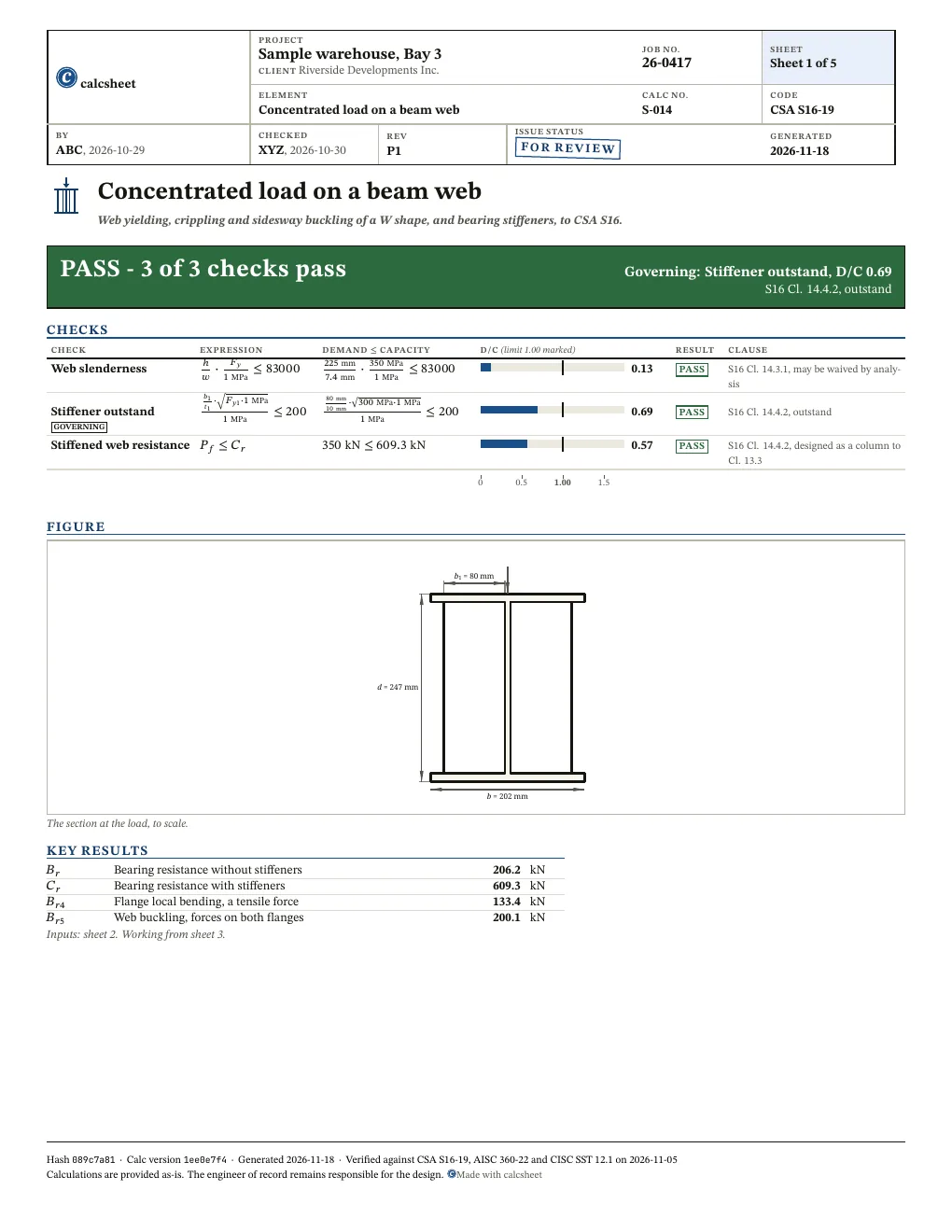
PASS Governing: Stiffener outstand, D/C 0.69, S16 Cl. 14.4.2, outstand3 of 3 checks below pass
Given
Jump to resultsType any value, everything below recomputes. Hover or tap a symbol to trace it.
Resume your last case ()? Load it
This printed copy omits the derivation. The full report, with every step, is the PDF at https://calc.struct.work/calc/concentrated-load.pdf.
Checks
All 3 checks pass. Largest D/C 0.69, Stiffener outstand.
Show all 3 checks
! marks a check that passes with D/C at or above 0.95: close to its limit. The band is a site convention, not a code limit.
| Check | D/C | Utilisation | Result |
|---|---|---|---|
| Web slendernessS16 Cl. 14.3.1, may be waived by analysis | 0.13 | PASS | |
| Stiffener outstandS16 Cl. 14.4.2, outstand | 0.69 | PASS | |
| Stiffened web resistanceS16 Cl. 14.4.2, designed as a column to Cl. 13.3 | 0.57 | PASS |
Results
Also worth checking
- Flange local bending under a tensile force and web buckling under forces on both flanges: reported for information, not compared with the load
- Openings in the web near the load, Cl. 14.3.3, and the reduction of the moment resistance for a thin web, Cl. 14.3.4
- The beam's own flexure and shear: the load is checked against the web's bearing resistance only
- Stiffener detailing: the clip at the flange fillet, the fit against the flange, the stiffener's class under Cl. 11.2 beyond the outstand ratio, and the fillet size limits of CSA W59 for the stiffener and web thicknesses
- The load's own connection, and bearing on the flange of the member that delivers the load
- Whether the tension flange is braced at the load: sidesway web buckling, AISC J10.4, is taken whether or not it is, which is conservative
- The electrode strength X_u is not capped at the matching electrode, Cl. 13.13.2.2: the value entered is used as it stands, so an overmatched electrode overstates the stiffener welds
- Torsional and weak-axis buckling of the stiffener column (F_ez and F_ey of Cl. 13.3.1.2): not computed, the web and flanges restrain the strip
Derivation
S16 Cl. 13.3.1.2, flexural buckling, KL = 0.75 h per Cl. 14.4.2
Report
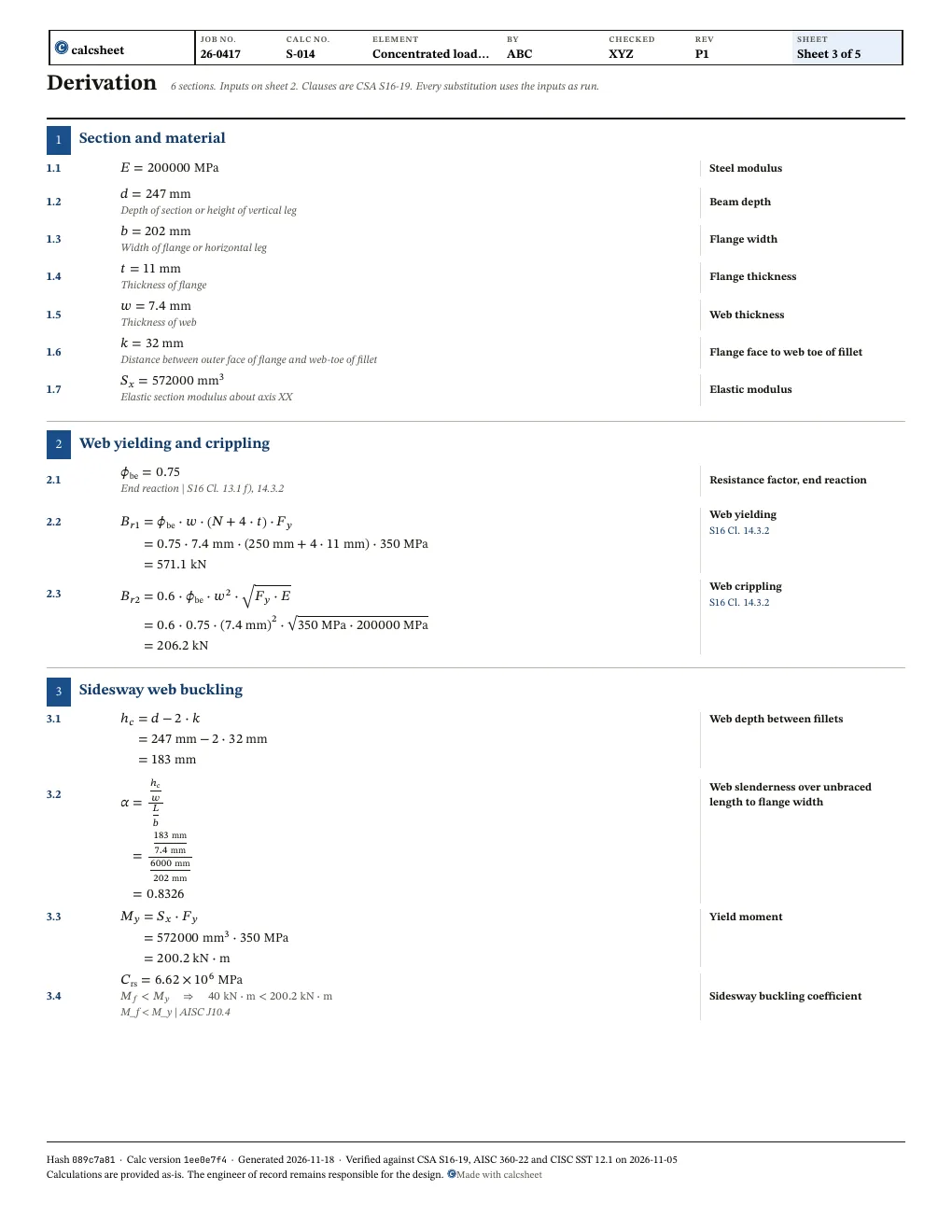
Sheet 1 and the first sheet of the working of the PDF report, at the declared values with a sample title block. Pro.
Questions
Why is AISC used for sidesway web buckling?
S16 has no clause for it, so the calc takes AISC 360 Section J10.4, which applies when the tension flange is not restrained at the load. The calc has no input for that and takes it either way, which is conservative.
When does AISC J10.4 sidesway web buckling not apply?
When (h/w)/(L/b) exceeds 2.3 with the compression flange restrained against rotation, or 1.7 without.
Revision history
After an independent checker's review: the default end reaction P_f is lowered from 400 to 350 kN to sit within the beam's own shear, stiffeners narrower than the flange fillet clip or wider than the flange are refused (Cl. 14.4.2), and the figure verdict now reads every check
| Value | Was | Now | Unit |
|---|---|---|---|
P_f | 400 | 350 | |
F_e | 120053 |