 calcsheet
 Single angle in tension
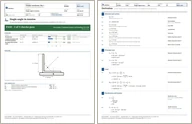
An equal-leg angle brace bolted by one leg, its tension and end moments combined to CSA S16 Cl. 13.9. Check an equal-leg angle brace bolted by one leg to a gusset under a factored tension. The load acts on the bolt line at the gusset's mid-plane, so the angle bends about both principal axes; its moment resistances are CSA S16 Cl. 13.5 d)'s, with Cl. 13.6.1 g)'s lateral-torsional buckling, and the tension and moments are combined by Cl. 13.9.
PASS Governing: Combined tension and bending, D/C 0.58, S16 Cl. 13.9.13 of 3 checks below pass
Given
Jump to resultsType any value, everything below recomputes. Hover or tap a symbol to trace it.
Resume your last case ()? Load it
This printed copy omits the derivation. The full report, with every step, is the PDF at https://calc.struct.work/calc/angle-tension.pdf.
Checks
All 3 checks pass. Largest D/C 0.58, Combined tension and bending.
Show all 3 checks
! marks a check that passes with D/C at or above 0.95: close to its limit. The band is a site convention, not a code limit.
| Check | D/C | Utilisation | Result |
|---|---|---|---|
| SlendernessS16 Cl. 10.4.2.2, tension member | 0.33 | PASS | |
| Combined tension and bendingS16 Cl. 13.9.1 | 0.58 | PASS | |
| Bending with tension reliefS16 Cl. 13.9.3 b) | 0.24 | PASS |
Results
Also worth checking
- Block shear and net section rupture at the bolts (Cl. 13.2 a) ii) and iii)): the tensile resistance is the gross section's yield
- The bolts, the gusset plate and the connection, including shear lag
- A single-angle row in S16 Table 2 (it has none): the leg is classed on the one-edge flexure row, 200 / sqrt(F_y) for Class 3, and a Class 4 leg takes the F_y at which it meets that limit (Cl. 13.5 d) ii))
- The moment gradient factor omega_2 of Cl. 13.6.1 a) ii): taken as 1.0, which is the uniform-moment, safe-side value
- Braces of a seismic force resisting system (Cl. 27, e.g. 27.5.2.5 tension-only bracing): its width-to-thickness, slenderness and capacity-design connection requirements
- Compression or a reversal of the load: the angle is checked in tension only
- A load line off the bolt gauge, or off the gusset's mid-plane
Derivation
S16 Cl. 13.5 d) ii), the F_y at which the leg meets the Class 3 limit
S16 Cl. 13.6.1 g), laterally unsupported, never above the Cl. 13.5 d) resistance
Report
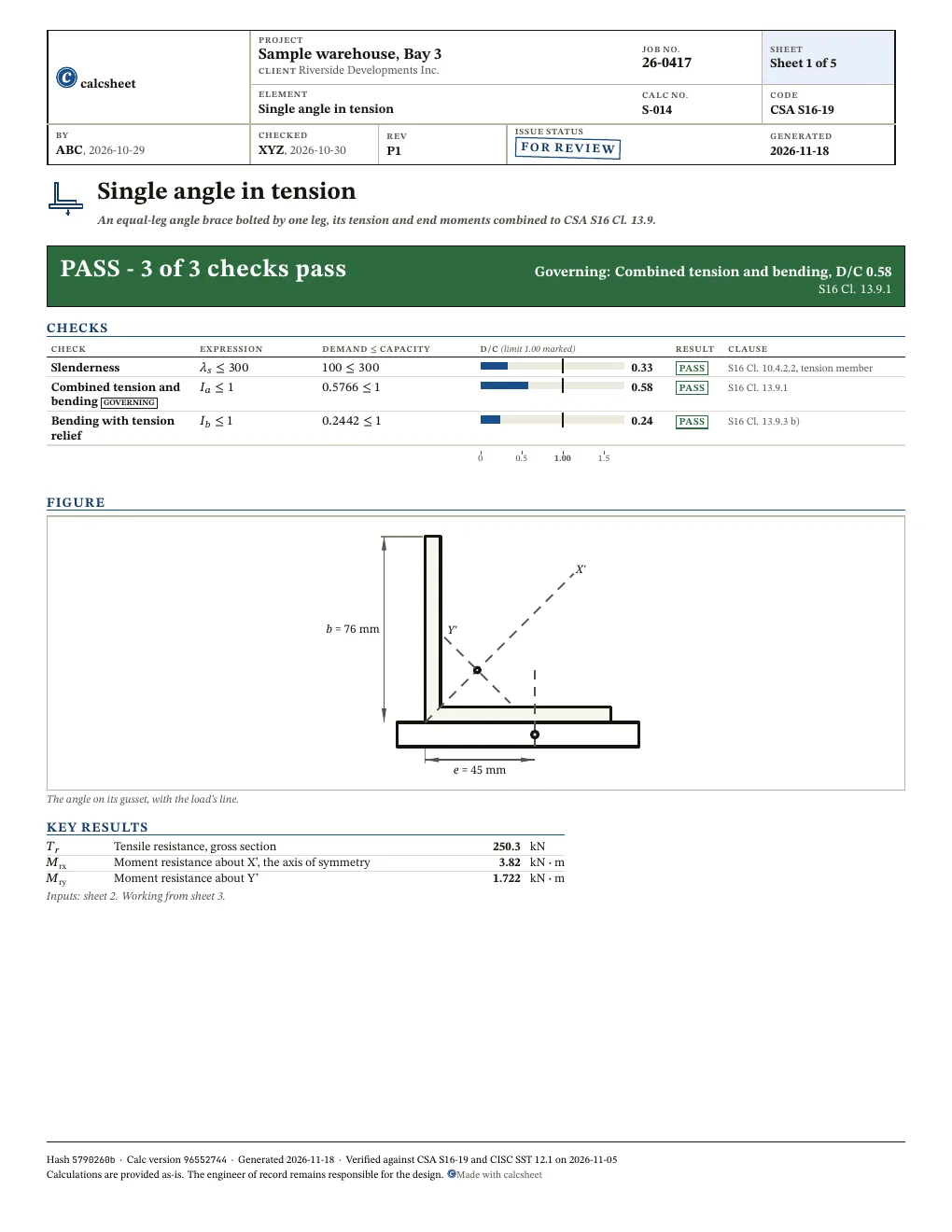
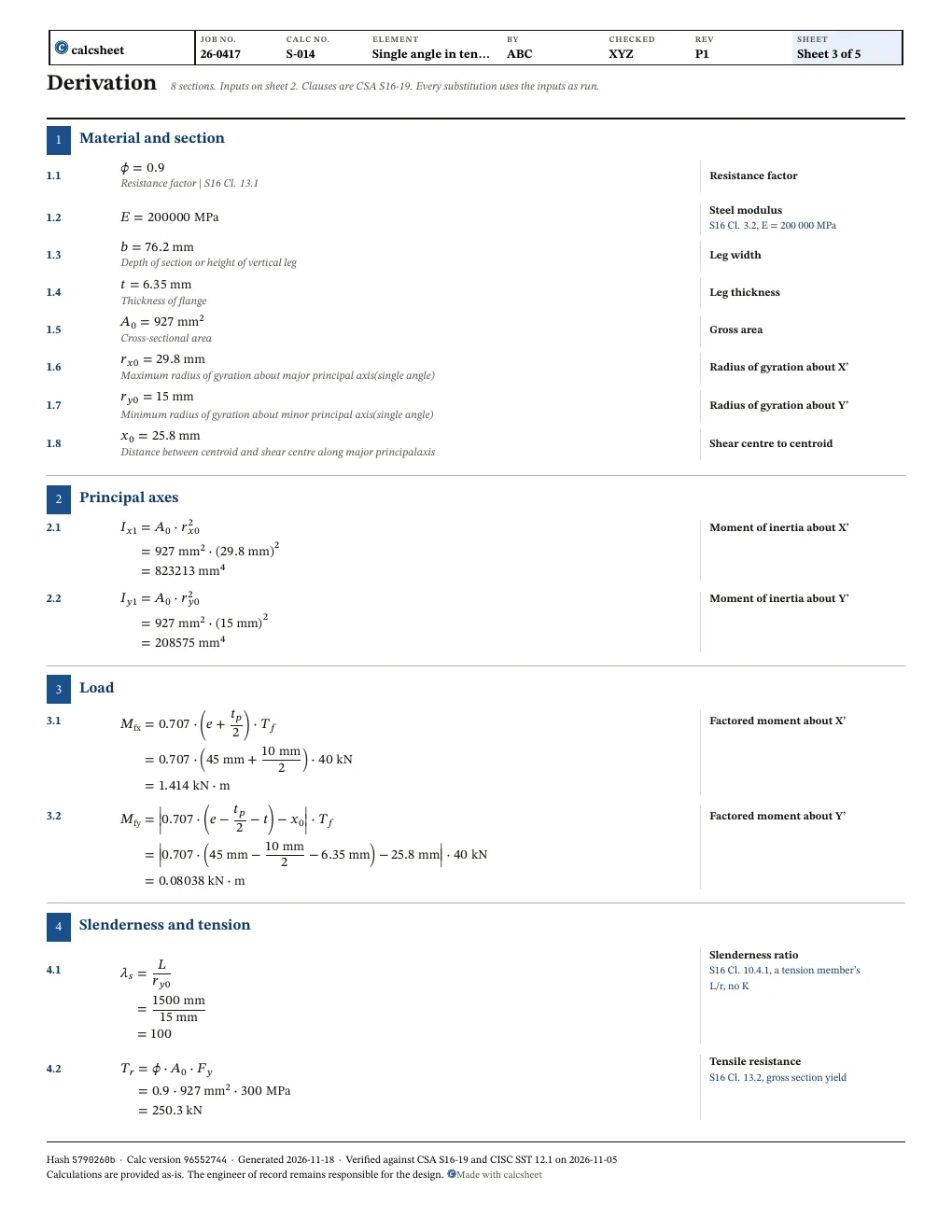
Sheet 1 and the first sheet of the working of the PDF report, at the declared values with a sample title block. Pro.
Questions
Where do M_fx and M_fy come from?
The tension acts at the gusset's mid-plane on the bolt line, off the angle's centroid in both principal directions: 0.707 (e + t_p/2) from the axis of symmetry, and the difference of the load's and the centroid's positions along it.
Is the net section checked?
No: T_r is the gross section's yield. Check the net section at the bolts with the connection.
Revision history
After an independent checker's review: moment resistances now follow S16 Cl. 13.5 d) and 13.6.1 g) instead of AISC F10, so the default leg is Class 4 and the default 75 kN tension now fails, a bolt gauge off the leg is refused, and the figure marks the centroid, principal axes and load point
| Value | Was | Now | Unit |
|---|---|---|---|
root_F_y | 17.3205 | ||
lambda_3 | 11.547 | ||
leg | 1 | 4 | |
F_cr | 277.778 | ||
M_rx | 5.08154 | 3.82013 | |
M_u | 14.36 | ||
M_rl | 4.12574 | ||
M_rx2 | 3.82013 | ||
S_ymin | 6886.06 | ||
M_ry | 2.78885 | 1.72152 | |
I_a | 0.466898 | 0.57665 | |
I_b | 0.177329 | 0.244235 | |
M_nx1 | 6.87623 | ||
M_cr | 13.2445 | ||
M_nx2 | 5.64616 | ||
lambda_p | 13.9427 | ||
lambda_r | 23.4961 | ||
M_nx3 | 6.87623 | ||
M_nx | 5.64616 | ||
M_ny1 | 3.09873 | ||
M_ny2 | 3.09873 |