ConcreteRC beam flexure

Factored moment resistance of a rectangular reinforced concrete section, singly or doubly reinforced, CSA A23.3-24 Cl. 10. Find the factored moment resistance of a rectangular reinforced concrete section to CSA A23.3-24 Clause 10, with tension steel only or with compression steel at d'. The compression steel stress comes from strain compatibility, so the top bars yield or not as the section decides. The calculator checks the moment against the resistance, the ductility limit on c/d of Eq. 10.5 and the minimum tension steel of Eq. 10.4, waived when the resistance is a third over the moment.

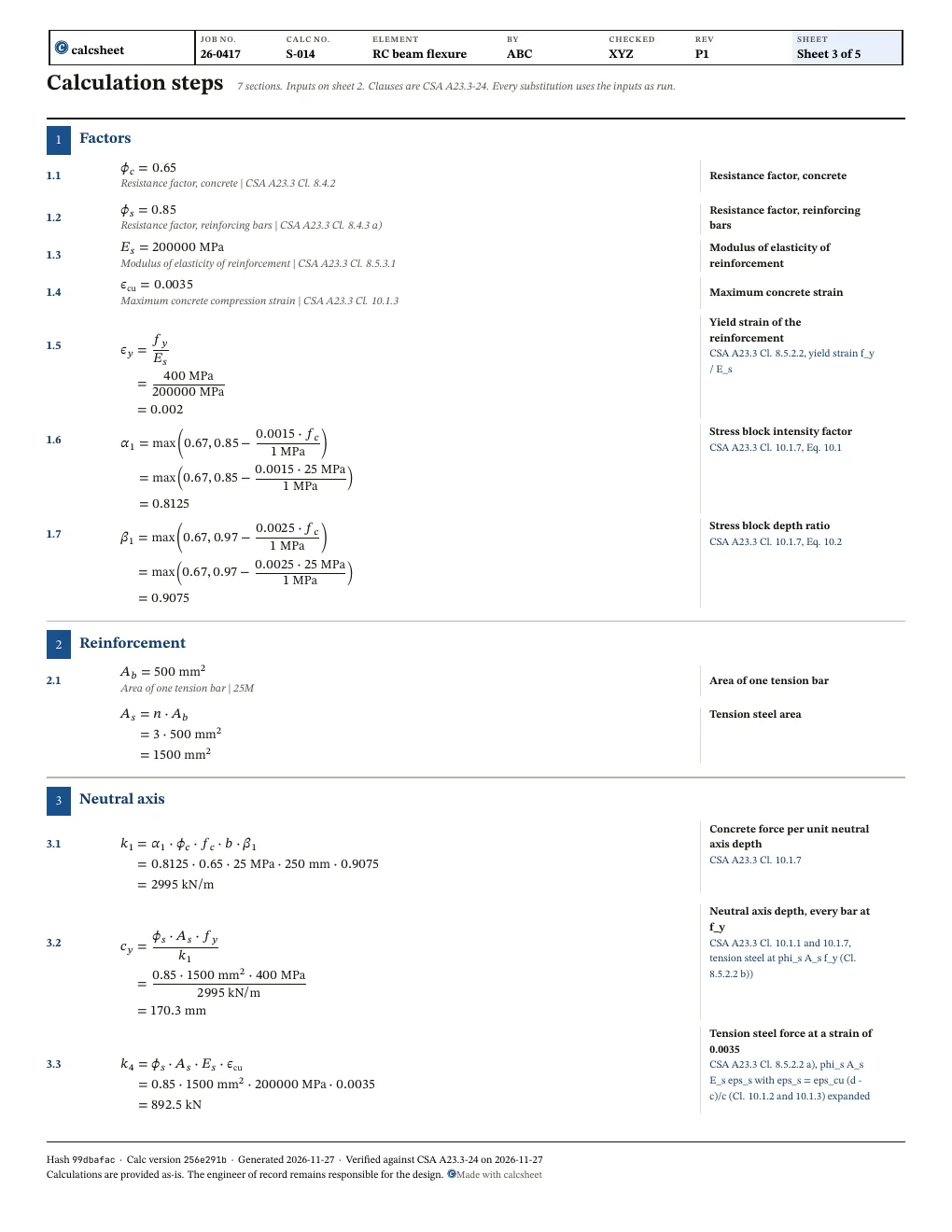
Calculation steps

SIImperial

CA$4.00 for this report, or Pro

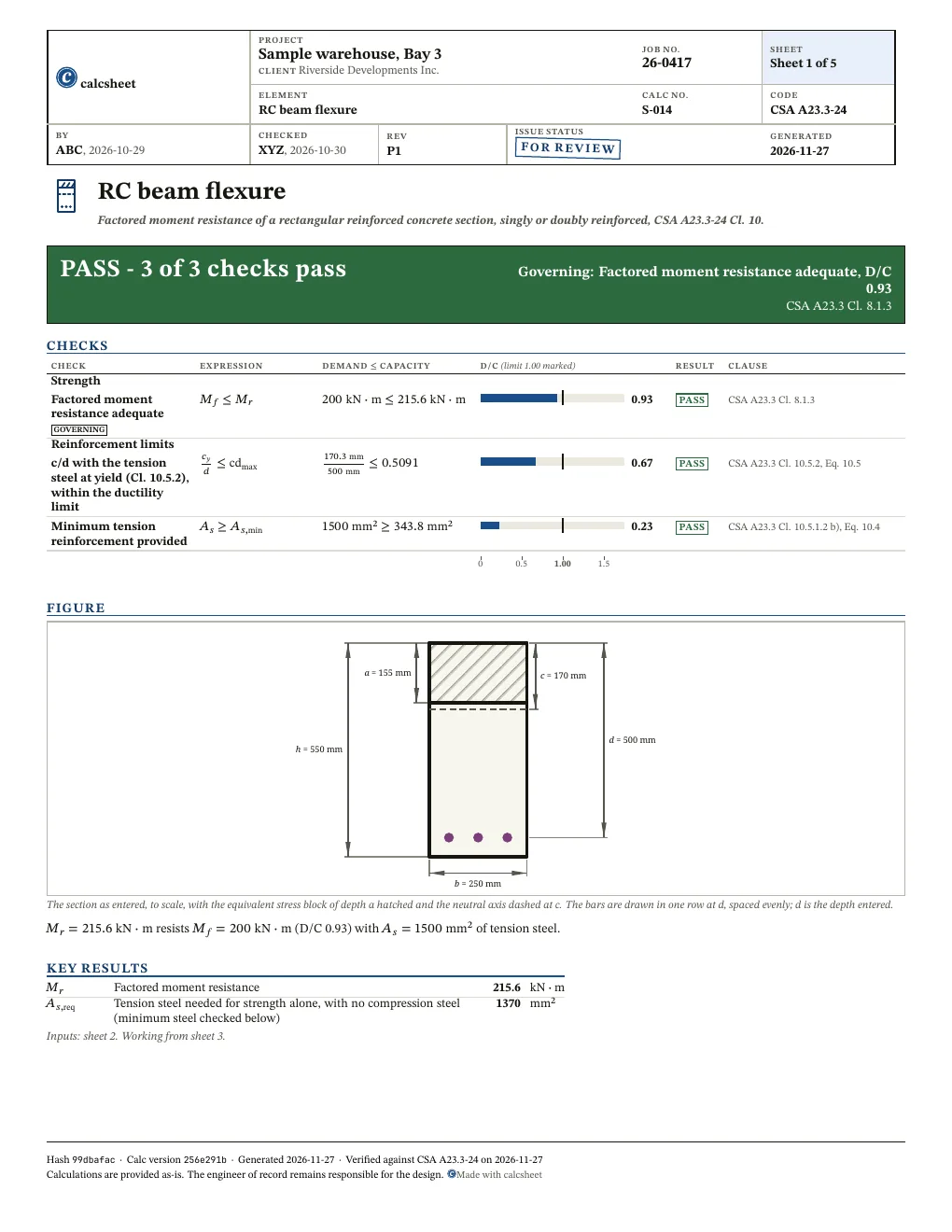
PASS Governing: Factored moment resistance adequate, D/C 0.93, CSA A23.3 Cl. 8.1.33 of 3 checks below pass

changed from the declared value
b = 250 mm h = 550 mm a = 155 mm c = 170 mm d = 500 mm
The section as entered, to scale, with the equivalent stress block of depth a hatched and the neutral axis dashed at c. The bars are drawn in one row at d, spaced evenly; d is the depth entered.

Given

Jump to results

Type any value, everything below recomputes. Hover or tap a symbol to trace it.

Section
changed from the declared value bb mm\mathrm{mm}100-2,000
changed from the declared value hh mm\mathrm{mm}150-3,000
changed from the declared value dd mm\mathrm{mm}50-3,000
Materials
changed from the declared value fcf_{c} MPa\mathrm{MPa}20-80
changed from the declared value fyf_{y} MPa\mathrm{MPa}400-500
Loads
changed from the declared value MfM_{f} kN⋅m\mathrm{kN} \cdot \mathrm{m}0-10,000
Tension steel
changed from the declared value
changed from the declared value nn 1-30

Title block

Optional. Printed in the title block of the PDF.

Results

Mr=215.6 kN⋅mM_{r} = 215.6\ \mathrm{kN} \cdot \mathrm{m} resists Mf=200 kN⋅mM_{f} = 200\ \mathrm{kN} \cdot \mathrm{m} (D/C 0.93) with As=1500 mm2A_{s} = 1500\ \mathrm{mm}^{2} of tension steel.

Quantity Description Value Unit
Mr\htmlClass{sym-M_r}{M_{r}} Factored moment resistance 215.6 kN⋅m\mathrm{kN} \cdot \mathrm{m}
As,req\htmlClass{sym-A_s_req}{A_{s,\mathrm{req}}} Tension steel needed for strength alone, with no compression steel (minimum steel checked below) 1370 mm2\mathrm{mm}^{2}

Checks

All 3 checks pass. Largest D/C 0.93, Factored moment resistance adequate.

Show all 3 checks and 2 design conditions

! marks a check that passes with D/C at or above 0.95: close to its limit. The band is a site convention, not a code limit.

Strength

Check D/C Utilisation Result
Factored moment resistance adequateCSA A23.3 Cl. 8.1.3Mf≤Mr⇒200 kN⋅m≤215.6 kN⋅m\htmlClass{sym-M_f}{M_{f}} \leq \htmlClass{sym-M_r}{M_{r}} \quad \Rightarrow \quad \htmlClass{sym-M_f}{200\ \mathrm{kN} \cdot \mathrm{m}} \leq \htmlClass{sym-M_r}{215.6\ \mathrm{kN} \cdot \mathrm{m}} 0.93 PASS

Reinforcement limits

Check D/C Utilisation Result
c/d with the tension steel at yield (Cl. 10.5.2), within the ductility limitCSA A23.3 Cl. 10.5.2, Eq. 10.5cyd≤cdmax⇒170.3 mm500 mm≤0.5091\frac{\htmlClass{sym-c_y}{c_{y}}}{\htmlClass{sym-d}{d}} \leq \htmlClass{sym-cd_max}{\mathrm{cd}_{\mathrm{max}}} \quad \Rightarrow \quad \frac{\htmlClass{sym-c_y}{170.3\ \mathrm{mm}}}{\htmlClass{sym-d}{500\ \mathrm{mm}}} \leq \htmlClass{sym-cd_max}{0.5091} 0.67 PASS
Minimum tension reinforcement providedCSA A23.3 Cl. 10.5.1.2 b), Eq. 10.4As≥As,min⇒1500 mm2≥343.8 mm2\htmlClass{sym-A_s}{A_{s}} \geq \htmlClass{sym-A_s_min}{A_{s,\mathrm{min}}} \quad \Rightarrow \quad \htmlClass{sym-A_s}{1500\ \mathrm{mm}^{2}} \geq \htmlClass{sym-A_s_min}{343.8\ \mathrm{mm}^{2}} 0.23 PASS

Design conditions

Minimum reinforcement required: M_r is less than 4/3 M_fCSA A23.3 Cl. 10.5.1.3Mr<43⋅Mf⇒215.6 kN⋅m<43⋅200 kN⋅m\htmlClass{sym-M_r}{M_{r}} < \frac{4}{3} \cdot \htmlClass{sym-M_f}{M_{f}} \quad \Rightarrow \quad \htmlClass{sym-M_r}{215.6\ \mathrm{kN} \cdot \mathrm{m}} < \frac{4}{3} \cdot \htmlClass{sym-M_f}{200\ \mathrm{kN} \cdot \mathrm{m}}
Tension steel yields: f_s = f_yCSA A23.3 Cl. 8.5.2.2ϵs≥ϵy⇒0.006779≥0.002\htmlClass{sym-epsilon_s}{\epsilon_{s}} \geq \htmlClass{sym-epsilon_y}{\epsilon_{y}} \quad \Rightarrow \quad \htmlClass{sym-epsilon_s}{0.006779} \geq \htmlClass{sym-epsilon_y}{0.002}
Also worth checking
  • Shear and torsion are not checked (Cl. 11, see rc-shear-torsion).
  • Crack control (Cl. 10.6.1) and skin reinforcement past 750 mm of depth (Cl. 10.6.2) are not checked.
  • Deflection is not checked (Cl. 9.8).
  • Development and splices of the bars are not checked (Cl. 12, see development-length-tension).
  • T- and L-sections are not covered (Cl. 10.3): this calc takes the rectangle b by h. A flange in compression is a follow-up; with the flange in tension, the wider b_t of Cl. 10.5.1.2 b) for the minimum steel and the flange reinforcement of Cl. 10.5.3 are not checked.
  • The cracking-moment route of Cl. 10.5.1.1 is not used, Eq. 10.4 being used in lieu (Cl. 10.5.1.2).
  • Slabs and footings, whose minimum steel is Cl. 7.8 (Cl. 10.5.1.2 a)), are not covered.
  • Lateral support spacing is not checked (Cl. 10.2).
  • Members with axial load are not covered: Cl. 10.5.2 is for flexural members without axial load.
  • Ties enclosing the compression bars are not checked (Cl. 7.6.6.1).
  • Bar fit and clear spacing across b, and the cover behind d and d', are taken as entered.
  • The concrete displaced by the compression bars is not deducted; where the bars lie within the stress block, deducting alpha_1 phi_c f'c A_s' lowers M_r slightly.
  • Deep flexural members (Cl. 10.7.1) and regions of discontinuity near supports, concentrated loads or openings are not covered: plane sections (Cl. 10.1.2) do not hold there, and the strut-and-tie model of Cl. 11.4 applies.
  • Beams of the seismic force resisting system are not covered: Cl. 21 and its reinforcement grade limits (Cl. 21.2.7) are not checked.
  • Fire resistance (Cl. 8.1.2), which can set the cover, is not checked.

Calculation steps

1.1Resistance factor, concrete
ϕc=0.65(Resistance factor, concrete | CSA A23.3 Cl. 8.4.2)\begin{aligned} \htmlClass{sym-phi_c}{\phi_{c}} &= 0.65 \quad \left(\text{Resistance factor, concrete | CSA A23.3 Cl. 8.4.2}\right) \end{aligned}
1.2Resistance factor, reinforcing bars
ϕs=0.85(Resistance factor, reinforcing bars | CSA A23.3 Cl. 8.4.3 a))\begin{aligned} \htmlClass{sym-phi_s}{\phi_{s}} &= 0.85 \quad \left(\text{Resistance factor, reinforcing bars | CSA A23.3 Cl. 8.4.3 a)}\right) \end{aligned}
1.3Modulus of elasticity of reinforcement
Es=200000 MPa(Modulus of elasticity of reinforcement | CSA A23.3 Cl. 8.5.3.1)\begin{aligned} \htmlClass{sym-E_s}{E_{s}} &= 200000\ \mathrm{MPa} \quad \left(\text{Modulus of elasticity of reinforcement | CSA A23.3 Cl. 8.5.3.1}\right) \end{aligned}
1.4Maximum concrete strain
ϵcu=0.0035(Maximum concrete compression strain | CSA A23.3 Cl. 10.1.3)\begin{aligned} \htmlClass{sym-epsilon_cu}{\epsilon_{\mathrm{cu}}} &= 0.0035 \quad \left(\text{Maximum concrete compression strain | CSA A23.3 Cl. 10.1.3}\right) \end{aligned}
1.5Yield strain of the reinforcement

CSA A23.3 Cl. 8.5.2.2, yield strain f_y / E_s

ϵy=fyEs=400 MPa200000 MPa=0.002\begin{aligned} \htmlClass{sym-epsilon_y}{\epsilon_{y}} &= \frac{\htmlClass{sym-f_y}{f_{y}}}{\htmlClass{sym-E_s}{E_{s}}} \\ &= \frac{\htmlClass{sym-f_y}{400\ \mathrm{MPa}}}{\htmlClass{sym-E_s}{200000\ \mathrm{MPa}}} \\ &= 0.002 \end{aligned}
1.6Stress block intensity factor

CSA A23.3 Cl. 10.1.7, Eq. 10.1

α1=max⁡(0.67,0.85−0.0015⋅fc1 MPa)=max⁡(0.67,0.85−0.0015⋅25 MPa1 MPa)=0.8125\begin{aligned} \htmlClass{sym-alpha_1}{\alpha_{1}} &= \max\left(0.67, 0.85 - \frac{0.0015 \cdot \htmlClass{sym-f_c}{f_{c}}}{1\ \mathrm{MPa}}\right) \\ &= \max\left(0.67, 0.85 - \frac{0.0015 \cdot \htmlClass{sym-f_c}{25\ \mathrm{MPa}}}{1\ \mathrm{MPa}}\right) \\ &= 0.8125 \end{aligned}
1.7Stress block depth ratio

CSA A23.3 Cl. 10.1.7, Eq. 10.2

β1=max⁡(0.67,0.97−0.0025⋅fc1 MPa)=max⁡(0.67,0.97−0.0025⋅25 MPa1 MPa)=0.9075\begin{aligned} \htmlClass{sym-beta_1}{\beta_{1}} &= \max\left(0.67, 0.97 - \frac{0.0025 \cdot \htmlClass{sym-f_c}{f_{c}}}{1\ \mathrm{MPa}}\right) \\ &= \max\left(0.67, 0.97 - \frac{0.0025 \cdot \htmlClass{sym-f_c}{25\ \mathrm{MPa}}}{1\ \mathrm{MPa}}\right) \\ &= 0.9075 \end{aligned}
2.1Area of one tension bar
Ab=500 mm2(Area of one tension bar | 25M)\begin{aligned} \htmlClass{sym-A_b}{A_{b}} &= 500\ \mathrm{mm}^{2} \quad \left(\text{Area of one tension bar | 25M}\right) \end{aligned}
Tension bar diameter
db=25.2 mm(Tension bar diameter | 25M)\begin{aligned} \htmlClass{sym-d_b}{d_{b}} &= 25.2\ \mathrm{mm} \quad \left(\text{Tension bar diameter | 25M}\right) \end{aligned}
Tension steel area
As=n⋅Ab=3⋅500 mm2=1500 mm2\begin{aligned} \htmlClass{sym-A_s}{A_{s}} &= \htmlClass{sym-n}{n} \cdot \htmlClass{sym-A_b}{A_{b}} \\ &= \htmlClass{sym-n}{3} \cdot \htmlClass{sym-A_b}{500\ \mathrm{mm}^{2}} \\ &= 1500\ \mathrm{mm}^{2} \end{aligned}
3.1Concrete force per unit neutral axis depth

CSA A23.3 Cl. 10.1.7

k1=α1⋅ϕc⋅fc⋅b⋅β1=0.8125⋅0.65⋅25 MPa⋅250 mm⋅0.9075=2995 kN/m\begin{aligned} \htmlClass{sym-k_1}{k_{1}} &= \htmlClass{sym-alpha_1}{\alpha_{1}} \cdot \htmlClass{sym-phi_c}{\phi_{c}} \cdot \htmlClass{sym-f_c}{f_{c}} \cdot \htmlClass{sym-b}{b} \cdot \htmlClass{sym-beta_1}{\beta_{1}} \\ &= \htmlClass{sym-alpha_1}{0.8125} \cdot \htmlClass{sym-phi_c}{0.65} \cdot \htmlClass{sym-f_c}{25\ \mathrm{MPa}} \cdot \htmlClass{sym-b}{250\ \mathrm{mm}} \cdot \htmlClass{sym-beta_1}{0.9075} \\ &= 2995\ \mathrm{kN/m} \end{aligned}
3.2Neutral axis depth, every bar at f_y

CSA A23.3 Cl. 10.1.1 and 10.1.7, tension steel at φs A_s f_y (Cl. 8.5.2.2 b))

cy=ϕs⋅As⋅fyk1=0.85⋅1500 mm2⋅400 MPa2995 kN/m=170.3 mm\begin{aligned} \htmlClass{sym-c_y}{c_{y}} &= \frac{\htmlClass{sym-phi_s}{\phi_{s}} \cdot \htmlClass{sym-A_s}{A_{s}} \cdot \htmlClass{sym-f_y}{f_{y}}}{\htmlClass{sym-k_1}{k_{1}}} \\ &= \frac{\htmlClass{sym-phi_s}{0.85} \cdot \htmlClass{sym-A_s}{1500\ \mathrm{mm}^{2}} \cdot \htmlClass{sym-f_y}{400\ \mathrm{MPa}}}{\htmlClass{sym-k_1}{2995\ \mathrm{kN/m}}} \\ &= 170.3\ \mathrm{mm} \end{aligned}
3.3Tension steel force at a strain of 0.0035

CSA A23.3 Cl. 8.5.2.2 a), φs A_s E_s eps_s with eps_s = eps_cu (d - c)/c (Cl. 10.1.2 and 10.1.3) expanded

k4=ϕs⋅As⋅Es⋅ϵcu=0.85⋅1500 mm2⋅200000 MPa⋅0.0035=892.5 kN\begin{aligned} \htmlClass{sym-k_4}{k_{4}} &= \htmlClass{sym-phi_s}{\phi_{s}} \cdot \htmlClass{sym-A_s}{A_{s}} \cdot \htmlClass{sym-E_s}{E_{s}} \cdot \htmlClass{sym-epsilon_cu}{\epsilon_{\mathrm{cu}}} \\ &= \htmlClass{sym-phi_s}{0.85} \cdot \htmlClass{sym-A_s}{1500\ \mathrm{mm}^{2}} \cdot \htmlClass{sym-E_s}{200000\ \mathrm{MPa}} \cdot \htmlClass{sym-epsilon_cu}{0.0035} \\ &= 892.5\ \mathrm{kN} \end{aligned}
3.4Neutral axis depth, tension steel elastic, top steel (if any) at f_y

CSA A23.3 Cl. 10.1.1, strain compatibility, tension steel elastic

ct=(−k4)+k42+4⋅k1⋅k4⋅d2⋅k1=(−892.5 kN)+(892.5 kN)2+4⋅2995 kN/m⋅892.5 kN⋅500 mm2⋅2995 kN/m=264.8 mm\begin{aligned} \htmlClass{sym-c_t}{c_{t}} &= \frac{\left(-\htmlClass{sym-k_4}{k_{4}}\right) + \sqrt{\htmlClass{sym-k_4}{k_{4}}^{2} + 4 \cdot \htmlClass{sym-k_1}{k_{1}} \cdot \htmlClass{sym-k_4}{k_{4}} \cdot \htmlClass{sym-d}{d}}}{2 \cdot \htmlClass{sym-k_1}{k_{1}}} \\ &= \frac{\left(-\htmlClass{sym-k_4}{892.5\ \mathrm{kN}}\right) + \sqrt{\left(\htmlClass{sym-k_4}{892.5\ \mathrm{kN}}\right)^{2} + 4 \cdot \htmlClass{sym-k_1}{2995\ \mathrm{kN/m}} \cdot \htmlClass{sym-k_4}{892.5\ \mathrm{kN}} \cdot \htmlClass{sym-d}{500\ \mathrm{mm}}}}{2 \cdot \htmlClass{sym-k_1}{2995\ \mathrm{kN/m}}} \\ &= 264.8\ \mathrm{mm} \end{aligned}
3.5Neutral axis depth

CSA A23.3 Cl. 10.1.1, equilibrium holds at the smaller

c=min⁡(cy,ct)=min⁡(170.3 mm,264.8 mm)=170.3 mm\begin{aligned} \htmlClass{sym-c}{c} &= \min\left(\htmlClass{sym-c_y}{c_{y}}, \htmlClass{sym-c_t}{c_{t}}\right) \\ &= \min\left(\htmlClass{sym-c_y}{170.3\ \mathrm{mm}}, \htmlClass{sym-c_t}{264.8\ \mathrm{mm}}\right) \\ &= 170.3\ \mathrm{mm} \end{aligned}

The tension steel force is the smaller of ϕsAsfy\phi_s A_s f_y and its elastic value, so the depth is the smaller of cyc_y and ctc_t.

3.6Depth of the equivalent stress block

CSA A23.3 Cl. 10.1.7 a)

a=β1⋅c=0.9075⋅170.3 mm=154.5 mm\begin{aligned} \htmlClass{sym-a}{a} &= \htmlClass{sym-beta_1}{\beta_{1}} \cdot \htmlClass{sym-c}{c} \\ &= \htmlClass{sym-beta_1}{0.9075} \cdot \htmlClass{sym-c}{170.3\ \mathrm{mm}} \\ &= 154.5\ \mathrm{mm} \end{aligned}
4.1Tension steel strain

CSA A23.3 Cl. 10.1.2 and 10.1.3

ϵs=ϵcu⋅(d−c)c=0.0035⋅(500 mm−170.3 mm)170.3 mm=0.006779\begin{aligned} \htmlClass{sym-epsilon_s}{\epsilon_{s}} &= \frac{\htmlClass{sym-epsilon_cu}{\epsilon_{\mathrm{cu}}} \cdot \left(\htmlClass{sym-d}{d} - \htmlClass{sym-c}{c}\right)}{\htmlClass{sym-c}{c}} \\ &= \frac{\htmlClass{sym-epsilon_cu}{0.0035} \cdot \left(\htmlClass{sym-d}{500\ \mathrm{mm}} - \htmlClass{sym-c}{170.3\ \mathrm{mm}}\right)}{\htmlClass{sym-c}{170.3\ \mathrm{mm}}} \\ &= 0.006779 \end{aligned}
4.2Tension steel stress

CSA A23.3 Cl. 8.5.2.2

fs=min⁡(ϵs⋅Es,fy)=min⁡(0.006779⋅200000 MPa,400 MPa)=400 MPa\begin{aligned} \htmlClass{sym-f_s}{f_{s}} &= \min\left(\htmlClass{sym-epsilon_s}{\epsilon_{s}} \cdot \htmlClass{sym-E_s}{E_{s}}, \htmlClass{sym-f_y}{f_{y}}\right) \\ &= \min\left(\htmlClass{sym-epsilon_s}{0.006779} \cdot \htmlClass{sym-E_s}{200000\ \mathrm{MPa}}, \htmlClass{sym-f_y}{400\ \mathrm{MPa}}\right) \\ &= 400\ \mathrm{MPa} \end{aligned}
5.1Factored moment resistance

CSA A23.3 Cl. 10.1.1 and 10.1.7

Mr=ϕs⋅As⋅fs⋅(d−a2)=0.85⋅1500 mm2⋅400 MPa⋅(500 mm−154.5 mm2)=215.6 kN⋅m\begin{aligned} \htmlClass{sym-M_r}{M_{r}} &= \htmlClass{sym-phi_s}{\phi_{s}} \cdot \htmlClass{sym-A_s}{A_{s}} \cdot \htmlClass{sym-f_s}{f_{s}} \cdot \left(\htmlClass{sym-d}{d} - \frac{\htmlClass{sym-a}{a}}{2}\right) \\ &= \htmlClass{sym-phi_s}{0.85} \cdot \htmlClass{sym-A_s}{1500\ \mathrm{mm}^{2}} \cdot \htmlClass{sym-f_s}{400\ \mathrm{MPa}} \cdot \left(\htmlClass{sym-d}{500\ \mathrm{mm}} - \frac{\htmlClass{sym-a}{154.5\ \mathrm{mm}}}{2}\right) \\ &= 215.6\ \mathrm{kN} \cdot \mathrm{m} \end{aligned}
6.1Ductility limit on c/d

CSA A23.3 Cl. 10.5.2, Eq. 10.5, f_yg = f_y for grades to 500 MPa

cdmax=0.8⋅700 MPa700 MPa+fy=0.8⋅700 MPa700 MPa+400 MPa=0.5091\begin{aligned} \htmlClass{sym-cd_max}{\mathrm{cd}_{\mathrm{max}}} &= 0.8 \cdot \frac{700\ \mathrm{MPa}}{700\ \mathrm{MPa} + \htmlClass{sym-f_y}{f_{y}}} \\ &= 0.8 \cdot \frac{700\ \mathrm{MPa}}{700\ \mathrm{MPa} + \htmlClass{sym-f_y}{400\ \mathrm{MPa}}} \\ &= 0.5091 \end{aligned}
6.2Minimum tension steel

CSA A23.3 Cl. 10.5.1.2 b), Eq. 10.4, b_t = b

As,min=0.2⋅fc⋅1 MPafy⋅b⋅h=0.2⋅25 MPa⋅1 MPa400 MPa⋅250 mm⋅550 mm=343.8 mm2\begin{aligned} \htmlClass{sym-A_s_min}{A_{s,\mathrm{min}}} &= \frac{0.2 \cdot \sqrt{\htmlClass{sym-f_c}{f_{c}} \cdot 1\ \mathrm{MPa}}}{\htmlClass{sym-f_y}{f_{y}}} \cdot \htmlClass{sym-b}{b} \cdot \htmlClass{sym-h}{h} \\ &= \frac{0.2 \cdot \sqrt{\htmlClass{sym-f_c}{25\ \mathrm{MPa}} \cdot 1\ \mathrm{MPa}}}{\htmlClass{sym-f_y}{400\ \mathrm{MPa}}} \cdot \htmlClass{sym-b}{250\ \mathrm{mm}} \cdot \htmlClass{sym-h}{550\ \mathrm{mm}} \\ &= 343.8\ \mathrm{mm}^{2} \end{aligned}
7.1Tension steel needed for M_f

CSA A23.3 Cl. 10.1.7 a) and 8.5.2.2 b), M_f = φs A_s f_y (d - a/2) with a = φs A_s f_y / (alpha_1 φc f'c b), solved for A_s

As,req=α1⋅ϕc⋅fc⋅b⋅dϕs⋅fy⋅(1−1−2⋅Mfα1⋅ϕc⋅fc⋅b⋅d2)=0.8125⋅0.65⋅25 MPa⋅250 mm⋅500 mm0.85⋅400 MPa⋅(1−1−2⋅200 kN⋅m0.8125⋅0.65⋅25 MPa⋅250 mm⋅(500 mm)2)=1370 mm2\begin{aligned} \htmlClass{sym-A_s_req}{A_{s,\mathrm{req}}} &= \frac{\htmlClass{sym-alpha_1}{\alpha_{1}} \cdot \htmlClass{sym-phi_c}{\phi_{c}} \cdot \htmlClass{sym-f_c}{f_{c}} \cdot \htmlClass{sym-b}{b} \cdot \htmlClass{sym-d}{d}}{\htmlClass{sym-phi_s}{\phi_{s}} \cdot \htmlClass{sym-f_y}{f_{y}}} \cdot \left(1 - \sqrt{1 - \frac{2 \cdot \htmlClass{sym-M_f}{M_{f}}}{\htmlClass{sym-alpha_1}{\alpha_{1}} \cdot \htmlClass{sym-phi_c}{\phi_{c}} \cdot \htmlClass{sym-f_c}{f_{c}} \cdot \htmlClass{sym-b}{b} \cdot \htmlClass{sym-d}{d}^{2}}}\right) \\ &= \frac{\htmlClass{sym-alpha_1}{0.8125} \cdot \htmlClass{sym-phi_c}{0.65} \cdot \htmlClass{sym-f_c}{25\ \mathrm{MPa}} \cdot \htmlClass{sym-b}{250\ \mathrm{mm}} \cdot \htmlClass{sym-d}{500\ \mathrm{mm}}}{\htmlClass{sym-phi_s}{0.85} \cdot \htmlClass{sym-f_y}{400\ \mathrm{MPa}}} \cdot \left(1 - \sqrt{1 - \frac{2 \cdot \htmlClass{sym-M_f}{200\ \mathrm{kN} \cdot \mathrm{m}}}{\htmlClass{sym-alpha_1}{0.8125} \cdot \htmlClass{sym-phi_c}{0.65} \cdot \htmlClass{sym-f_c}{25\ \mathrm{MPa}} \cdot \htmlClass{sym-b}{250\ \mathrm{mm}} \cdot \left(\htmlClass{sym-d}{500\ \mathrm{mm}}\right)^{2}}}\right) \\ &= 1370\ \mathrm{mm}^{2} \end{aligned}

Minimum reinforcement required: M_r is less than 4/3 M_f, CSA A23.3 Cl. 10.5.1.3. Mr<43⋅Mf⇒215.6 kN⋅m<43⋅200 kN⋅mM_{r} < \frac{4}{3} \cdot M_{f} \quad \Rightarrow \quad 215.6\ \mathrm{kN} \cdot \mathrm{m} < \frac{4}{3} \cdot 200\ \mathrm{kN} \cdot \mathrm{m}

Tension steel yields: f_s = f_y, CSA A23.3 Cl. 8.5.2.2. ϵs≥ϵy⇒0.006779≥0.002\epsilon_{s} \geq \epsilon_{y} \quad \Rightarrow \quad 0.006779 \geq 0.002

Report

Sheet 1 and the first sheet of the working of the PDF report, at the declared values with a sample title block. Pro.
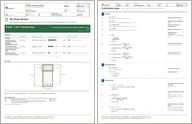
Show the two sheets
Sheet 1 of the RC beam flexure report: title block, verdict and checks
Sheet 1: title block, verdict and checks · full size
The first sheet of the working in the RC beam flexure report: each step with its clause
The working: each step with its clause · full size

Questions

What does the c/d limit of Cl. 10.5.2 check?

That the tension steel yields well before the concrete crushes. Eq. 10.5 of A23.3-24 limits c/d to 0.8 x 700/(700 + f_yg), with c found with the tension steel at phi_s f_yg and the stress block of Cl. 10.1.7; at f_y = 400 MPa the limit is 0.509. A section past the limit is not refused: the ductility check fails, and M_r is still computed by strain compatibility with the tension steel below yield.

When is the minimum tension steel of Eq. 10.4 waived?

Cl. 10.5.1.3 waives it where M_r is at least one-third greater than M_f. Otherwise the tension steel must be at least 0.2 sqrt(f'c) b_t h / f_y (Cl. 10.5.1.2 b)), with b_t = b for a rectangle. The cracking-moment route of Cl. 10.5.1.1 is the alternative and is not used here.

How is the compression steel stress f_s_prime found?

By strain compatibility (Cl. 10.1.1): the strain at d' is 0.0035 (c - d')/c, and the stress is E_s times that strain, not more than f_y (Cl. 8.5.2.2). The neutral axis depth is the one that balances every bar at its own stress, so the top bars yield or not as the section decides. A negative value means the top bars sit below the neutral axis, in tension.

Revision history

Rc-flexure-rect end result in a sentence, with the steel needed
ValueWasNowUnit
A_s_req1369.72mm2\mathrm{mm}^{2}
Validate and publish rc-flexure-rect, strain-compatible M_r
ValueWasNowUnit
k_12995.46kN/m\mathrm{kN/m}
c_y170.258mm\mathrm{mm}
k_4892.5kN\mathrm{kN}
c_t264.75mm\mathrm{mm}
f_s400MPa\mathrm{MPa}