
ConcreteStandard hook development length

Standard hook development length

CSA A23.3-24Verified against CSA A23.3-24: 12 formulas and 4 clauses compared with the code text
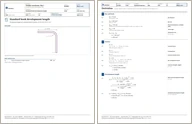
Sample report sheets

Development length of a standard hook in tension, to CSA A23.3-24 Cl. 12.5. Calculate the development length of a standard hook in tension per CSA A23.3-24 Cl. 12.5. Input concrete strength, steel yield strength, bar size and hook type, the side cover, the ties or stirrups enclosing the hooks and the spacing of the hooked bars, and the coating and density conditions that apply. The four factors of Table 12.5 are worked out from those inputs and each is shown with the row that set it. Excess reinforcement may shorten the length per Cl. 12.5.5, never below 150 mm or eight bar diameters, and at a member end the calc checks the enclosing ties of Cl. 12.5.6. Straight bars are the Tension development length and lap splice page and the Compression development length page.

First report free, then a free sign-in

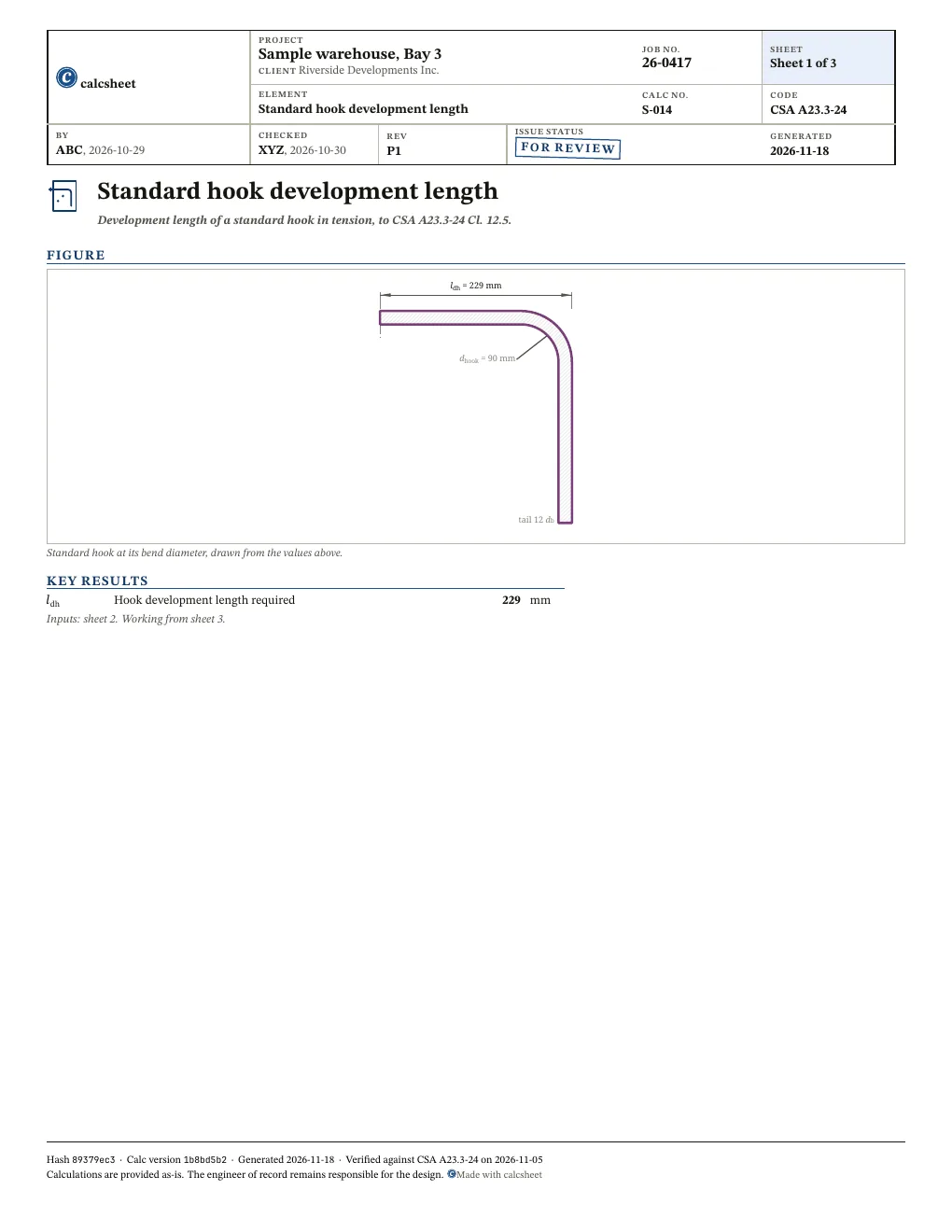
dhook = 90 mm tail 12 db ldh = 229 mm
Standard hook at its bend diameter, drawn from the values above.

Given

Jump to results

Type any value, everything below recomputes. Hover or tap a symbol to trace it.

Materials
changed from the declared value fcf_{c} MPa\mathrm{MPa}20-80
changed from the declared value fc,maxf_{c,\mathrm{max}} MPa\mathrm{MPa}25-80
changed from the declared value fyf_{y} MPa\mathrm{MPa}300-500
changed from the declared value
Hook
changed from the declared value
changed from the declared value nhn_{h} 1-50
changed from the declared value shs_{h} mm\mathrm{mm}25-2,000
changed from the declared value
changed from the declared value As,ratioA_{s,\mathrm{ratio}} 0.1-1
Cover and ties
changed from the declared value csidec_{\mathrm{side}} mm\mathrm{mm}10-500
changed from the declared value ctbc_{\mathrm{tb}} mm\mathrm{mm}10-500
changed from the declared value AthA_{\mathrm{th}} mm2\mathrm{mm}^{2}0-10,000
changed from the declared value sts_{t} mm\mathrm{mm}10-1,000
changed from the declared value ete_{t} mm\mathrm{mm}0-500

Title block

Optional. Printed in the title block of the PDF.

Results

Quantity Description Value Unit
ldh\htmlClass{sym-l_dh}{l_{\mathrm{dh}}} Hook development length required 229 mm\mathrm{mm}

Hook development length required, in mm\mathrm{mm}, for every bar size against concrete compressive strength with the other inputs as entered. Bold: 15M at 25 MPa25\ \mathrm{MPa}, whose derivation is below.

Bar size25 MPa25\ \mathrm{MPa}30 MPa30\ \mathrm{MPa}35 MPa35\ \mathrm{MPa}40 MPa40\ \mathrm{MPa}45 MPa45\ \mathrm{MPa}50 MPa50\ \mathrm{MPa}
10M150a150a150a150a150a150a
15M229218.8210.5203.6197.7192.5
20M308.1294.3283.2273.9266259.1
25M754.3720.7693.5670.7651.2634.3
30M974.9931.5896.2866.8841.7819.8
35M127212151169113110981070
45M172316461584153214871448
55M252624132322224621802124
  1. ldhl_{dh} at the larger of 8 dbd_{b} and 150 mm, Cl. 12.5.1
Also worth checking
  • The tie or stirrup arrangement that makes up the enclosing reinforcement area, Cl. 12.5.4 (Condition 1 or 2, spacing up to 8 bar diameters): the area is taken as entered
  • The bend diameter and tail length of the standard hook, Cl. 7.1: the bend comes from the bar table and the tail is drawn at a fixed length, neither checked against the detail
  • The excess reinforcement ratio is taken as entered; its exceptions in Cl. 12.5.5 are not checked
  • Hooked bars in compression: hooks do not count, so use the compression development length page, Cl. 12.5.7
  • A bar stress of 1.25 times the yield strength where the anchorage may see inelastic deformation, the note to Cl. 12.1.3
  • Anchorage capacity by the complete load path, including concrete breakout, Cl. 12.1.5 b): l_dh is the development length of Cl. 12.1.5 a) only
  • Headed bars counted in A_th must have their heads at least 15 d_b from the hooked bar, Cl. 12.1.4
  • Hooks in ductile-frame beam-column joints, Cl. 21.3.3.5: the bar extends to the far face of the column core, and low-density concrete takes 1.25 times the length

Derivation

1.1Bar diameter
db=16 mm(Bar diameter | 15M)\begin{aligned} \htmlClass{sym-d_b}{d_{b}} &= 16\ \mathrm{mm} \quad \left(\text{Bar diameter | 15M}\right) \end{aligned}
1.2Bar area
Ab=200 mm2(Bar area | 15M)\begin{aligned} \htmlClass{sym-A_b}{A_{b}} &= 200\ \mathrm{mm}^{2} \quad \left(\text{Bar area | 15M}\right) \end{aligned}
1.3Hook bend diameter, weldable grade
dhook=90 mm(Standard hook bend diameter, grade 400W or 500W, A23.1 Table 16 | 15M)\begin{aligned} \htmlClass{sym-d_hook}{d_{\mathrm{hook}}} &= 90\ \mathrm{mm} \quad \left(\text{Standard hook bend diameter, grade 400W or 500W, A23.1 Table 16 | 15M}\right) \end{aligned}
1.4Hook angle
θhook=90(Hook bend angle, degrees | 90 deg)\begin{aligned} \htmlClass{sym-theta_hook}{\theta_{\mathrm{hook}}} &= 90 \quad \left(\text{Hook bend angle, degrees | 90 deg}\right) \end{aligned}
1.5Hooked bar area

Cl. 3.2, A_hs

Ahs=nh⋅Ab=2⋅200 mm2=400 mm2\begin{aligned} \htmlClass{sym-A_hs}{A_{\mathrm{hs}}} &= \htmlClass{sym-n_h}{n_{h}} \cdot \htmlClass{sym-A_b}{A_{b}} \\ &= \htmlClass{sym-n_h}{2} \cdot \htmlClass{sym-A_b}{200\ \mathrm{mm}^{2}} \\ &= 400\ \mathrm{mm}^{2} \end{aligned}

cside<6⋅db⇒50 mm<6⋅16 mmc_{\mathrm{side}} < 6 \cdot d_{b} \quad \Rightarrow \quad 50\ \mathrm{mm} < 6 \cdot 16\ \mathrm{mm}

2.1Location factor
kl=1(Other bar location | Table 12.5)\begin{aligned} \htmlClass{sym-k_l}{k_{l}} &= 1 \quad \left(\text{Other bar location | Table 12.5}\right) \end{aligned}
2.2Coating factor
kc=1(Uncoated | Table 12.5)\begin{aligned} \htmlClass{sym-k_c}{k_{c}} &= 1 \quad \left(\text{Uncoated | Table 12.5}\right) \end{aligned}
2.3Concrete density factor
kd=1(Normal-density concrete | Table 12.5)\begin{aligned} \htmlClass{sym-k_d}{k_{d}} &= 1 \quad \left(\text{Normal-density concrete | Table 12.5}\right) \end{aligned}

Ath<0.4⋅Ahs⇒0 mm2<0.4⋅400 mm2A_{\mathrm{th}} < 0.4 \cdot A_{\mathrm{hs}} \quad \Rightarrow \quad 0\ \mathrm{mm}^{2} < 0.4 \cdot 400\ \mathrm{mm}^{2}

sh≥6⋅db⇒150 mm≥6⋅16 mms_{h} \geq 6 \cdot d_{b} \quad \Rightarrow \quad 150\ \mathrm{mm} \geq 6 \cdot 16\ \mathrm{mm}

2.4Bar arrangement factor
kr=0.6(Hooked bars at 6 d_b or more | Table 12.5)\begin{aligned} \htmlClass{sym-k_r}{k_{r}} &= 0.6 \quad \left(\text{Hooked bars at 6 d\_b or more | Table 12.5}\right) \end{aligned}
2.5Concrete strength, capped

Cl. 12.1.2

fc,cap=min⁡(fc,64 MPa)=min⁡(25 MPa,64 MPa)=25 MPa\begin{aligned} \htmlClass{sym-f_c_cap}{f_{c,\mathrm{cap}}} &= \min\left(\htmlClass{sym-f_c}{f_{c}}, 64\ \mathrm{MPa}\right) \\ &= \min\left(\htmlClass{sym-f_c}{25\ \mathrm{MPa}}, 64\ \mathrm{MPa}\right) \\ &= 25\ \mathrm{MPa} \end{aligned}
3.1Basic hook development length

Cl. 12.5.2

lhb=kl⋅kc⋅kd⋅kr⋅fy⋅(db1 mm)1.5⋅1 mm30⋅(fc,cap1 MPa)0.25⋅1 MPa=1⋅1⋅1⋅0.6⋅400 MPa⋅(16 mm1 mm)1.5⋅1 mm30⋅(25 MPa1 MPa)0.25⋅1 MPa=229 mm\begin{aligned} \htmlClass{sym-l_hb}{l_{\mathrm{hb}}} &= \frac{\htmlClass{sym-k_l}{k_{l}} \cdot \htmlClass{sym-k_c}{k_{c}} \cdot \htmlClass{sym-k_d}{k_{d}} \cdot \htmlClass{sym-k_r}{k_{r}} \cdot \htmlClass{sym-f_y}{f_{y}} \cdot \left(\frac{\htmlClass{sym-d_b}{d_{b}}}{1\ \mathrm{mm}}\right)^{1.5} \cdot 1\ \mathrm{mm}}{30 \cdot \left(\frac{\htmlClass{sym-f_c_cap}{f_{c,\mathrm{cap}}}}{1\ \mathrm{MPa}}\right)^{0.25} \cdot 1\ \mathrm{MPa}} \\ &= \frac{\htmlClass{sym-k_l}{1} \cdot \htmlClass{sym-k_c}{1} \cdot \htmlClass{sym-k_d}{1} \cdot \htmlClass{sym-k_r}{0.6} \cdot \htmlClass{sym-f_y}{400\ \mathrm{MPa}} \cdot \left(\frac{\htmlClass{sym-d_b}{16\ \mathrm{mm}}}{1\ \mathrm{mm}}\right)^{1.5} \cdot 1\ \mathrm{mm}}{30 \cdot \left(\frac{\htmlClass{sym-f_c_cap}{25\ \mathrm{MPa}}}{1\ \mathrm{MPa}}\right)^{0.25} \cdot 1\ \mathrm{MPa}} \\ &= 229\ \mathrm{mm} \end{aligned}
3.2Hooked bar development length

Cl. 12.5.1 and 12.5.5

ldh=max⁡(lhb⋅As,ratio,8⋅db,150 mm)=max⁡(229 mm⋅1,8⋅16 mm,150 mm)=229 mm\begin{aligned} \htmlClass{sym-l_dh}{l_{\mathrm{dh}}} &= \max\left(\htmlClass{sym-l_hb}{l_{\mathrm{hb}}} \cdot \htmlClass{sym-A_s_ratio}{A_{s,\mathrm{ratio}}}, 8 \cdot \htmlClass{sym-d_b}{d_{b}}, 150\ \mathrm{mm}\right) \\ &= \max\left(\htmlClass{sym-l_hb}{229\ \mathrm{mm}} \cdot \htmlClass{sym-A_s_ratio}{1}, 8 \cdot \htmlClass{sym-d_b}{16\ \mathrm{mm}}, 150\ \mathrm{mm}\right) \\ &= 229\ \mathrm{mm} \end{aligned}

Report

Sheet 1 and the first sheet of the working of the PDF report, at the declared values with a sample title block. First report free, then a free sign-in.
Show the two sheets
Sheet 1 of the Standard hook development length report: title block, verdict, checks and figures
Sheet 1: title block, verdict, checks, figures · full size
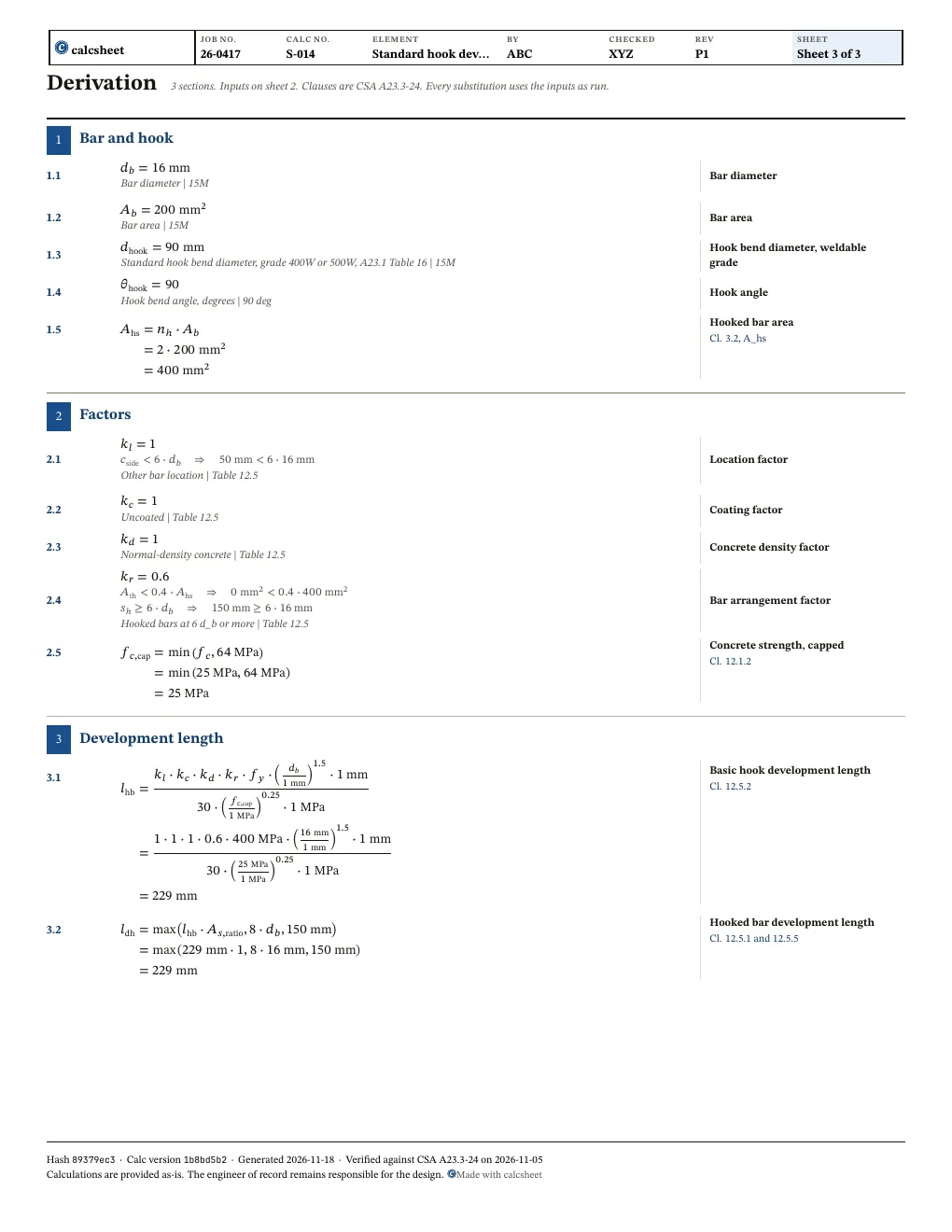
The first sheet of the working in the Standard hook development length report: each step with its clause
The working: each step with its clause · full size

Questions

When does k_l drop to 0.8?

Table 12.5 gives 0.8 to a 35M or smaller hook with side cover normal to the plane of the hook of at least 6 d_b, or to one ending inside a column core with that side cover at least 60 mm. 45M and 55M hooks take 1.0.

When does k_r drop to 0.6?

For 35M and smaller hooks enclosed by ties or stirrups with A_th of at least 0.4 A_hs, or spaced at least 6 d_b centre to centre. The ties have to satisfy Condition 1 or 2 of Cl. 12.5.4. At a discontinuous end Cl. 12.5.6 allows it only for a hook anchored in a column with both the side cover and the top or bottom cover over 60 mm, and the calc applies that.

What sets the floor on l_dh?

Cl. 12.5.1: l_dh is never less than 8 d_b or 150 mm, whichever is greater, and that holds after the A_s_ratio reduction of Cl. 12.5.5. Eight diameters passes 150 mm from 20M up, since 8 x 19.5 = 156 mm.

What does Cl. 12.5.6 ask for at the end of a member?

Where both the side cover and the top or bottom cover to the hook are under 60 mm, the hook is enclosed along l_dh by ties perpendicular to it at no more than 3 d_b, and the first tie encloses the bend within 2 d_b of its outside. The calc checks both, from s_t and e_t.

Revision history

feat(tables,registry,examples): sweep= tables for development length
ValueWasNowUnit
f_c_max50MPa\mathrm{MPa}
f_c_cap25MPa\mathrm{MPa}