ConcreteStandard hook development length (A23.3-19)

Development length of a standard hook in tension, to CSA A23.3-19 Cl. 12.5. Calculate the development length of a standard hook in tension per CSA A23.3-19 Cl. 12.5, the edition NBC 2020 references. The basic length is 100 d_b / sqrt(f'c) for a bar with f_y of 400 MPa, with sqrt(f'c) capped at 8 MPa, and Cl. 12.5.3 multiplies it by f_y / 400, by 0.7 where the side and tail cover allow, by 0.8 where at least three ties at 3 d_b or less span the hook's inside diameter, by the excess steel ratio, and by 1.3 for low-density concrete and 1.2 for epoxy-coated bars. The result is never less than 8 d_b or 150 mm, and at a member end with both covers under 60 mm the calc checks the ties of Cl. 12.5.4. The same calc to CSA A23.3-24 is the Standard hook development length page.

First report free, then a free sign-in

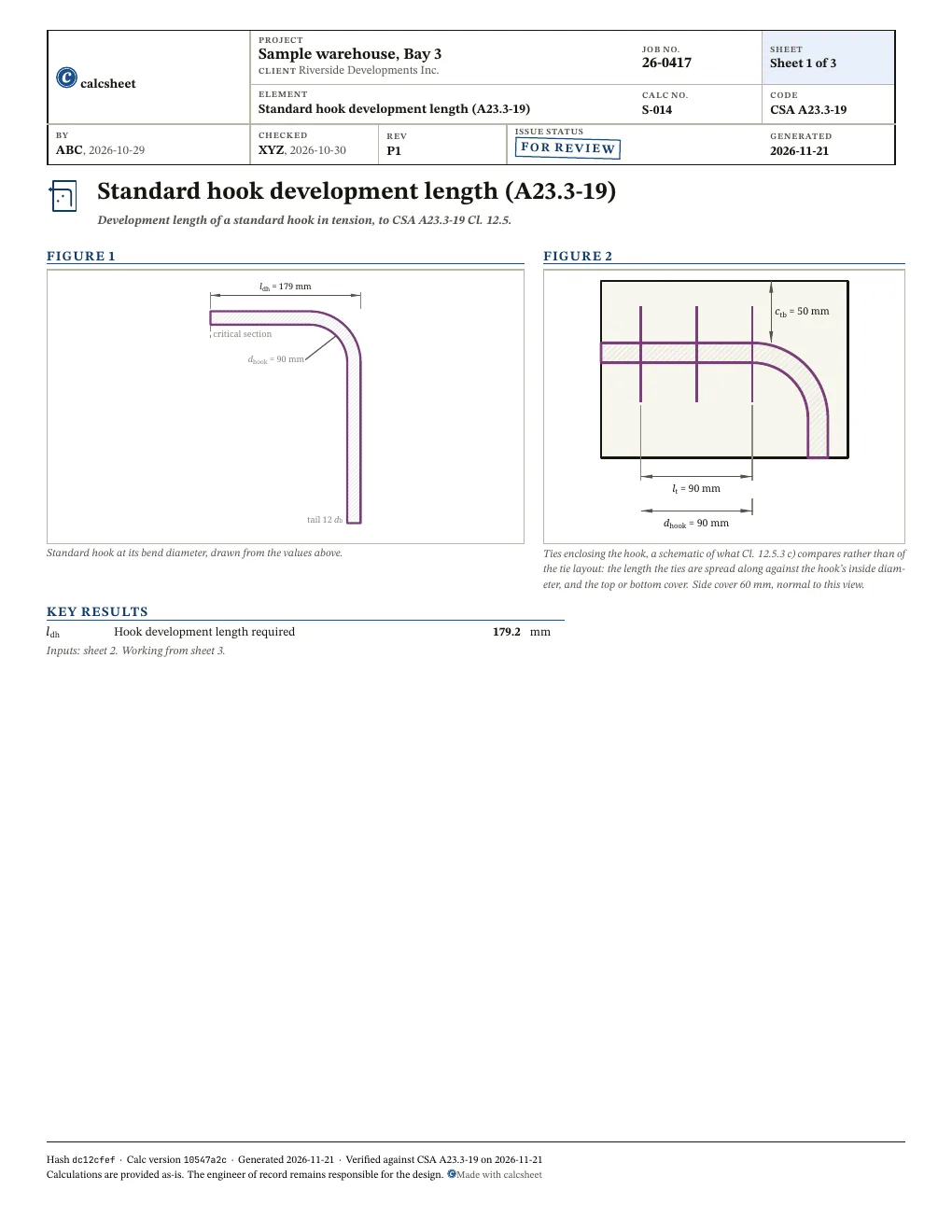
critical section dhook = 90 mm tail 12 db ldh = 179 mm
Standard hook at its bend diameter, drawn from the values above.
ctb = 50 mm lt = 90 mm dhook = 90 mm
Ties enclosing the hook, a schematic of what Cl. 12.5.3 c) compares rather than of the tie layout: the length the ties are spread along against the hook's inside diameter, and the top or bottom cover. Side cover 60 mm, normal to this view.

Given

Jump to results

Type any value, everything below recomputes. Hover or tap a symbol to trace it.

Materials
changed from the declared value fcf_{c} MPa\mathrm{MPa}20-80
changed from the declared value fyf_{y} MPa\mathrm{MPa}300-500
changed from the declared value
Hook
changed from the declared value
changed from the declared value As,ratioA_{s,\mathrm{ratio}} 0.1-1
Cover and ties
changed from the declared value csidec_{\mathrm{side}} mm\mathrm{mm}10-500
changed from the declared value ctailc_{\mathrm{tail}} mm\mathrm{mm}10-500
changed from the declared value ctbc_{\mathrm{tb}} mm\mathrm{mm}10-500
changed from the declared value ntn_{t} 0-20
changed from the declared value sts_{t} mm\mathrm{mm}10-1,000

Title block

Optional. Printed in the title block of the PDF.

Results

Quantity Description Value Unit
ldh\htmlClass{sym-l_dh}{l_{\mathrm{dh}}} Hook development length required 179.2 mm\mathrm{mm}

Hook development length required, in mm\mathrm{mm}, for every bar size against concrete compressive strength, fc′f'_{c} with the other inputs as entered. Bold: 15M at 25 MPa25\ \mathrm{MPa}, whose derivation is below.

Bar size25 MPa25\ \mathrm{MPa}30 MPa30\ \mathrm{MPa}35 MPa35\ \mathrm{MPa}40 MPa40\ \mathrm{MPa}45 MPa45\ \mathrm{MPa}50 MPa50\ \mathrm{MPa}
10M158.2150a150a150a150a150a
15M179.2163.6151.5150a150a150a
20M273249.2230.7215.8203.5193
25M352.8322.1298.2278.9263249.5
30M418.6382.1353.8330.9312296
35M499.8456.3422.4395.1372.5353.4
45M874797.8738.7691651.4618
55M11281030953.3891.8840.8797.6
  1. ldhl_{dh} at the larger of 8 dbd_{b} and 150 mm, Cl. 12.5.1
Also worth checking
  • The tail length of the standard hook, CSA A23.1 Cl. 6.6.2.2 (reprinted in Annex A): the hook drawing shows the minimum tail and the tie drawing a stub
  • The hook is taken as bent at the Table 16 minimum for the grade chosen, CSA A23.1 Cl. 6.6.2.3; a larger bend needs the ties to span more, and that a 400 or 500 grade matches f_y is not checked
  • The ties are taken as enclosing the hook vertically or horizontally, and s_t as the largest spacing among them, Cl. 12.5.3 c) and 12.5.4; neither is checked
  • The excess reinforcement ratio is taken as entered; that anchorage or development for f_y is not specifically required, Cl. 12.5.3 d), is not checked
  • Hooked bars in compression: hooks are not effective, Cl. 12.1.1 and 12.5.5, so use the compression development length page
  • Anchorage of stirrups and ties, Cl. 12.13, which Cl. 12.5.1 excepts
  • Hooked bars within a bundle, Cl. 12.4, and mechanical anchorage, Cl. 12.6
  • Seismic detailing of hooks and anchorage in beam-column joints to Clause 21

Derivation

1.1Bar diameter
db=16 mm(Bar diameter | 15M)\begin{aligned} \htmlClass{sym-d_b}{d_{b}} &= 16\ \mathrm{mm} \quad \left(\text{Bar diameter | 15M}\right) \end{aligned}
1.2Hook inside bend diameter
dhook=90 mm(Minimum inside bend, grade 400W or 500W, A23.1 Table 16 | 15M)\begin{aligned} \htmlClass{sym-d_hook}{d_{\mathrm{hook}}} &= 90\ \mathrm{mm} \quad \left(\text{Minimum inside bend, grade 400W or 500W, A23.1 Table 16 | 15M}\right) \end{aligned}
1.3Hook angle
θhook=90(Hook bend angle, degrees | 90 deg)\begin{aligned} \htmlClass{sym-theta_hook}{\theta_{\mathrm{hook}}} &= 90 \quad \left(\text{Hook bend angle, degrees | 90 deg}\right) \end{aligned}
2.1Root of concrete strength, capped

Cl. 12.1.2

fc,root=min⁡(fc⋅1 MPa,8 MPa)=min⁡(25 MPa⋅1 MPa,8 MPa)=5 MPa\begin{aligned} \htmlClass{sym-f_c_root}{f_{c,\mathrm{root}}} &= \min\left(\sqrt{\htmlClass{sym-f_c}{f_{c}} \cdot 1\ \mathrm{MPa}}, 8\ \mathrm{MPa}\right) \\ &= \min\left(\sqrt{\htmlClass{sym-f_c}{25\ \mathrm{MPa}} \cdot 1\ \mathrm{MPa}}, 8\ \mathrm{MPa}\right) \\ &= 5\ \mathrm{MPa} \end{aligned}
2.2Yield strength factor, item a)

Cl. 12.5.3 a)

ka=fy400 MPa=400 MPa400 MPa=1\begin{aligned} \htmlClass{sym-k_a}{k_{a}} &= \frac{\htmlClass{sym-f_y}{f_{y}}}{400\ \mathrm{MPa}} \\ &= \frac{\htmlClass{sym-f_y}{400\ \mathrm{MPa}}}{400\ \mathrm{MPa}} \\ &= 1 \end{aligned}

cside≥60 mm⇒60 mm≥60 mmc_{\mathrm{side}} \geq 60\ \mathrm{mm} \quad \Rightarrow \quad 60\ \mathrm{mm} \geq 60\ \mathrm{mm}

ctail≥50 mm⇒50 mm≥50 mmc_{\mathrm{tail}} \geq 50\ \mathrm{mm} \quad \Rightarrow \quad 50\ \mathrm{mm} \geq 50\ \mathrm{mm}

2.3Side and tail cover factor, item b)
kb=0.7(Side cover at least 60 mm, 90 deg hook with tail cover at least 50 mm | Cl. 12.5.3 b))\begin{aligned} \htmlClass{sym-k_b}{k_{b}} &= 0.7 \quad \left(\text{Side cover at least 60 mm, 90 deg hook with tail cover at least 50 mm | Cl. 12.5.3 b)}\right) \end{aligned}

nt≥2⇒3≥2n_{t} \geq 2 \quad \Rightarrow \quad 3 \geq 2

2.4Length the ties are spread along

Cl. 12.5.3 c)

lt=(nt−1)⋅st=(3−1)⋅45 mm=90 mm\begin{aligned} \htmlClass{sym-l_t}{l_{t}} &= \left(\htmlClass{sym-n_t}{n_{t}} - 1\right) \cdot \htmlClass{sym-s_t}{s_{t}} \\ &= \left(\htmlClass{sym-n_t}{3} - 1\right) \cdot \htmlClass{sym-s_t}{45\ \mathrm{mm}} \\ &= 90\ \mathrm{mm} \end{aligned}

nt≥3⇒3≥3n_{t} \geq 3 \quad \Rightarrow \quad 3 \geq 3

st≤3⋅db⇒45 mm≤3⋅16 mms_{t} \leq 3 \cdot d_{b} \quad \Rightarrow \quad 45\ \mathrm{mm} \leq 3 \cdot 16\ \mathrm{mm}

lt≥dhook⇒90 mm≥90 mml_{t} \geq d_{\mathrm{hook}} \quad \Rightarrow \quad 90\ \mathrm{mm} \geq 90\ \mathrm{mm}

2.5Enclosing ties factor, item c)
kc=0.8(Three or more ties at 3 d_b or less along the inside diameter | Cl. 12.5.3 c))\begin{aligned} \htmlClass{sym-k_c}{k_{c}} &= 0.8 \quad \left(\text{Three or more ties at 3 d\_b or less along the inside diameter | Cl. 12.5.3 c)}\right) \end{aligned}
2.6Excess reinforcement factor, item d)

Cl. 12.5.3 d)

kd=As,ratio=1\begin{aligned} \htmlClass{sym-k_d}{k_{d}} &= \htmlClass{sym-A_s_ratio}{A_{s,\mathrm{ratio}}} \\ &= 1 \end{aligned}
2.7Low-density concrete factor, item e)
ke=1(Normal-density concrete: item e) does not apply | Cl. 12.5.3)\begin{aligned} \htmlClass{sym-k_e}{k_{e}} &= 1 \quad \left(\text{Normal-density concrete: item e) does not apply | Cl. 12.5.3}\right) \end{aligned}
2.8Epoxy coating factor, item f)
kf=1(Uncoated: item f) does not apply | Cl. 12.5.3)\begin{aligned} \htmlClass{sym-k_f}{k_{f}} &= 1 \quad \left(\text{Uncoated: item f) does not apply | Cl. 12.5.3}\right) \end{aligned}
3.1Basic hook development length

Cl. 12.5.2

lhb=100⋅db⋅1 MPafc,root=100⋅16 mm⋅1 MPa5 MPa=320 mm\begin{aligned} \htmlClass{sym-l_hb}{l_{\mathrm{hb}}} &= \frac{100 \cdot \htmlClass{sym-d_b}{d_{b}} \cdot 1\ \mathrm{MPa}}{\htmlClass{sym-f_c_root}{f_{c,\mathrm{root}}}} \\ &= \frac{100 \cdot \htmlClass{sym-d_b}{16\ \mathrm{mm}} \cdot 1\ \mathrm{MPa}}{\htmlClass{sym-f_c_root}{5\ \mathrm{MPa}}} \\ &= 320\ \mathrm{mm} \end{aligned}
3.2Hooked bar development length

Cl. 12.5.1 and 12.5.3

ldh=max⁡(lhb⋅ka⋅kb⋅kc⋅kd⋅ke⋅kf,8⋅db,150 mm)=max⁡(320 mm⋅1⋅0.7⋅0.8⋅1⋅1⋅1,8⋅16 mm,150 mm)=179.2 mm\begin{aligned} \htmlClass{sym-l_dh}{l_{\mathrm{dh}}} &= \max\left(\htmlClass{sym-l_hb}{l_{\mathrm{hb}}} \cdot \htmlClass{sym-k_a}{k_{a}} \cdot \htmlClass{sym-k_b}{k_{b}} \cdot \htmlClass{sym-k_c}{k_{c}} \cdot \htmlClass{sym-k_d}{k_{d}} \cdot \htmlClass{sym-k_e}{k_{e}} \cdot \htmlClass{sym-k_f}{k_{f}}, 8 \cdot \htmlClass{sym-d_b}{d_{b}}, 150\ \mathrm{mm}\right) \\ &= \max\left(\htmlClass{sym-l_hb}{320\ \mathrm{mm}} \cdot \htmlClass{sym-k_a}{1} \cdot \htmlClass{sym-k_b}{0.7} \cdot \htmlClass{sym-k_c}{0.8} \cdot \htmlClass{sym-k_d}{1} \cdot \htmlClass{sym-k_e}{1} \cdot \htmlClass{sym-k_f}{1}, 8 \cdot \htmlClass{sym-d_b}{16\ \mathrm{mm}}, 150\ \mathrm{mm}\right) \\ &= 179.2\ \mathrm{mm} \end{aligned}

Report

Sheet 1 and the first sheet of the working of the PDF report, at the declared values with a sample title block. First report free, then a free sign-in.
Show the two sheets
Sheet 1 of the Standard hook development length (A23.3-19) report: title block, verdict, checks and figures
Sheet 1: title block, verdict, checks, figures · full size
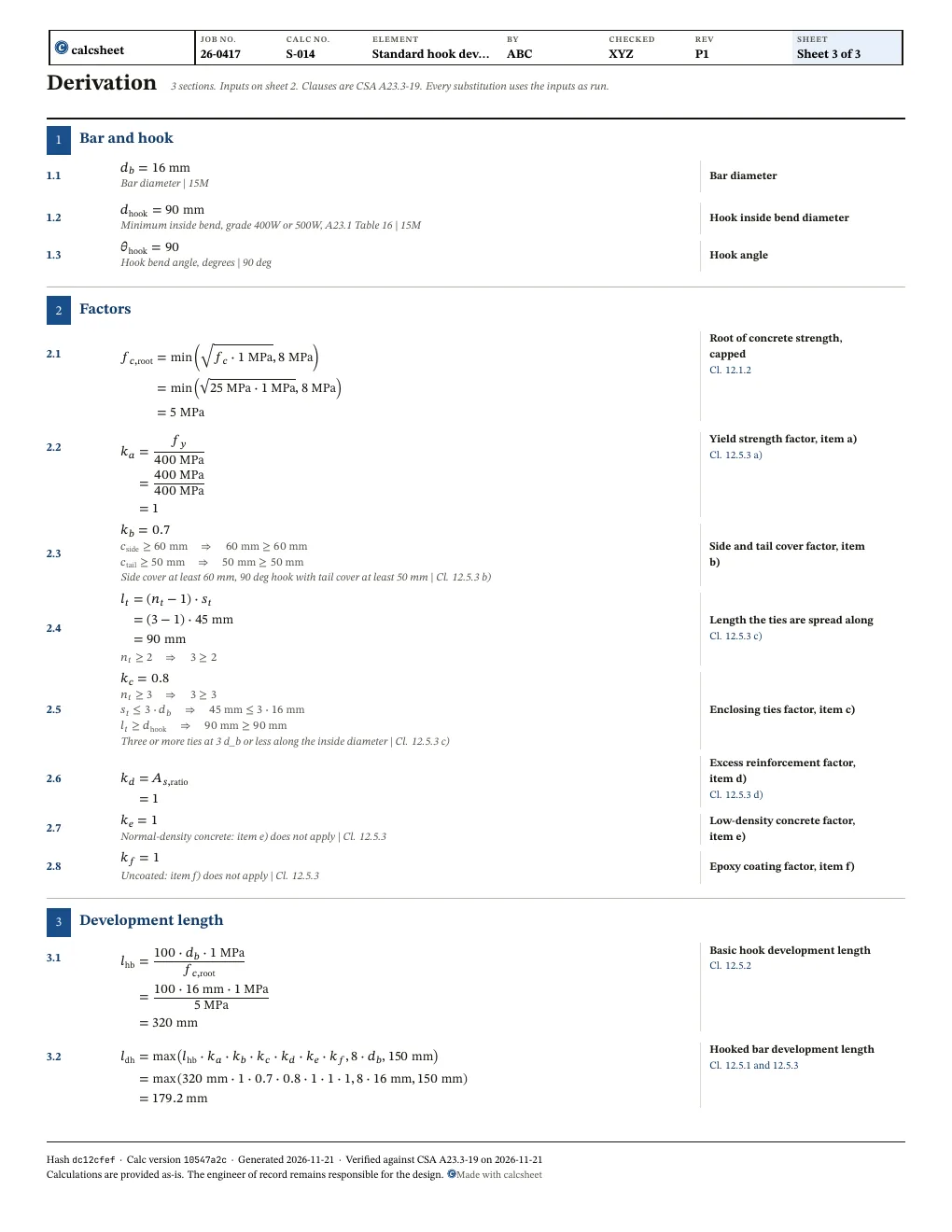
The first sheet of the working in the Standard hook development length (A23.3-19) report: each step with its clause
The working: each step with its clause · full size

Questions

Should I use CSA A23.3-19 or A23.3-24?

Use the edition your building code references. NBC 2020 references CSA A23.3-19. A provincial code may differ, so check the one that governs the project. The Edition select on the code line opens the same case under the other edition.

When does k_b drop to 0.7?

Cl. 12.5.3 b) gives 0.7 to a 35M or smaller hook with side cover, normal to the plane of the hook, of at least 60 mm; a 90 degree hook also needs at least 50 mm of cover on the extension beyond the hook. 45M and 55M hooks take 1.0.

When does k_c drop to 0.8?

Cl. 12.5.3 c) gives 0.8 to a 35M or smaller hook enclosed within at least three ties or stirrup ties at no more than 3 d_b, spread along at least the inside diameter of the hook, which the calc takes from CSA A23.1 Table 16 for the grade chosen. At the end of a member with both covers under 60 mm, Cl. 12.5.4 requires those ties and withholds the 0.8.

What sets the floor on l_dh?

Cl. 12.5.1: l_dh is never less than 8 d_b or 150 mm, whichever is greater, after every factor of Cl. 12.5.3, the excess steel ratio of item d) included. Eight diameters passes 150 mm from 20M up, since 8 x 19.5 = 156 mm.