 calcsheet
 Cantilever retaining wall
Stability to CFEM and the stem, toe and heel to CSA A23.3, with surcharge, backslope, passive toe, key and a Mononobe-Okabe case.
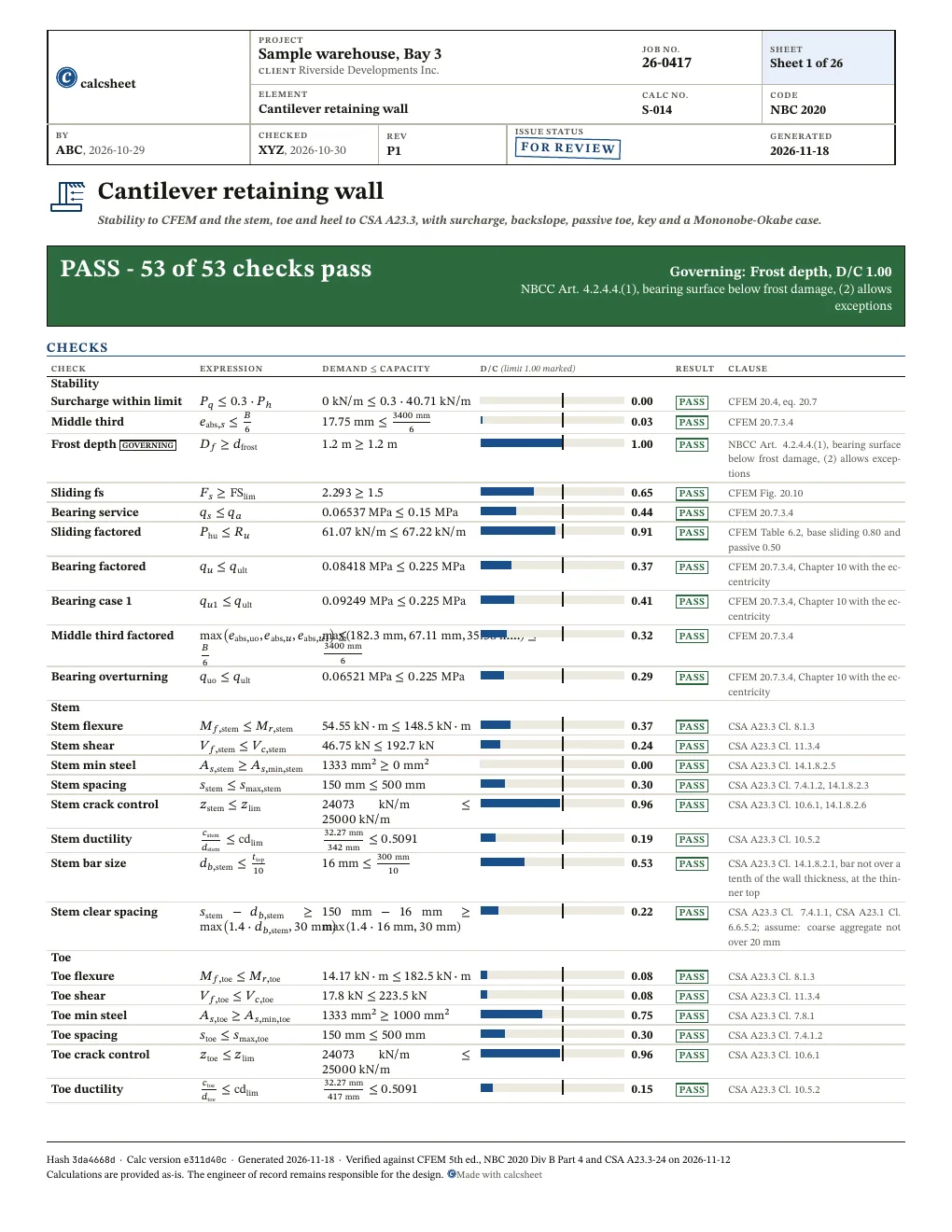
PASS Governing: Frost depth, D/C 1.00, NBCC Art. 4.2.4.4.(1), bearing surface below frost damage, (2) allows exceptions53 of 53 checks below pass
Section through the wall, to scale, with each input drawn where it acts: the lengths, the grade line, the backfill slope and surcharge, and the friction angles on the virtual back and the base.
Service loads on the wall after CFEM Fig. 20.10: the weights at their centroids, the thrusts on the virtual back, passive resistance, base friction, the resultant and the pressure under the base, each coloured by the check it governs. Dashed arrows are the seismic increment and the wall inertia. The dashed level line is q_s, which adds the surcharge weight over the heel that the diagram leaves out. Factored and seismic resultants are not drawn.
Given
Jump to resultsType any value, everything below recomputes. Hover or tap a symbol to trace it.
Resume your last case ()? Load it
This printed copy omits the derivation. The full report, with every step, is the PDF at https://calc.struct.work/calc/retaining-wall.pdf.
Results
Checks
All 53 checks pass. Largest D/C 1.00, Frost depth.
Show all 53 checks
! marks a check that passes with D/C at or above 0.95: close to its limit. The band is a site convention, not a code limit.
Stability
| Check | D/C | Utilisation | Result |
|---|---|---|---|
| Surcharge within limitCFEM 20.4, eq. 20.7 | 0.00 | PASS | |
| Middle thirdCFEM 20.7.3.4 | 0.03 | PASS | |
| Frost depthNBCC Art. 4.2.4.4.(1), bearing surface below frost damage, (2) allows exceptions | 1.00 | PASS | |
| Sliding fsCFEM Fig. 20.10 | 0.65 | PASS | |
| Bearing serviceCFEM 20.7.3.4 | 0.44 | PASS | |
| Sliding factoredCFEM Table 6.2, base sliding 0.80 and passive 0.50 | 0.91 | PASS | |
| Bearing factoredCFEM 20.7.3.4, Chapter 10 with the eccentricity | 0.37 | PASS | |
| Bearing case 1CFEM 20.7.3.4, Chapter 10 with the eccentricity | 0.41 | PASS | |
| Middle third factoredCFEM 20.7.3.4 | 0.32 | PASS | |
| Bearing overturningCFEM 20.7.3.4, Chapter 10 with the eccentricity | 0.29 | PASS |
Stem
| Check | D/C | Utilisation | Result |
|---|---|---|---|
| Stem flexureCSA A23.3 Cl. 8.1.3 | 0.37 | PASS | |
| Stem shearCSA A23.3 Cl. 11.3.4 | 0.24 | PASS | |
| Stem min steelCSA A23.3 Cl. 14.1.8.2.5 | 0.00 | PASS | |
| Stem spacingCSA A23.3 Cl. 7.4.1.2, 14.1.8.2.3 | 0.30 | PASS | |
| Stem crack controlCSA A23.3 Cl. 10.6.1, 14.1.8.2.6 | 0.96 | PASS | |
| Stem ductilityCSA A23.3 Cl. 10.5.2 | 0.19 | PASS | |
| Stem bar sizeCSA A23.3 Cl. 14.1.8.2.1, bar not over a tenth of the wall thickness, at the thinner top | 0.53 | PASS | |
| Stem clear spacingCSA A23.3 Cl. 7.4.1.1, CSA A23.1 Cl. 6.6.5.2; assume: coarse aggregate not over 20 mm | 0.22 | PASS |
Toe
| Check | D/C | Utilisation | Result |
|---|---|---|---|
| Toe flexureCSA A23.3 Cl. 8.1.3 | 0.08 | PASS | |
| Toe shearCSA A23.3 Cl. 11.3.4 | 0.08 | PASS | |
| Toe min steelCSA A23.3 Cl. 7.8.1 | 0.75 | PASS | |
| Toe spacingCSA A23.3 Cl. 7.4.1.2 | 0.30 | PASS | |
| Toe crack controlCSA A23.3 Cl. 10.6.1 | 0.96 | PASS | |
| Toe ductilityCSA A23.3 Cl. 10.5.2 | 0.15 | PASS | |
| Toe clear spacingCSA A23.3 Cl. 7.4.1.1, CSA A23.1 Cl. 6.6.5.2; assume: coarse aggregate not over 20 mm | 0.22 | PASS | |
| Base depthCSA A23.3 Cl. 15.7 | 0.37 | PASS | |
| Toe flexure 1CSA A23.3 Cl. 8.1.3 | 0.08 | PASS | |
| Toe shear 1CSA A23.3 Cl. 11.3.4 | 0.08 | PASS | |
| Toe flexure oCSA A23.3 Cl. 8.1.3 | 0.06 | PASS | |
| Toe shear oCSA A23.3 Cl. 11.3.4 | 0.07 | PASS | |
| Toe flexure ECSA A23.3 Cl. 8.1.3 | 0.08 | PASS | |
| Toe shear ECSA A23.3 Cl. 11.3.4 | 0.09 | PASS |
Heel
| Check | D/C | Utilisation | Result |
|---|---|---|---|
| Heel flexureCSA A23.3 Cl. 8.1.3 | 0.26 | PASS | |
| Heel shearCSA A23.3 Cl. 11.3.4 | 0.16 | PASS | |
| Heel min steelCSA A23.3 Cl. 7.8.1 | 0.75 | PASS | |
| Heel spacingCSA A23.3 Cl. 7.4.1.2 | 0.30 | PASS | |
| Heel crack controlCSA A23.3 Cl. 10.6.1 | 0.96 | PASS | |
| Heel ductilityCSA A23.3 Cl. 10.5.2 | 0.14 | PASS | |
| Heel clear spacingCSA A23.3 Cl. 7.4.1.1, CSA A23.1 Cl. 6.6.5.2; assume: coarse aggregate not over 20 mm | 0.22 | PASS | |
| Heel flexure 1CSA A23.3 Cl. 8.1.3 | 0.25 | PASS | |
| Heel shear 1CSA A23.3 Cl. 11.3.4 | 0.16 | PASS | |
| Heel flexure oCSA A23.3 Cl. 8.1.3 | 0.28 | PASS | |
| Heel shear oCSA A23.3 Cl. 11.3.4 | 0.15 | PASS | |
| Heel flexure ECSA A23.3 Cl. 8.1.3 | 0.44 | PASS | |
| Heel shear ECSA A23.3 Cl. 11.3.4 | 0.21 | PASS |
Key
| Check | D/C | Utilisation | Result |
|---|---|---|---|
| Key flexureCSA A23.3 Cl. 8.1.3 | 0.00 | PASS | |
| Key shearCSA A23.3 Cl. 11.3.4 | 0.00 | PASS | |
| Key clear spacingCSA A23.3 Cl. 7.4.1.1, CSA A23.1 Cl. 6.6.5.2; assume: coarse aggregate not over 20 mm | 0.22 | PASS |
Seismic
| Check | D/C | Utilisation | Result |
|---|---|---|---|
| Seismic middle thirdCFEM 20.7.3.4 | 0.56 | PASS | |
| Seismic bearingCFEM 20.7.3.4 | 0.35 | PASS | |
| Seismic slidingCFEM Table 6.2, base sliding 0.80, without the surcharge weight | 0.99 | PASS | |
| Seismic stem flexureCSA A23.3 Cl. 8.1.3 | 0.36 | PASS | |
| Seismic stem shearCSA A23.3 Cl. 11.3.4 | 0.21 | PASS |
Also worth checking
- Global stability of the wall and its slope, and settlement of the foundation, CFEM 20.7.3.5 and 20.7.3.6
- Water in the backfill: hydrostatic and seepage pressure, drainage, and cohesion are not modelled
- Line and point surcharges and compaction-induced pressure, CFEM 20.4
- The bearing resistance itself: the allowable and ultimate bearing pressures are entered from the geotechnical report
- Development, anchorage and splice lengths of the bars, CSA A23.3 Cl. 12, and the stem to base joint
- Shrinkage and temperature steel and the horizontal bars of the stem, which the main bar checks do not cover
- Inclination of the resultant: q_ult must be the factored resistance for the inclined and eccentric load on the effective width B' in each case, CFEM 20.7.3.4 and NBCC Art. 4.2.4.6
- Overturning with the resistance factor of CFEM Table 6.2: the resultant is held in the middle third and bearing is checked instead, as CFEM 20.7.3.4 allows when the eccentricity and inclination are accounted for
- Liquefaction and loss of soil strength in shaking, NBCC Art. 4.1.8.16.(10) and CFEM 18.7.1.3
- Frost and swelling pressure on the wall, CFEM 20.6, and clay backfill, CFEM 20.7.2: the backfill is taken as specified free-draining granular fill
- Wall free to move: active pressure applies only to an unrestrained wall, CFEM 20.7.1; a restrained wall takes at-rest pressure
- Sliding along weak layers below the base, CFEM 20.7.3.3
- Seismic increment on the surcharge: the surcharge is given no inertia
- Longitudinal reinforcement for the tension caused by shear, Cl. 11.3.9, and the front-face vertical steel of Cl. 14.1.8.2.4
- Shear key: ductility, minimum steel, crack control and spacing, Cl. 10.5.1, 10.5.2, 10.6.1 and 7.4.1.2
Derivation
CFEM Fig. 20.10, W is the wall and the soil above the footing, no surcharge
NBC 2020 Div B Art. 4.1.3.2.(4), Table 4.1.3.2.-A case 1, 1.4D with H at 1.5
CSA A23.3 Cl. 10.6.1, in lieu of computing the service stress
Assumed: linear contact pressure, heavier at the toe when e_u is positive
NBC 2020 Div B Art. 4.1.3.2.(5), base self-weight offsetting the toe pressure
CSA A23.3 Cl. 15.5.2 and 11.3.2, section d_v from the wall face
CSA A23.3 Cl. 15.4.2, 15.4.3 a); the backslope wedge acts at two thirds of the heel, P_v at its tip
Assumed: the key carries the full passive force on its face; moment at its root, the base underside
CFEM 18.7.5.3, inertia of the wall and the soil over the heel, which M-O leaves out
CFEM Table 6.2, base sliding 0.80, without the surcharge weight
NBC 2020 Div B Art. 4.1.3.2.(4), combination 1; assume: linear contact pressure
NBC 2020 Div B Art. 4.1.3.2.(5), the counteracting 0.9D case; assume: linear contact pressure
NBC 2020 Div B Art. 4.1.3.2.-A case 5, the seismic case; assume: linear contact pressure
Report
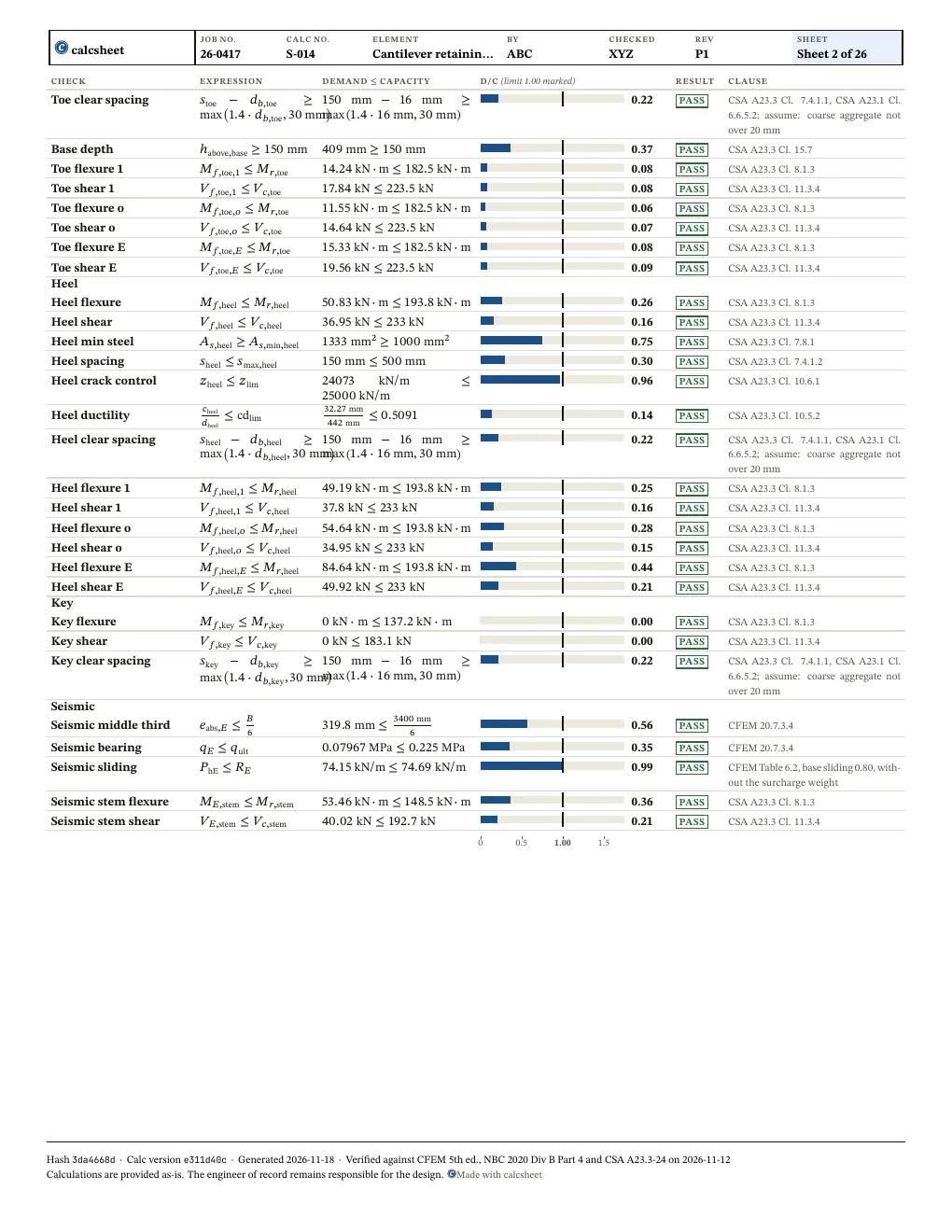
Sheet 1 and the first sheet of the working of the PDF report, at the declared values with a sample title block. Pro.
Questions
How does the calc get K_a, the active earth pressure coefficient?
Coulomb's K_a with a vertical virtual back through the heel, which reduces to Rankine's tan^2(45 - phi/2) for level backfill and no wall friction (CFEM 20.2.2). The sliding check, sliding_fs, uses the thrust it gives.
How is the seismic thrust P_AE computed?
By Mononobe-Okabe: K_AE from CFEM 18.7.1.1 with k_h equal to the peak ground acceleration and k_v two thirds of it, the increment over the static thrust acting at 0.6 H, plus the horizontal inertia of the wall and the soil over the heel.
Revision history
After an independent checker's review: the toe and heel are now designed for every combination the stability checks use, the heel carries the vertical thrust and a triangular backslope wedge, base above the frost depth fails (NBCC 4.2.4.4.(1), default depth now 1.2 m), and impossible geometry is refused
| Value | Was | Now | Unit |
|---|---|---|---|
D_f | 1 | 1.2 | |
alpha_D1 | 1.4 | ||
frost_depth | |||
z_bot | 1000 | 1200 | |
z_top | 1000 | 1200 | |
V_sb | 219.938 | ||
M_Rsb | 424.27 | ||
x_sb | 1682.25 | ||
e_sb | 17.7532 | ||
e_abs_sb | 17.7532 | ||
V_u1 | 307.913 | ||
M_Ru1 | 593.979 | ||
M_Ou1 | 81.4219 | ||
x_u1 | 1664.62 | ||
e_u1 | 35.382 | ||
e_abs_u1 | 35.382 | ||
B_u1 | 3329.24 | ||
q_u1 | 0.0924874 | ||
bearing_case_1 | |||
stem_bar_size | |||
stem_clear_spacing | |||
toe_clear_spacing | |||
h_above_base | 409 | ||
base_depth | |||
heel_clear_spacing |
and 50 more.
fix(units,examples): zero keeps its unit, zero cope, shear tab rules
| Value | Was | Now | Unit |
|---|---|---|---|
A_s_min_stem | 0 \mathrm{m}^{2} | 0 |
fix(examples): revalidate the A23.3 calcs against CSA A23.3-24
| Value | Was | Now | Unit |
|---|---|---|---|
k_beta | 230 | ||
V_f_heel | 32.9026 | 36.6528 | |
x_v_heel | 397.8 | ||
q_vh | 83.1613 |