LoadsSnow drift on a lower roof

Drift beside a roof projection, or below a higher roof across a gap, to NBC 2020. Find the specified snow load on a lower roof and the drift surcharge beside a rooftop enclosure, penthouse or mechanical unit (NBCC Article 4.1.6.7), or below a higher roof with or without a horizontal gap between the buildings (Articles 4.1.6.5 and 4.1.6.6): the peak accumulation factor, the drift length and the load at the face, in kPa.

CA$4.00 for this report, or Pro

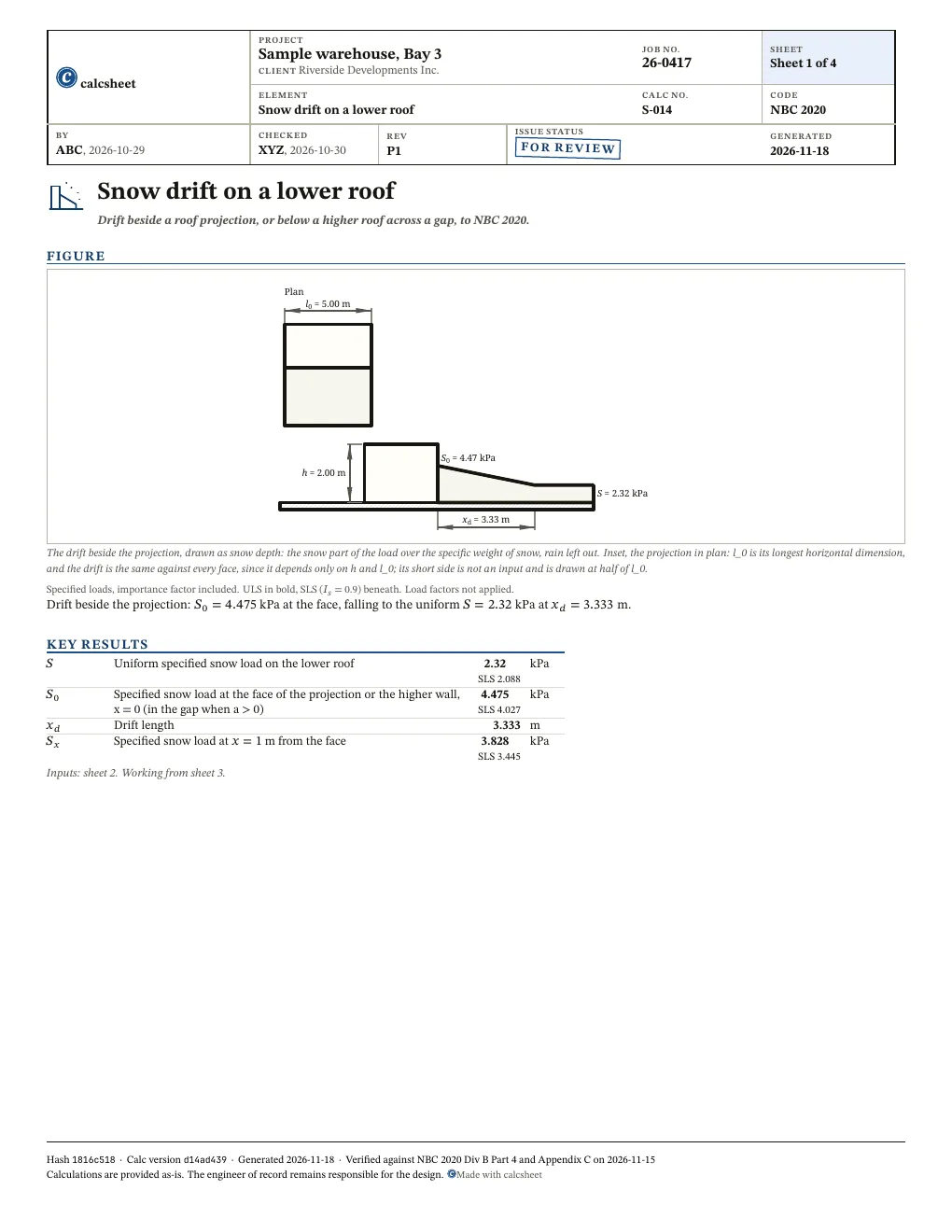
h = 2.00 m Plan l0 = 5.00 m xd = 3.33 m S0 = 4.47 kPa S = 2.32 kPa
The drift beside the projection, drawn as snow depth: the snow part of the load over the specific weight of snow, rain left out. Inset, the projection in plan: l_0 is its longest horizontal dimension, and the drift is the same against every face, since it depends only on h and l_0; its short side is not an input and is drawn at half of l_0.

Given

Jump to results

Type any value, everything below recomputes. Hover or tap a symbol to trace it.

Snow
changed from the declared value
changed from the declared value SsS_{s} kPa\mathrm{kPa}0.3-15
changed from the declared value SrS_{r} kPa\mathrm{kPa}0-2
Lower roof
changed from the declared value ww m\mathrm{m}1-500
changed from the declared value ll m\mathrm{m}1-500
changed from the declared value HmH_{m} m\mathrm{m}0-300
changed from the declared value α\alpha 0-90
changed from the declared value
changed from the declared value xx m\mathrm{m}0-500
Projection or step
changed from the declared value hh m\mathrm{m}0.1-50
changed from the declared value l0l_{0} m\mathrm{m}0.1-200

Title block

Optional. Printed in the title block of the PDF.

Snow load on the lower roof

Specified loads, importance factor included. ULS in bold, SLS (IsI_{s} = 0.9) beneath. Load factors not applied.

Drift beside the projection: S0=4.475 kPaS_{0} = 4.475\ \mathrm{kPa} at the face, falling to the uniform S=2.32 kPaS = 2.32\ \mathrm{kPa} at xd=3.333 mx_{d} = 3.333\ \mathrm{m}.

Quantity Description Value Unit
S\htmlClass{sym-S}{S} Uniform specified snow load on the lower roof 2.32SLS 2.088 kPa\mathrm{kPa}
S0\htmlClass{sym-S_0}{S_{0}} Specified snow load at the face of the projection or the higher wall, x = 0 (in the gap when a > 0) 4.475SLS 4.027 kPa\mathrm{kPa}
xd\htmlClass{sym-x_d}{x_{d}} Drift length 3.333 m\mathrm{m}
Sx\htmlClass{sym-S_x}{S_{x}} Specified snow load at x=1 mx = 1\ \mathrm{m} from the face 3.828SLS 3.445 kPa\mathrm{kPa}
Also worth checking
  • Drift at the corners of a projection or a step: extended radially round an outside corner with a radius equal to the drift length, and the higher of the two faces where drifts overlap at an inside corner, Article 4.1.6.8
  • Partial loading of the uniform load, Article 4.1.6.3
  • A source roof exposed to the wind, with a wind exposure factor below 1.0: Sentence 4.1.6.5.(3) caps F at 5 only for 1.0, and this calc takes 1.0
  • Snow sliding off a sloped higher roof onto the lower one, Article 4.1.6.11
  • A larger projection worked as a step by Article 4.1.6.5, which Sentence 4.1.6.7.(2) permits
  • A drift longer than the lower roof, which is cut off at its far edge
  • Valleys, gable, arch and curved roofs, Articles 4.1.6.9 to 4.1.6.12
  • Rain ponding and loads from rain alone, Article 4.1.6.4; ice and meltwater build-up, Article 4.1.6.15; roofs with solar panels, Article 4.1.6.16
  • The higher roof's own snow load, and an existing lower roof that a new higher building now overshadows, Note A-4.1.6.1.(1)

Derivation

1.1Specific weight of snow

NBC 4.1.6.13.(1)

γ=min⁡(0.43 m−1⋅Ss+2.2 kN/m3,4 kN/m3)=min⁡(0.43 m−1⋅2.4 kPa+2.2 kN/m3,4 kN/m3)=3.232 kN/m3\begin{aligned} \htmlClass{sym-gamma}{\gamma} &= \min\left(0.43\ \mathrm{m}^{-1} \cdot \htmlClass{sym-S_s}{S_{s}} + 2.2\ \mathrm{kN/m³}, 4\ \mathrm{kN/m³}\right) \\ &= \min\left(0.43\ \mathrm{m}^{-1} \cdot \htmlClass{sym-S_s}{2.4\ \mathrm{kPa}} + 2.2\ \mathrm{kN/m³}, 4\ \mathrm{kN/m³}\right) \\ &= 3.232\ \mathrm{kN/m³} \end{aligned}
1.2Characteristic length of the lower roof

NBC 4.1.6.2.(2)

lc=2⋅w−w2l=2⋅12 m−(12 m)224 m=18 m\begin{aligned} \htmlClass{sym-l_c}{l_{c}} &= 2 \cdot \htmlClass{sym-w}{w} - \frac{\htmlClass{sym-w}{w}^{2}}{\htmlClass{sym-l}{l}} \\ &= 2 \cdot \htmlClass{sym-w}{12\ \mathrm{m}} - \frac{\left(\htmlClass{sym-w}{12\ \mathrm{m}}\right)^{2}}{\htmlClass{sym-l}{24\ \mathrm{m}}} \\ &= 18\ \mathrm{m} \end{aligned}
1.3Wind exposure factor where drift accumulates
Cw=1(drift accumulates, Clause 4.1.6.2.(4)(c))\begin{aligned} \htmlClass{sym-C_w}{C_{w}} &= 1 \quad \left(\text{drift accumulates, Clause 4.1.6.2.(4)(c)}\right) \end{aligned}

Mean height at least 1 m plus the ground snow depth: the basic roof snow load factor follows the roof size, NBC 4.1.6.2.(2)(c). Hm≥1 m+Ssγ⇒6 m≥1 m+2.4 kPa3.232 kN/m3H_{m} \geq 1\ \mathrm{m} + \frac{S_{s}}{\gamma} \quad \Rightarrow \quad 6\ \mathrm{m} \geq 1\ \mathrm{m} + \frac{2.4\ \mathrm{kPa}}{3.232\ \mathrm{kN/m³}}

lc≤70 mCw2⇒18 m≤70 m12l_{c} \leq \frac{70\ \mathrm{m}}{C_{w}^{2}} \quad \Rightarrow \quad 18\ \mathrm{m} \leq \frac{70\ \mathrm{m}}{1^{2}}

1.4Basic roof snow load factor
Cb=0.8(Subclause 4.1.6.2.(2)(a)(i))\begin{aligned} \htmlClass{sym-C_b}{C_{b}} &= 0.8 \quad \left(\text{Subclause 4.1.6.2.(2)(a)(i)}\right) \end{aligned}

α≤30⇒0≤30\alpha \leq 30 \quad \Rightarrow \quad 0 \leq 30

1.5Slope factor of the lower roof
Cs=1(slope 30 degrees or less, Clause 4.1.6.2.(5)(a))\begin{aligned} \htmlClass{sym-C_s}{C_{s}} &= 1 \quad \left(\text{slope 30 degrees or less, Clause 4.1.6.2.(5)(a)}\right) \end{aligned}

Below a step CsC_{s} follows the slope at every distance, or is 1.0 on a lower roof with parapets, Table 4.1.6.5.-A; beside a projection the slope is held to where CsC_{s} is 1.0.

1.6Importance factor, ultimate limit states
Is=1(ultimate limit states, Table 4.1.6.2.-A)\begin{aligned} \htmlClass{sym-I_s}{I_{s}} &= 1 \quad \left(\text{ultimate limit states, Table 4.1.6.2.-A}\right) \end{aligned}
1.7Rain load, not over the snow term

NBC 4.1.6.2.(1), rain load cap

Sr,u=min⁡(Sr,Ss⋅Cb⋅Cw⋅Cs)=min⁡(0.4 kPa,2.4 kPa⋅0.8⋅1⋅1)=0.4 kPa\begin{aligned} \htmlClass{sym-S_r_u}{S_{r,u}} &= \min\left(\htmlClass{sym-S_r}{S_{r}}, \htmlClass{sym-S_s}{S_{s}} \cdot \htmlClass{sym-C_b}{C_{b}} \cdot \htmlClass{sym-C_w}{C_{w}} \cdot \htmlClass{sym-C_s}{C_{s}}\right) \\ &= \min\left(\htmlClass{sym-S_r}{0.4\ \mathrm{kPa}}, \htmlClass{sym-S_s}{2.4\ \mathrm{kPa}} \cdot \htmlClass{sym-C_b}{0.8} \cdot \htmlClass{sym-C_w}{1} \cdot \htmlClass{sym-C_s}{1}\right) \\ &= 0.4\ \mathrm{kPa} \end{aligned}
1.8Uniform specified snow load

NBC 4.1.6.2.(1), uniform load

S=Is⋅(Ss⋅Cb⋅Cw⋅Cs+Sr,u)=1⋅(2.4 kPa⋅0.8⋅1⋅1+0.4 kPa)=2.32 kPa\begin{aligned} \htmlClass{sym-S}{S} &= \htmlClass{sym-I_s}{I_{s}} \cdot \left(\htmlClass{sym-S_s}{S_{s}} \cdot \htmlClass{sym-C_b}{C_{b}} \cdot \htmlClass{sym-C_w}{C_{w}} \cdot \htmlClass{sym-C_s}{C_{s}} + \htmlClass{sym-S_r_u}{S_{r,u}}\right) \\ &= \htmlClass{sym-I_s}{1} \cdot \left(\htmlClass{sym-S_s}{2.4\ \mathrm{kPa}} \cdot \htmlClass{sym-C_b}{0.8} \cdot \htmlClass{sym-C_w}{1} \cdot \htmlClass{sym-C_s}{1} + \htmlClass{sym-S_r_u}{0.4\ \mathrm{kPa}}\right) \\ &= 2.32\ \mathrm{kPa} \end{aligned}
1.9Importance factor, serviceability
Is,sls=0.9(serviceability limit states, Table 4.1.6.2.-A)\begin{aligned} \htmlClass{sym-I_s_sls}{I_{s,\mathrm{sls}}} &= 0.9 \quad \left(\text{serviceability limit states, Table 4.1.6.2.-A}\right) \end{aligned}
1.10Uniform specified snow load, serviceability

NBC 4.1.6.2.(1), serviceability

Ssls=Is,sls⋅(Ss⋅Cb⋅Cw⋅Cs+Sr,u)=0.9⋅(2.4 kPa⋅0.8⋅1⋅1+0.4 kPa)=2.088 kPa\begin{aligned} \htmlClass{sym-S_sls}{S_{\mathrm{sls}}} &= \htmlClass{sym-I_s_sls}{I_{s,\mathrm{sls}}} \cdot \left(\htmlClass{sym-S_s}{S_{s}} \cdot \htmlClass{sym-C_b}{C_{b}} \cdot \htmlClass{sym-C_w}{C_{w}} \cdot \htmlClass{sym-C_s}{C_{s}} + \htmlClass{sym-S_r_u}{S_{r,u}}\right) \\ &= \htmlClass{sym-I_s_sls}{0.9} \cdot \left(\htmlClass{sym-S_s}{2.4\ \mathrm{kPa}} \cdot \htmlClass{sym-C_b}{0.8} \cdot \htmlClass{sym-C_w}{1} \cdot \htmlClass{sym-C_s}{1} + \htmlClass{sym-S_r_u}{0.4\ \mathrm{kPa}}\right) \\ &= 2.088\ \mathrm{kPa} \end{aligned}

The point x is within the lower roof's larger plan dimension l of the face, NBC 4.1.6.2.(2), l the larger plan dimension of the roof. x≤l⇒1 m≤24 mx \leq l \quad \Rightarrow \quad 1\ \mathrm{m} \leq 24\ \mathrm{m}

Projection 3 m long or more: the drift surcharge is considered, NBC 4.1.6.7.(3). l0≥3 m⇒5 m≥3 ml_{0} \geq 3\ \mathrm{m} \quad \Rightarrow \quad 5\ \mathrm{m} \geq 3\ \mathrm{m}

2.1Peak accumulation factor, height term

NBC 4.1.6.7.(1)(a)

Ca0,1=0.67⋅γ⋅hCb⋅Ss=0.67⋅3.232 kN/m3⋅2 m0.8⋅2.4 kPa=2.256\begin{aligned} \htmlClass{sym-C_a0_1}{C_{a0,1}} &= \frac{0.67 \cdot \htmlClass{sym-gamma}{\gamma} \cdot \htmlClass{sym-h}{h}}{\htmlClass{sym-C_b}{C_{b}} \cdot \htmlClass{sym-S_s}{S_{s}}} \\ &= \frac{0.67 \cdot \htmlClass{sym-gamma}{3.232\ \mathrm{kN/m³}} \cdot \htmlClass{sym-h}{2\ \mathrm{m}}}{\htmlClass{sym-C_b}{0.8} \cdot \htmlClass{sym-S_s}{2.4\ \mathrm{kPa}}} \\ &= 2.256 \end{aligned}

The drift is the same against every face of the projection, since it depends only on hh and l0l_{0}.

2.2Peak accumulation factor, length term

NBC 4.1.6.7.(1)(a)

Ca0,2=γ⋅l07.5⋅Cb⋅Ss+1=3.232 kN/m3⋅5 m7.5⋅0.8⋅2.4 kPa+1=2.122\begin{aligned} \htmlClass{sym-C_a0_2}{C_{a0,2}} &= \frac{\htmlClass{sym-gamma}{\gamma} \cdot \htmlClass{sym-l_0}{l_{0}}}{7.5 \cdot \htmlClass{sym-C_b}{C_{b}} \cdot \htmlClass{sym-S_s}{S_{s}}} + 1 \\ &= \frac{\htmlClass{sym-gamma}{3.232\ \mathrm{kN/m³}} \cdot \htmlClass{sym-l_0}{5\ \mathrm{m}}}{7.5 \cdot \htmlClass{sym-C_b}{0.8} \cdot \htmlClass{sym-S_s}{2.4\ \mathrm{kPa}}} + 1 \\ &= 2.122 \end{aligned}
2.3Peak accumulation factor

NBC 4.1.6.7.(1)(a)

Ca0=min⁡(Ca0,1,Ca0,2)=min⁡(2.256,2.122)=2.122\begin{aligned} \htmlClass{sym-C_a0}{C_{a0}} &= \min\left(\htmlClass{sym-C_a0_1}{C_{a0,1}}, \htmlClass{sym-C_a0_2}{C_{a0,2}}\right) \\ &= \min\left(\htmlClass{sym-C_a0_1}{2.256}, \htmlClass{sym-C_a0_2}{2.122}\right) \\ &= 2.122 \end{aligned}

Peak accumulation factor above 1.0: a drift forms, NBC 4.1.6.2.(8). Ca0>1⇒2.122>1C_{a0} > 1 \quad \Rightarrow \quad 2.122 > 1

2.4Drift length

NBC 4.1.6.7.(1)(b)

xd=min⁡(3.35⋅h,23⋅l0)=min⁡(3.35⋅2 m,23⋅5 m)=3.333 m\begin{aligned} \htmlClass{sym-x_d}{x_{d}} &= \min\left(3.35 \cdot \htmlClass{sym-h}{h}, \frac{2}{3} \cdot \htmlClass{sym-l_0}{l_{0}}\right) \\ &= \min\left(3.35 \cdot \htmlClass{sym-h}{2\ \mathrm{m}}, \frac{2}{3} \cdot \htmlClass{sym-l_0}{5\ \mathrm{m}}\right) \\ &= 3.333\ \mathrm{m} \end{aligned}
2.5Rain load at the face, not over the snow term

NBC 4.1.6.2.(1)

Sr,0=min⁡(Sr,Ss⋅Cb⋅Cw⋅Cs⋅Ca0)=min⁡(0.4 kPa,2.4 kPa⋅0.8⋅1⋅1⋅2.122)=0.4 kPa\begin{aligned} \htmlClass{sym-S_r_0}{S_{r,0}} &= \min\left(\htmlClass{sym-S_r}{S_{r}}, \htmlClass{sym-S_s}{S_{s}} \cdot \htmlClass{sym-C_b}{C_{b}} \cdot \htmlClass{sym-C_w}{C_{w}} \cdot \htmlClass{sym-C_s}{C_{s}} \cdot \htmlClass{sym-C_a0}{C_{a0}}\right) \\ &= \min\left(\htmlClass{sym-S_r}{0.4\ \mathrm{kPa}}, \htmlClass{sym-S_s}{2.4\ \mathrm{kPa}} \cdot \htmlClass{sym-C_b}{0.8} \cdot \htmlClass{sym-C_w}{1} \cdot \htmlClass{sym-C_s}{1} \cdot \htmlClass{sym-C_a0}{2.122}\right) \\ &= 0.4\ \mathrm{kPa} \end{aligned}
2.6Specified snow load at the face

NBC 4.1.6.2.(1), at the face, x = 0

S0=Is⋅(Ss⋅Cb⋅Cw⋅Cs⋅Ca0+Sr,0)=1⋅(2.4 kPa⋅0.8⋅1⋅1⋅2.122+0.4 kPa)=4.475 kPa\begin{aligned} \htmlClass{sym-S_0}{S_{0}} &= \htmlClass{sym-I_s}{I_{s}} \cdot \left(\htmlClass{sym-S_s}{S_{s}} \cdot \htmlClass{sym-C_b}{C_{b}} \cdot \htmlClass{sym-C_w}{C_{w}} \cdot \htmlClass{sym-C_s}{C_{s}} \cdot \htmlClass{sym-C_a0}{C_{a0}} + \htmlClass{sym-S_r_0}{S_{r,0}}\right) \\ &= \htmlClass{sym-I_s}{1} \cdot \left(\htmlClass{sym-S_s}{2.4\ \mathrm{kPa}} \cdot \htmlClass{sym-C_b}{0.8} \cdot \htmlClass{sym-C_w}{1} \cdot \htmlClass{sym-C_s}{1} \cdot \htmlClass{sym-C_a0}{2.122} + \htmlClass{sym-S_r_0}{0.4\ \mathrm{kPa}}\right) \\ &= 4.475\ \mathrm{kPa} \end{aligned}
2.7Specified snow load at the face, serviceability

NBC 4.1.6.2.(1), serviceability

S0,sls=Is,sls⋅(Ss⋅Cb⋅Cw⋅Cs⋅Ca0+Sr,0)=0.9⋅(2.4 kPa⋅0.8⋅1⋅1⋅2.122+0.4 kPa)=4.027 kPa\begin{aligned} \htmlClass{sym-S_0_sls}{S_{0,\mathrm{sls}}} &= \htmlClass{sym-I_s_sls}{I_{s,\mathrm{sls}}} \cdot \left(\htmlClass{sym-S_s}{S_{s}} \cdot \htmlClass{sym-C_b}{C_{b}} \cdot \htmlClass{sym-C_w}{C_{w}} \cdot \htmlClass{sym-C_s}{C_{s}} \cdot \htmlClass{sym-C_a0}{C_{a0}} + \htmlClass{sym-S_r_0}{S_{r,0}}\right) \\ &= \htmlClass{sym-I_s_sls}{0.9} \cdot \left(\htmlClass{sym-S_s}{2.4\ \mathrm{kPa}} \cdot \htmlClass{sym-C_b}{0.8} \cdot \htmlClass{sym-C_w}{1} \cdot \htmlClass{sym-C_s}{1} \cdot \htmlClass{sym-C_a0}{2.122} + \htmlClass{sym-S_r_0}{0.4\ \mathrm{kPa}}\right) \\ &= 4.027\ \mathrm{kPa} \end{aligned}

x<xd⇒1 m<3.333 mx < x_{d} \quad \Rightarrow \quad 1\ \mathrm{m} < 3.333\ \mathrm{m}

3.1Accumulation factor at the distance x

NBC 4.1.6.5.(1)

Ca,x=Ca0−(Ca0−1)⋅xxd=2.122−(2.122−1)⋅1 m3.333 m=1.786\begin{aligned} \htmlClass{sym-C_a_x}{C_{a,x}} &= \htmlClass{sym-C_a0}{C_{a0}} - \frac{\left(\htmlClass{sym-C_a0}{C_{a0}} - 1\right) \cdot \htmlClass{sym-x}{x}}{\htmlClass{sym-x_d}{x_{d}}} \\ &= \htmlClass{sym-C_a0}{2.122} - \frac{\left(\htmlClass{sym-C_a0}{2.122} - 1\right) \cdot \htmlClass{sym-x}{1\ \mathrm{m}}}{\htmlClass{sym-x_d}{3.333\ \mathrm{m}}} \\ &= 1.786 \end{aligned}
3.2Rain load at the distance x, not over the snow term

NBC 4.1.6.2.(1)

Sr,x=min⁡(Sr,Ss⋅Cb⋅Cw⋅Cs⋅Ca,x)=min⁡(0.4 kPa,2.4 kPa⋅0.8⋅1⋅1⋅1.786)=0.4 kPa\begin{aligned} \htmlClass{sym-S_r_x}{S_{r,x}} &= \min\left(\htmlClass{sym-S_r}{S_{r}}, \htmlClass{sym-S_s}{S_{s}} \cdot \htmlClass{sym-C_b}{C_{b}} \cdot \htmlClass{sym-C_w}{C_{w}} \cdot \htmlClass{sym-C_s}{C_{s}} \cdot \htmlClass{sym-C_a_x}{C_{a,x}}\right) \\ &= \min\left(\htmlClass{sym-S_r}{0.4\ \mathrm{kPa}}, \htmlClass{sym-S_s}{2.4\ \mathrm{kPa}} \cdot \htmlClass{sym-C_b}{0.8} \cdot \htmlClass{sym-C_w}{1} \cdot \htmlClass{sym-C_s}{1} \cdot \htmlClass{sym-C_a_x}{1.786}\right) \\ &= 0.4\ \mathrm{kPa} \end{aligned}
3.3Specified snow load at the distance x

NBC 4.1.6.2.(1), at x

Sx=Is⋅(Ss⋅Cb⋅Cw⋅Cs⋅Ca,x+Sr,x)=1⋅(2.4 kPa⋅0.8⋅1⋅1⋅1.786+0.4 kPa)=3.828 kPa\begin{aligned} \htmlClass{sym-S_x}{S_{x}} &= \htmlClass{sym-I_s}{I_{s}} \cdot \left(\htmlClass{sym-S_s}{S_{s}} \cdot \htmlClass{sym-C_b}{C_{b}} \cdot \htmlClass{sym-C_w}{C_{w}} \cdot \htmlClass{sym-C_s}{C_{s}} \cdot \htmlClass{sym-C_a_x}{C_{a,x}} + \htmlClass{sym-S_r_x}{S_{r,x}}\right) \\ &= \htmlClass{sym-I_s}{1} \cdot \left(\htmlClass{sym-S_s}{2.4\ \mathrm{kPa}} \cdot \htmlClass{sym-C_b}{0.8} \cdot \htmlClass{sym-C_w}{1} \cdot \htmlClass{sym-C_s}{1} \cdot \htmlClass{sym-C_a_x}{1.786} + \htmlClass{sym-S_r_x}{0.4\ \mathrm{kPa}}\right) \\ &= 3.828\ \mathrm{kPa} \end{aligned}
3.4Specified snow load at the distance x, serviceability

NBC 4.1.6.2.(1), serviceability

Sx,sls=Is,sls⋅(Ss⋅Cb⋅Cw⋅Cs⋅Ca,x+Sr,x)=0.9⋅(2.4 kPa⋅0.8⋅1⋅1⋅1.786+0.4 kPa)=3.445 kPa\begin{aligned} \htmlClass{sym-S_x_sls}{S_{x,\mathrm{sls}}} &= \htmlClass{sym-I_s_sls}{I_{s,\mathrm{sls}}} \cdot \left(\htmlClass{sym-S_s}{S_{s}} \cdot \htmlClass{sym-C_b}{C_{b}} \cdot \htmlClass{sym-C_w}{C_{w}} \cdot \htmlClass{sym-C_s}{C_{s}} \cdot \htmlClass{sym-C_a_x}{C_{a,x}} + \htmlClass{sym-S_r_x}{S_{r,x}}\right) \\ &= \htmlClass{sym-I_s_sls}{0.9} \cdot \left(\htmlClass{sym-S_s}{2.4\ \mathrm{kPa}} \cdot \htmlClass{sym-C_b}{0.8} \cdot \htmlClass{sym-C_w}{1} \cdot \htmlClass{sym-C_s}{1} \cdot \htmlClass{sym-C_a_x}{1.786} + \htmlClass{sym-S_r_x}{0.4\ \mathrm{kPa}}\right) \\ &= 3.445\ \mathrm{kPa} \end{aligned}

Report

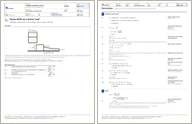
Sheet 1 and the first sheet of the working of the PDF report, at the declared values with a sample title block. Pro.

Show the two sheets
Sheet 1 of the Snow drift on a lower roof report: title block, verdict, checks and figures
Sheet 1: title block, verdict, checks, figures · full size
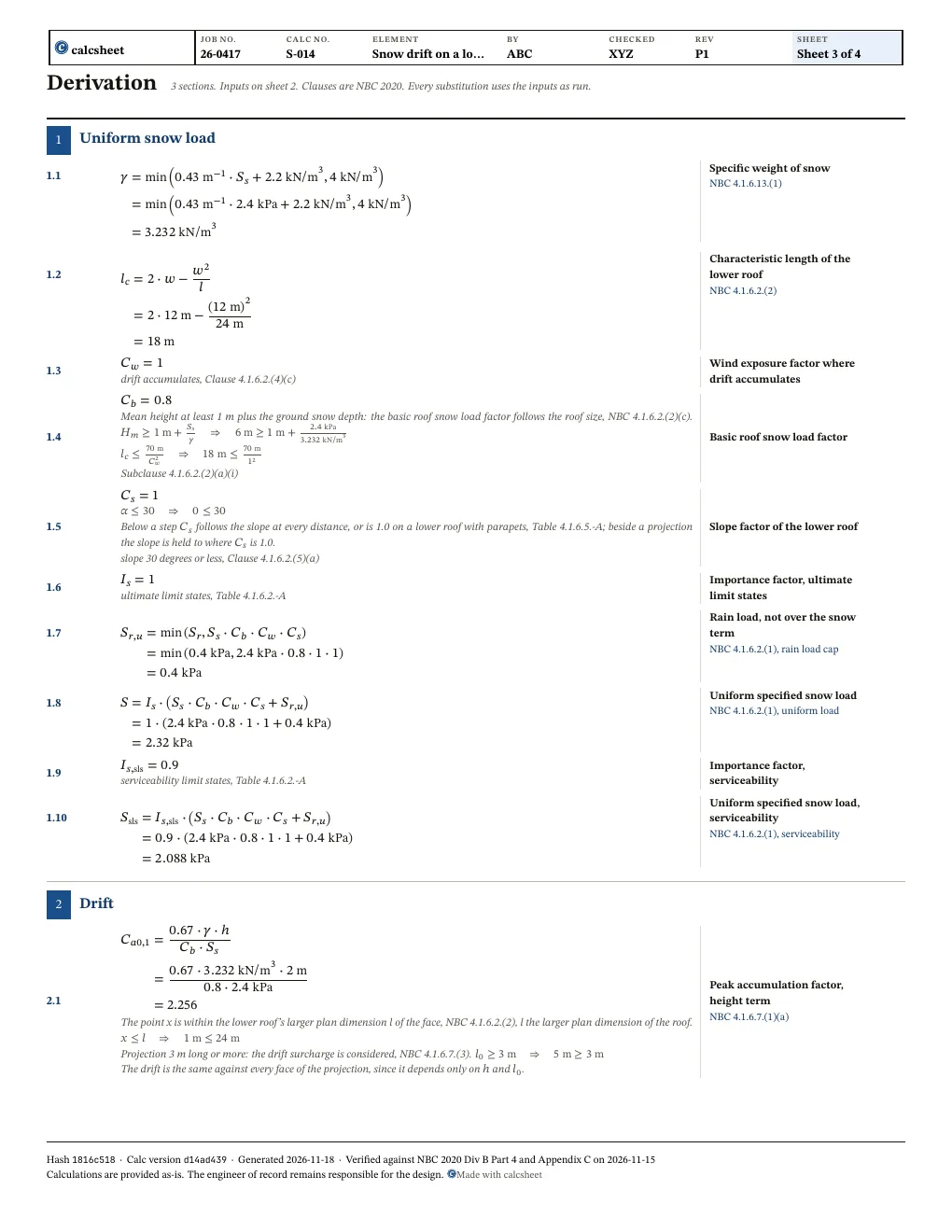
The first sheet of the working in the Snow drift on a lower roof report: each step with its clause
The working: each step with its clause · full size

Questions

Why does NBCC give no drift beside my rooftop unit?

NBCC Sentence 4.1.6.7.(3) drops the surcharge when the longest horizontal dimension l_0 is under 3 m. And beside a short unit in deep snow the drift would not rise above the uniform snow: when the peak factor C_a0 does not exceed 1.0 the uniform load governs.

How does the gap between two buildings change the NBCC drift?

NBCC Sentence 4.1.6.6.(1): over 5 m the higher roof may be ignored. Within 5 m the drift is worked out as if the roofs touched and the lower roof starts at x = a, so its edge takes C_a at x = a rather than the peak.

Which of the NBCC Cases I, II and III governs C_a0?

NBCC Sentence 4.1.6.5.(5) takes the highest C_a0 of the three. Case I is snow blown off the higher roof; Cases II and III are snow from the lower roof itself, from the source areas upwind of the step and beside the higher roof in Figure 4.1.6.5.-B.

Revision history

fix(examples,render,registry): correct snow-drift sources and figure
ValueWasNowUnit
within_roof